

Induction cooktops have a reputation problem. People hear “electromagnetic” and picture something complicated. Or expensive. Or fragile.
Most of that reputation is wrong.
This guide covers how induction actually works, which type makes sense for your kitchen, what cookware you need, and the mistakes worth avoiding before you spend a dollar.
By the end of this page, you’ll understand exactly how induction technology works, which type fits your lifestyle, what cookware you need, and how to avoid the most common mistakes buyers make.
What Is an Induction Cooktop?
An induction cooktop is a cooking surface that uses electromagnetic energy to heat cookware directly — rather than heating a burner or element that then heats the pan.
Unlike traditional gas stoves or conventional electric cooktops, induction doesn’t produce an open flame or a glowing coil. The glass-ceramic surface itself stays relatively cool to the touch. Only the pan gets hot, and only while it’s sitting on the active zone.
This fundamental difference is what makes induction cooking faster, safer, and more energy-efficient than most people expect.
Why Demand Is Growing
Induction cooktops have been the dominant cooking technology in Europe and Asia for years. In the U.S., adoption is accelerating rapidly — driven by new home construction standards, electrification trends, rising gas prices, and growing awareness of indoor air quality concerns linked to gas combustion.
Five years ago, finding a decent induction cooktop under $100 was hard. Now they’re at Target, Amazon, and every appliance showroom in the country. The price floor dropped, the options multiplied, and the excuses for not trying one got thinner.
Find the best induction cooktops reviewedHow Does an Induction Cooktop Work?
The science behind induction cooking is straightforward, even if it seems like magic the first time you see water boil in under two minutes.
The Electromagnetic Principle
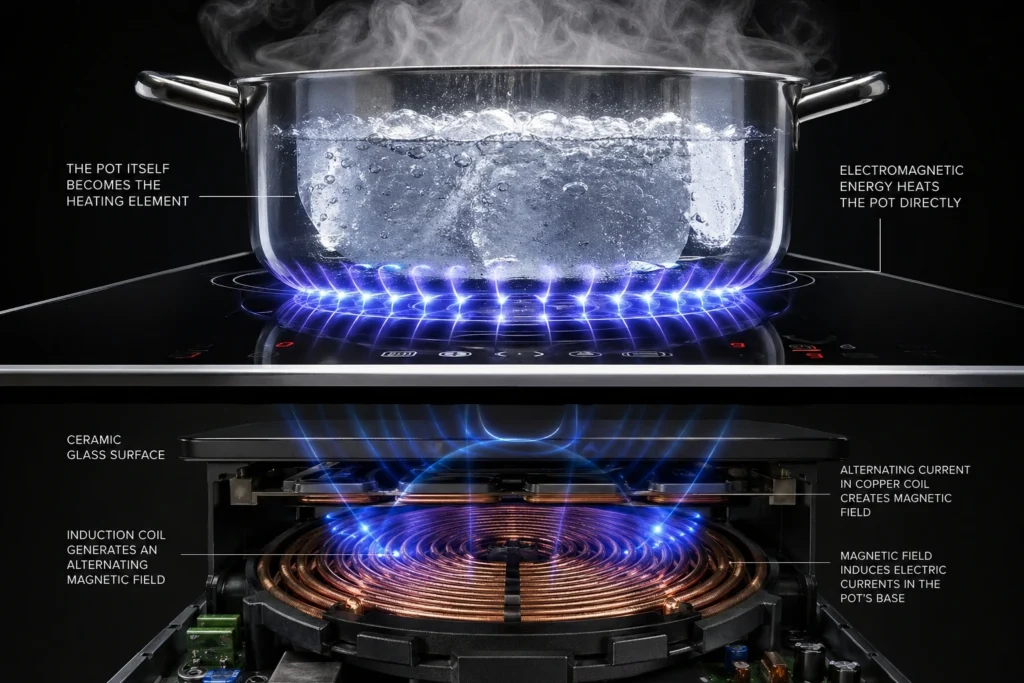
Inside every induction cooktop is a copper coil. When electricity passes through that coil, it generates a fluctuating magnetic field. When you place a ferromagnetic pan on the cooking zone, that magnetic field induces an electrical current directly inside the pan’s metal base. That current — called an eddy current — produces heat within the pan itself.
The pan becomes the heating element. The cooktop surface is just the interface.
Why This Makes Induction So Efficient
Gas stoves are essentially outdoor appliances running indoors. A significant portion of the heat goes sideways — into the air, up the sides of the pan, into your kitchen. You’re paying for all of it.
Induction skips that entirely. The pan is the heating element. ~85–90% of the electricity you use becomes cooking heat. On gas, you’re lucky to hit 40%.
Induction skips the middleman entirely. Because heat is generated in the pan rather than transferred to it, induction cooktops operate at roughly 85–90% energy efficiency — compared to about 74% for smooth-top electric and 40% for gas.
That translates to faster boiling times, lower electricity bills, and a cooler kitchen during summer cooking.
Precision Temperature Control
Another key advantage of electromagnetic heating: it’s instantly adjustable. Dial down the heat and the magnetic field weakens immediately, reducing power to the pan in real time. This gives induction cooktops a level of precision that rivals professional gas ranges — and in many ways exceeds them.
You can simmer chocolate without scorching it, hold a stock at a gentle 180°F for hours, or sear a steak at maximum power without delay.
Main Types of Induction Cooktops
Induction cooktops come in several distinct form factors. Knowing the differences helps you pick the right one for your space and cooking habits.

Portable Induction Cooktops
Portable induction cooktops — also called countertop induction burners — are standalone units that plug into a standard 120V household outlet. They require no installation and can be stored when not in use.
They’re popular for:
- Small apartments and studio kitchens
- Dorm rooms and office break rooms
- RV and boat cooking
- Supplemental burners when hosting or batch cooking
- Anyone who wants to try induction before committing to a full installation
Most portable models are single-burner units in the 1,000–1,800W range. Double-burner portable models are also widely available. Prices typically range from $30 to $150 for home-grade units.
[See Best Portable Induction Cooktops]
Built-In Induction Cooktops
Built-in induction cooktops are permanently installed into a kitchen countertop, replacing a gas or electric cooktop. They connect to a 240V circuit and require professional installation.
These are the right choice if you’re doing a kitchen renovation, replacing an existing cooktop, or want seamless countertop integration. Built-in models typically offer 4–5 cooking zones, bridge zones for griddles, boost modes, and advanced child-lock and timer functions.
Expect to spend $700–$3,000+ for a quality built-in unit, plus installation costs.
[See Best Built-In Induction Cooktops]
Single Burner Models
Single-burner induction cooktops are the most affordable and space-efficient option. They’re ideal as a primary cooktop in a tiny home or as a supplemental station in a larger kitchen.
Look for models with at least 1,800W of power for versatile cooking. Units under 1,000W will struggle with tasks like boiling large pots of water or searing.
Double Burner Models
Double-burner portable induction cooktops give you two independent cooking zones in a compact footprint. They’re a practical middle ground — more versatile than a single burner, and far less expensive than a full built-in unit.
Many double-burner models still run on 120V, though higher-powered versions may require a 240V outlet.
Commercial Induction Models
Commercial induction cooktops are built for restaurant kitchens, catering operations, and high-volume cooking environments. They feature heavy-duty construction, higher wattage (3,500W–5,000W per zone), precise temperature holding, and compatibility with large commercial cookware.
These aren’t typically appropriate for home kitchens, but high-end home models borrow many of the same features.
Benefits of Using an Induction Cooktop
The case for induction cooking is strong. Here’s a breakdown of the main advantages.
Faster Heating
Induction cooktops heat water significantly faster than gas or electric alternatives. A standard pot of water that takes 8–10 minutes on gas can come to a boil in 4–5 minutes on a high-powered induction burner. This speed advantage compounds when you’re cooking multiple dishes simultaneously.
Precise Temperature Control
Induction offers near-instant response when you adjust the heat setting. There’s no thermal lag from a heated coil or residual heat from a gas flame. If you turn it down, it responds immediately — critical for delicate sauces, tempering chocolate, or maintaining a low simmer for braises.
Many mid-range and premium induction cooktops offer temperature-specific settings (rather than just “low-medium-high”), letting you dial in precise temperatures like 140°F for sous vide-style cooking.
Safety
This is one of the most compelling reasons families with young children choose induction. Because the cooktop surface only heats through contact with a magnetic pan, the glass surface around the active zone stays relatively cool — usually not much warmer than the ambient kitchen temperature.
Spills don’t bake onto a scorching surface. There’s no open flame. If you remove the pan, the cooking zone shuts off automatically. Many models include child locks that disable the controls entirely.
Easy Cleaning
The flat, smooth glass-ceramic surface is far easier to clean than grate-covered gas burners or coil electric stoves. Because the surface doesn’t get dangerously hot, spills don’t carbonize — you can wipe most messes away with a damp cloth. Stubborn residue comes off with a cooktop scraper and ceramic cleaner.
Energy Savings
Induction’s high efficiency (85–90%) means you’re converting more of the electricity you pay for into actual cooking heat. Households that switch from gas to induction often see measurable reductions in their monthly energy costs — even accounting for the difference between gas and electricity rates in their area.
Potential Drawbacks of Induction Cooktops
Induction cooking isn’t perfect for everyone. Here are the limitations you should know before buying.
Requires Compatible Cookware
This is the most common friction point for new induction users. Induction cooktops only work with ferromagnetic cookware — pans that contain iron in their base. If a magnet sticks to the bottom of a pan, it will work on induction. If it doesn’t, it won’t.
Common compatible materials include cast iron and magnetic stainless steel. Aluminum, copper, and ceramic cookware (without a magnetic base layer) will not work unless they have an induction-compatible disc bonded to the bottom.
Many households end up needing to replace some or all of their existing cookware when switching to induction. This adds to the total cost of the transition.
[Best Cookware for Induction Cooktops]
Higher Upfront Cost
A quality portable induction burner can be had for $50–$100. But built-in induction cooktops cost significantly more than comparable gas or electric models at the entry level, and the premium widens in the mid-range.
When you factor in potential cookware upgrades and professional installation, the total upfront investment can be substantially higher than sticking with a gas or coil electric setup — even though the long-term energy savings may offset the difference over time.
Fan Noise
There’s a fan inside every induction cooktop. It runs when the unit gets warm, and it makes noise — not loud, but noticeable in a quiet kitchen. If you’re used to the silence of a gas burner or a smooth-top electric, it takes getting used to. Check reviews specifically for fan noise before buying a built-in unit for an open-plan space.
Learning Curve
Experienced cooks who are deeply accustomed to gas cooking sometimes find the transition to induction disorienting at first. The visual cues are different — there’s no flame to watch. Heat settings that seem lower than you’d expect on gas can produce more heat than anticipated.
Most cooks adapt within a week or two of regular use, but it’s worth setting expectations accordingly.
Induction cooktop problems and fixes
What Cookware Works With Induction Cooktops?
Cookware compatibility is the single most important practical consideration when switching to induction. Here’s what you need to know.

The Simple Test: Use a Magnet
Hold a refrigerator magnet to the bottom of any pan. If it sticks firmly, the pan will work on induction. If it doesn’t stick at all, it won’t. It’s that simple.
Compatible Cookware Types
Cast iron — Both seasoned cast iron and enameled cast iron work excellently on induction. Cast iron holds heat well and distributes it evenly once hot, making it ideal for searing, frying, and slow cooking. Brands like Lodge and Le Creuset are popular choices.
Magnetic stainless steel — Many stainless steel pans work on induction, but not all. 18/0 stainless (no nickel) is magnetic; 18/8 and 18/10 stainless are less reliably so. Always check with the magnet test.
Carbon steel — Excellent induction performance. Carbon steel pans heat quickly and evenly, making them a favorite of professional cooks using induction ranges.
Induction-ready aluminum and copper — Some aluminum and copper cookware is manufactured with a magnetic stainless steel base bonded to the bottom specifically to make it induction-compatible. Look for “induction-ready” or “induction-compatible” labeling.
Incompatible Cookware
- Pure aluminum (without a magnetic base)
- Copper (without a magnetic base)
- Glass or ceramic (without a magnetic base)
- Most older non-stick pans (many have aluminum bodies)
Induction Adapter Plates
If you have non-compatible cookware you love, induction adapter discs are available. These are flat magnetic plates that sit on the induction zone and transfer heat to any pan placed on top — including glass, ceramic, and copper. They work, but reduce efficiency and somewhat undercut the precision and speed advantages of induction.
Induction cooktop cookware guide
Induction Cooktop vs Gas vs Electric: A Quick Comparison
Each cooking technology has genuine strengths. Here’s how they stack up across the dimensions that matter most.
| Feature | Induction | Gas | Smooth-Top Electric |
|---|---|---|---|
| Heat-up speed | Fastest | Fast | Slowest |
| Temperature precision | Excellent | Good | Fair |
| Energy efficiency | ~85–90% | ~40% | ~74% |
| Surface temperature safety | High (cool surface) | Low (open flame) | Medium (hot surface) |
| Cookware compatibility | Magnetic only | Universal | Universal |
| Upfront cost | Medium–High | Low–Medium | Low–Medium |
| Cleaning ease | Excellent | Difficult | Good |
| Power outage use | No | Yes (with manual ignition) | No |
Gas retains one genuine advantage: it works when the power is out (with manual lighting) and some cooks prefer the visual feedback of a flame for wok cooking and charring. Electric smooth-top cooktops are the most affordable to install and work with any cookware.
Induction wins on speed, efficiency, safety, and cleanliness — but requires compatible cookware and a 240V circuit for built-in installations.
Induction vs gas vs electric comparisons
How to Choose the Right Induction Cooktop
If you’ve decided induction is right for you, here’s what to evaluate before buying.
Induction cooktop buying guideBudget
Portable single-burner models start around $30–$50, with quality options in the $70–$120 range. Double-burner portables typically run $80–$200. Built-in cooktops start around $500–$700 for entry-level and climb to $2,000–$3,500 for premium brands.
Set a realistic budget and don’t forget to factor in potential cookware costs and installation fees for built-in units.
Size and Number of Burners
For a primary kitchen cooktop, most households do well with four burners. A 30-inch or 36-inch built-in gives you the most flexibility. If counter space is limited, a 24-inch two-burner built-in is a practical option.
For portable use, decide whether you need one or two burners based on how you typically cook.
Wattage
Wattage determines how powerful and versatile a cooktop is. For portable models, look for at least 1,800W per zone to ensure you can boil water quickly and reach high heat for searing. For built-in cooktops, individual zones typically range from 1,200W to 3,700W, with boost modes that temporarily increase output.
Higher wattage isn’t always necessary — it depends on how and what you cook.
Safety Features
Key safety features to look for include:
- Child lock — Disables the control panel
- Auto-shutoff — Powers off if a pan is removed or if no input is detected for a set period
- Residual heat indicator — Alerts you when the surface is still warm after cooking
- Overheat protection — Automatically reduces power or shuts off if the unit overheats

Kitchen Space and Installation
For built-in models, measure your cutout dimensions carefully and verify electrical requirements before purchasing. Most built-in induction cooktops require a dedicated 240V/50A circuit. If your kitchen isn’t currently wired for this, factor in the cost of an electrical upgrade.
For portable models, any standard 120V outlet works — though high-powered portables may trip a circuit if you’re running other high-draw appliances simultaneously.
Best Induction Cooktops by Need
Finding the right induction cooktop depends heavily on your specific situation. Here’s a brief overview of the categories worth exploring — each links to a more detailed guide.
- Best overall portable induction cooktop — Great for most home cooks looking for a reliable, affordable countertop unit [See Best Portable Induction Cooktops]
- Best induction cooktop under $100 — Strong performers at accessible price points for budget-conscious buyers [See Best Induction Cooktops Under $100]
- Best built-in induction cooktop — Top-rated permanent installations for kitchen renovations [See Best Built-In Induction Cooktops]
- Best induction cooktop for RV use — Compact, efficient, and compatible with limited power setups [See Best RV Induction Cooktops]
- Best induction cooktop for small kitchens — Space-saving models that don’t sacrifice performance [See Best Induction Cooktops for Small Kitchens]
[See Best Induction Cooktops]
Popular Induction Cooktop Brands
A handful of brands dominate the induction cooktop market across different price segments.
Duxtop
Duxtop is one of the most recognized names in portable induction cooking. The brand is known for reliable, no-frills countertop induction burners at accessible price points. Their models are widely available and have accumulated large bodies of consumer reviews. A solid starting point for anyone new to induction.
[Read Duxtop Induction Cooktop Review]
NuWave
NuWave focuses on portable induction cooktops with a broader feature set — including precise temperature control in specific-degree increments, which makes them popular with precision cooking enthusiasts. They also offer combination induction/air fryer units.
[Read NuWave Induction Cooktop Review]
Bosch
Bosch is a leader in the built-in induction cooktop segment. Their units are known for build quality, sleek European design, and advanced features like FlexInduction zones that can merge two cooking zones into one large area for oversized cookware. A premium choice for kitchen renovations.
[Read Bosch Induction Cooktop Review]
GE and GE Profile
GE offers a range of induction ranges and cooktops across multiple tiers. Their Profile line includes smart connectivity features and is positioned as a mid-to-premium option for American kitchens. Wide availability and strong service network are practical advantages.
[Read GE Induction Cooktop Review]
Frigidaire
Frigidaire produces some of the most affordable built-in induction cooktops available from a major appliance manufacturer. Their Gallery series offers a good entry point for homeowners who want the benefits of induction without paying premium brand prices.
[Read Frigidaire Induction Cooktop Review]
Induction cooktop brand reviewsFrequently Asked Questions
Are induction cooktops safe?
Yes — induction cooktops are widely considered the safest residential cooking technology available. The cooking surface itself doesn’t generate heat; only the pan does. There’s no open flame, no exposed heating element, and most units include automatic shutoff, child locks, and residual heat indicators. The risk of burns from accidentally touching the cooktop surface is significantly lower than with gas or electric alternatives.
Do induction cooktops require special pans?
Yes. Induction cooktops only work with cookware that has a magnetic base — typically cast iron, carbon steel, or magnetic stainless steel. A simple test: if a magnet sticks firmly to the bottom of a pan, it will work on induction. Pure aluminum, copper, and ceramic pans without a magnetic base layer will not work. Many cookware sets today are labeled “induction-compatible” to make selection easier.
Are induction cooktops worth it?
For most households, yes — especially if you value speed, safety, energy efficiency, or easy cleaning. The higher upfront cost is offset over time by lower energy bills and reduced maintenance. The main friction point is cookware compatibility: if you need to replace a significant portion of your pots and pans, factor that into your total cost calculation. For households with young children, the safety advantages alone often justify the investment.
Do induction cooktops use more electricity than electric stoves?
No — they actually use less electricity for the same cooking tasks. Because induction converts 85–90% of electrical energy into cooking heat (versus ~74% for smooth-top electric), you need less electricity to accomplish the same result. You may cook faster and use fewer kilowatt-hours per meal.
Can induction cooktops replace gas stoves?
For most home cooking, yes. Induction matches or exceeds gas in speed and temperature precision. The one area where gas retains a meaningful edge is high-heat wok cooking, where chefs use the flame itself to char and smoke food (a technique called “wok hei”). For everything else — simmering, sautéing, boiling, frying, baking with a pan — induction handles it well. Gas also works during power outages, which induction does not.
How long do induction cooktops last?
Quality portable induction burners typically last 3–5 years with regular use. Built-in induction cooktops from reputable brands are generally expected to last 8–15 years, comparable to gas and electric ranges. The electronic components are the most likely failure point over time. Buying from brands with strong warranty support and available parts is advisable for built-in installations.
Are induction cooktops easy to clean?
Yes — they’re among the easiest cooking surfaces to clean. The flat glass-ceramic surface has no grates, coils, or burner rings to navigate. Because the surface doesn’t get dangerously hot, food spills don’t bake on immediately and can usually be wiped away with a damp cloth after cooking. Stubborn residue responds well to ceramic cooktop cleaner and a non-abrasive scraper. Avoid abrasive pads that can scratch the glass.

Why are induction cooktops more expensive than gas or electric?
Induction cooktops contain sophisticated electronics — the copper coils, inverter circuitry, and control systems are more complex and costly to manufacture than a gas valve or an electric coil. Build-in models also typically feature higher-quality glass-ceramic surfaces rated for the specific thermal and mechanical demands of induction cooking. Prices have come down substantially as manufacturing has scaled up, and affordable models are now widely available in the portable segment.
Induction cooktop how-to guidesFinal Verdict
Here’s the honest answer: if you cook regularly, have kids in the kitchen, or care about not scrubbing burnt-on residue off a gas grate on a Tuesday night — induction is probably already worth it for you.
The cookware question is real. If you’re starting from scratch, budget for it. If you already own cast iron or magnetic stainless, you’re mostly set.
Start with a $80 portable unit. Use it for a month. If it changes how you cook — and it probably will — then you’ll know whether a built-in installation makes sense.
Induction is the right choice if you:
- Are renovating a kitchen and want a future-proof cooking setup
- Cook frequently and value speed and precision
- Have young children and prioritize cooktop safety
- Want the easiest-to-clean cooking surface available
- Are open to replacing non-compatible cookware
You might stick with gas or electric if:
- You rely heavily on wok cooking with open-flame technique
- You want to cook during power outages
- Your existing cookware investment is large and non-compatible
- Your electrical panel needs expensive upgrades to support 240V installation
For most people starting out, a quality portable induction cooktop is a low-risk, low-cost way to experience induction cooking firsthand before committing to a permanent installation. Start there, test it with your existing cookware, and let the results guide your next decision.
This guide is regularly updated to reflect current models, pricing, and induction cooking technology. Last reviewed April 2026.