

The best 6-burner induction cooktops to upgrade your kitchen in 2026 include the Bosch Benchmark 36-Inch, Gaggenau CX492611, GE Profile PHP9036, and Wolf 36-Inch Induction Cooktop — each delivering precision heat control, professional-grade wattage, and smart kitchen features that gas and electric cooktops simply cannot match. These six-zone cooktops are purpose-built for home chefs who cook multiple dishes simultaneously, whether hosting dinner parties or preparing complex weeknight meals. Importantly, a 6-burner induction cooktop is not just a luxury upgrade — it is a strategic investment in speed, safety, and energy efficiency that pays off over time. For a complete overview, see best induction cooktops.
Choosing the right 6-burner induction cooktop requires evaluating key features including wattage output, FlexInduction zone technology, touch controls, auto pan detection, and Wi-Fi smart connectivity. Beyond raw power, the best models distinguish themselves through reliability rates, cookware compatibility, and intuitive interfaces that empower home chefs rather than frustrate them. Understanding these criteria before purchasing ensures you invest in a cooktop that matches your cooking style, kitchen layout, and long-term budget.
To make the right decision, it also helps to understand how induction compares to gas and electric alternatives — particularly in areas of heat efficiency, cookware requirements, and ease of cleaning. Induction delivers up to 90% heat efficiency compared to just 40–55% for gas, which translates directly into faster cooking times and a cooler, more comfortable kitchen environment. This fundamental advantage explains why more home chefs worldwide are making the switch.
Below, this guide walks you through everything you need to know: from what a 6-burner induction cooktop actually is, to which model deserves a spot in your kitchen, to where to buy it and what to budget. Let’s explore each section in detail so you can make a confident, well-informed decision.
What Is a 6-Burner Induction Cooktop and Why Does It Matter for Your Kitchen?
A 6-burner induction cooktop is a built-in cooking appliance — typically 36 inches wide — that uses electromagnetic fields to heat cookware directly, producing faster, safer, and more energy-efficient cooking than traditional gas or electric alternatives. Unlike gas burners that generate an open flame or electric radiant cooktops that heat a surface element, induction transfers energy directly into the magnetic base of your pots and pans. The result is near-instant heat response, precise temperature control, and a cooktop surface that stays cool to the touch outside the cookware zone.
For home chefs, the significance of having six cooking zones cannot be overstated. With six burners available simultaneously, you can sear a steak on high heat, simmer a delicate sauce, boil pasta, sauté vegetables, and warm bread — all at the same time, all at precisely the temperatures you need. Specifically, this multi-zone capability transforms the way ambitious home cooks approach complex recipes, dinner parties, and family meals, removing the constant juggling act of a 4-burner setup.
Best 4-burner induction cooktopsIs a 6-Burner Induction Cooktop Worth It for Home Cooking?
Yes, a 6-burner induction cooktop is absolutely worth it for home cooking — for three core reasons: superior energy efficiency, significantly faster heat-up times, and enhanced kitchen safety compared to gas or electric alternatives.
Specifically, the energy efficiency argument alone is compelling. Induction cooktops transfer approximately 90% of generated energy directly to your cookware, compared to 65–70% for electric radiant models and just 40–55% for gas burners. This means less wasted heat, a cooler kitchen, and lower electricity bills over time. For families or individuals who cook daily, this efficiency difference adds up meaningfully across months and years of use.
From a safety standpoint, induction cooktops eliminate the open flame entirely. The ceramic glass surface only heats where it is in contact with magnetic cookware, meaning accidental burns from touching the cooktop surface are dramatically reduced. Families with young children will find this particularly reassuring. Additionally, induction cooktops feature auto shut-off, child lock functions, and residual heat warnings — multiple layers of protection that gas cooktops simply cannot offer.
The financial investment is real: quality 6-burner induction cooktops range from $1,500 to over $6,000 depending on brand and features. However, when weighed against long-term energy savings, the elimination of gas line costs, and the durability of premium models, the return on investment for serious home chefs is clear.

What Size Cooktop Do You Need for 6 Burners?
A 6-burner induction cooktop requires a 36-inch-wide installation space, which is the industry standard configuration for six cooking zones in a residential kitchen setting.
Before purchasing, measuring your existing countertop cutout is essential. Most 36-inch cooktops require a cutout of approximately 34¾ inches wide by 19¾ inches deep, though exact dimensions vary by manufacturer and model. If your kitchen currently accommodates a 30-inch 4-burner cooktop, upgrading to a 36-inch 6-burner model will require countertop modification — a factor to budget for during the planning stage. On the positive side, the 36-inch format integrates seamlessly into standard kitchen island configurations and pairs visually with matching 36-inch range hood installations for a cohesive, professional aesthetic.
Best 36-inch induction cooktopsWhat Are the Key Features to Look for in a 6-Burner Induction Cooktop?
There are five key feature categories to evaluate when selecting a 6-burner induction cooktop: wattage and power output, temperature and control interface, safety systems, FlexInduction zone technology, and smart connectivity — each directly affecting cooking performance and long-term satisfaction.
Understanding these criteria before comparing specific models prevents the common mistake of choosing based on aesthetics alone. Below, each feature category is examined in detail so you can assess models objectively and match specifications to your actual cooking habits.
How Much Wattage Does a Good 6-Burner Induction Cooktop Need?
A quality 6-burner induction cooktop should deliver at least 3,500 watts on its primary power burner, with premium models offering between 3,700W and 5,500W for professional-grade boiling and searing performance.
Wattage directly determines how quickly a burner can bring large volumes of water to a boil, sear proteins at high heat, or recover temperature after adding cold ingredients to a hot pan. The distinction between a power burner and a simmer burner within the same cooktop is important: power burners (typically 3,500W–5,500W) are positioned for high-heat tasks, while simmer burners (often 1,200W–1,800W) are optimized for precise low-temperature cooking like melting chocolate, making hollandaise, or maintaining a gentle braise.
To illustrate: the Gaggenau CX492611 features a maximum output of 5,500 watts on its power zone — one of the highest available in residential induction — while the Bosch Benchmark offers a strong 3,700W primary element combined with FlexInduction bridge capability. For home chefs who regularly cook large-batch recipes or entertain frequently, higher wattage on at least one or two burners is a non-negotiable specification.
According to Consumer Reports’ lab testing, induction cooktops at higher wattage settings boil 4 quarts of water approximately 2 to 4 minutes faster than equivalent gas or electric models — a practically meaningful difference during busy cooking sessions.
What Control Features Should a 6-Burner Induction Cooktop Have?
A well-designed 6-burner induction cooktop should include touch controls or precision knobs, an integrated digital timer, auto pan detection, and clearly marked individual zone indicators — all contributing to accurate, effortless heat management across six simultaneous cooking zones.
Touch controls, found on most premium models including Bosch and GE Profile, allow for clean, flat surfaces with no raised knobs to trap food residue. The Bosch Benchmark’s Direct Select 2.0 interface, for example, assigns a dedicated slider control to each burner zone, enabling immediate, single-touch adjustment without navigating menus. The GE Profile PHP9036’s red LED display offers a different but equally intuitive approach, with clear visual feedback on heat levels across all six zones.
Auto pan detection is another critical control feature: the cooktop automatically recognizes when a pot or pan is placed on a zone and activates heating accordingly. Conversely, when you remove cookware and forget to switch off the zone, the cooktop detects the absence of a pan and disengages the element — preventing energy waste and unnecessary surface heating. This feature alone contributes significantly to the safety and efficiency profile of modern induction cooktops.
The child lock function, available on virtually all 6-burner induction models reviewed here, disables the control panel completely with a simple button hold — an essential feature for households with young children exploring the kitchen environment.
Is Safety a Concern with 6-Burner Induction Cooktops?
No, safety is not a significant concern with 6-burner induction cooktops — in fact, induction is measurably safer than both gas and electric radiant alternatives, for three core reasons: no open flame, cool-touch surface outside cookware zones, and multiple built-in protective systems.
Because induction heating is generated electromagnetically within the cookware itself rather than from an external heat source, the glass ceramic surface of an induction cooktop only becomes warm where it is in direct contact with a hot pan — and even then, only through conducted heat from the cookware, not from the cooktop generating heat independently. This means accidental contact with an “active” zone without a pan in place carries virtually no burn risk, a stark contrast to gas burners with open flames or electric radiant elements that remain dangerously hot for extended periods after being switched off.
Built-in residual heat indicators alert users when a zone remains warm after cookware is removed — typically displayed as an “H” on the digital readout — preventing accidental contact burns during kitchen cleanup. Combined with auto shut-off timers and child lock functionality, these layered safety features make 6-burner induction cooktops the most safety-conscious choice for family kitchens.
What Are the Best 6-Burner Induction Cooktops in 2026?
The best 6-burner induction cooktops in 2026 are the Bosch Benchmark 36-Inch (best overall), Gaggenau CX492611 (best premium), GE Profile PHP9036 (best value), and Wolf 36-Inch Induction Cooktop (best for serious home chefs) — each excelling in distinct performance, feature, and reliability categories.
The following reviews evaluate each model across the criteria that matter most to home chefs: reliability rates, wattage, smart features, cooking flexibility, and real-world usability. Whether you are upgrading from a gas range, replacing an aging electric cooktop, or outfitting a new kitchen from scratch, one of these four models will fit your needs.
Best 48-inch induction cooktopsBest Overall – Bosch Benchmark 36-Inch Induction Cooktop
The Bosch Benchmark 36-inch induction cooktop earns the best overall designation through a rare combination of industry-leading reliability, advanced FlexInduction zone technology, and smart home connectivity — all delivered in a sleek, user-friendly package.
According to Yale Appliance’s analysis of over 33,000 service calls, the Bosch Benchmark induction cooktop carries an industry-low average service rate of just 1.7% — meaning fewer than 2 in every 100 units require professional service. For a high-use kitchen appliance, this reliability metric is exceptional and directly translates to lower lifetime ownership cost and fewer disruptive repairs.
Technically, the Bosch Benchmark features two FlexInduction zones that allow adjacent burners to be combined into a single elongated cooking zone — ideal for a stovetop griddle, fish pan, or any oversized cookware that spans multiple standard zones. Its largest element reaches 3,700 watts for rapid boiling, while the Direct Select 2.0 interface provides intuitive, per-zone control without menu navigation. Wi-Fi connectivity via the Bosch Home Connect app enables remote diagnostics and allows the cooktop to automatically activate and adjust a compatible ventilation hood — a genuinely useful smart feature rather than a marketing gimmick.
Bosch Benchmark 36-inch induction cooktop review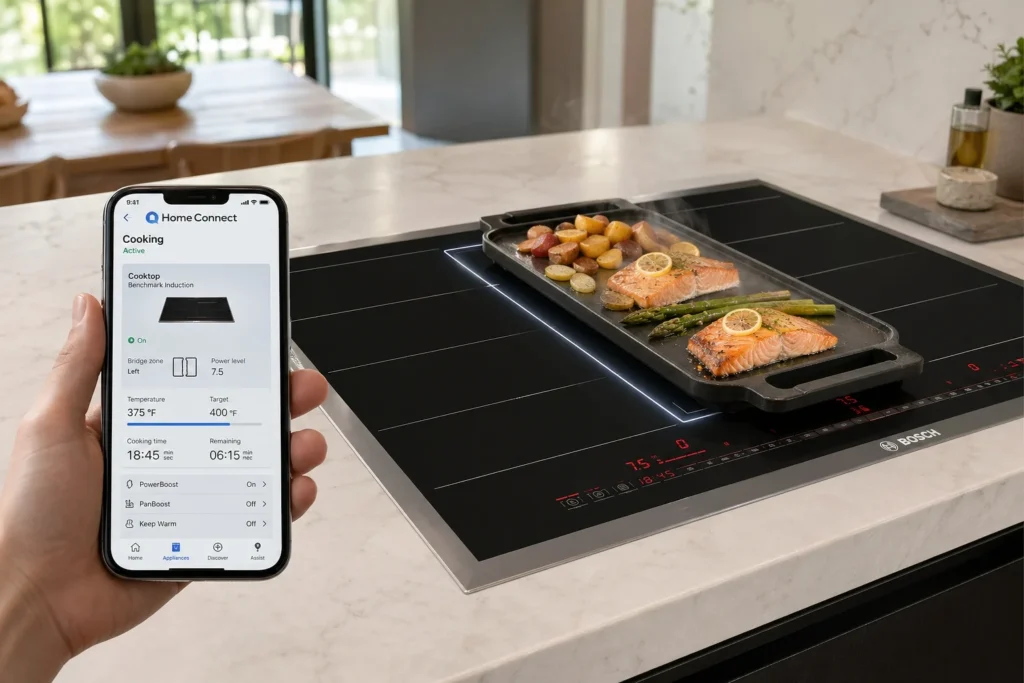
Key specifications:
- Max wattage: 3,700W (primary power burner)
- Smart features: Wi-Fi Home Connect, auto hood sync
- Zones: 6 induction zones with FlexInduction bridge
- Reliability rate: ~1.7% service call rate (Yale Appliance data)
- Price range: $2,400–$2,800
Pros: Exceptional reliability, FlexInduction bridge zones, smart home integration, easy-clean flat surface Cons: Higher upfront cost, requires compatible Bosch hood for full smart functionality
Best Premium Pick – Gaggenau CX492611 6-Burner Induction Cooktop
The Gaggenau CX492611 represents the pinnacle of residential induction cooktop technology, offering a full-surface cooking zone where pots and pans can be placed anywhere on the ceramic glass — with the cooktop automatically detecting cookware size, shape, and position and activating the precise heating area needed.
This full-surface FlexInduction technology eliminates the concept of fixed burner positions entirely. A large cast iron Dutch oven, an oddly shaped griddle, or an elongated fish poacher — all are accommodated without needing to center cookware over a specific zone. For home chefs who work with a diverse range of cookware shapes and sizes, this freedom is transformative. The middle zone accommodates particularly large pots, while both side zones can activate as griddle surfaces for irregular pan shapes.
The Gaggenau CX492611 delivers a maximum output of 5,500 watts — the highest available in this review — enabling true restaurant-grade boiling and searing performance at home. With 17 power levels and 5 dedicated frying levels, temperature precision across the full range from gentle warming to aggressive high-heat cooking is unmatched among residential appliances.
Gaggenau induction cooktop review Gaggenau vs Miele vs Thermador luxury comparison
Key specifications:
- Max wattage: 5,500W
- Technology: Full-surface FlexInduction, auto cookware detection
- Power levels: 17 power + 5 frying levels
- Price range: $4,500–$6,000+
Pros: Full-surface cooking freedom, highest wattage output, automatic cookware detection, professional-grade performance Cons: Premium price point, requires full kitchen renovation planning for proper integration
Best Value – GE Profile PHP9036 6-Burner Induction Cooktop
The GE Profile PHP9036 delivers exceptional performance-per-dollar value for home chefs seeking professional-grade induction cooking at a more accessible price point, combining SyncBurner technology, a 3,700W primary element, and an intuitive red LED control interface.
SyncBurner technology is GE Profile’s answer to bridge zone functionality: two adjacent elements can be synchronized to function as a single extended cooking zone, ideal for griddle cooking, extra-large stockpots, or dual-side warming of a roasting pan. This feature brings FlexInduction-style flexibility to a significantly lower price bracket. The integrated kitchen timer appears directly on the cooktop surface, enabling simultaneous timing of multiple dishes without reaching for a separate device.
The GE Profile PHP9036’s red LED display provides clear, immediate visual feedback on heat levels across all zones — particularly valuable in kitchen environments with variable lighting. Pan size sensors automatically recognize cookware diameter and adjust the active heating zone accordingly, improving both energy efficiency and cooking accuracy.
Key specifications:
- Max wattage: 3,700W
- Technology: SyncBurners, pan size sensors, red LED display
- Smart features: Integrated timer, ADA compliant
- Price range: $1,600–$2,000
Pros: Best price-to-performance ratio, SyncBurner bridge zones, intuitive LED display, wide brand service network Cons: No Wi-Fi connectivity, fewer power levels than Gaggenau or Bosch Benchmark
Best for Professional Home Chefs – Wolf 36-Inch Induction Cooktop
The Wolf 36-inch induction cooktop earns its position as the top choice for serious, professional home chefs through exceptional build quality, premium bridge element configuration, and a brand reputation built on decades of professional kitchen equipment manufacturing.
Wolf’s induction cooktops are engineered to the same durability standards as the brand’s professional gas ranges — which means heavy-gauge stainless steel trim, reinforced ceramic glass rated for intensive daily use, and internal components designed to withstand the thermal cycling demands of a high-output kitchen. For home chefs who cook professionally-complex recipes daily, entertain on a large scale, or operate home catering businesses, Wolf’s build quality delivers confidence that less-specialized brands simply cannot match.
Bridge elements on the Wolf 36-inch model allow two adjacent zones to operate as a unified cooking surface — accommodating large roasting pans, paella dishes, or extended griddle surfaces with even, consistent heat distribution across the entire bridge zone. Temperature precision at the low end is equally impressive: Wolf’s induction technology maintains stable simmer temperatures without the cycling fluctuations that affect lesser models, making it ideal for delicate sauces, tempering chocolate, and slow-cooked braises.

Key specifications:
- Max wattage: 3,600W+ per power element
- Technology: Bridge elements, precision simmer control
- Build: Heavy-gauge stainless trim, professional-grade ceramic glass
- Price range: $3,200–$4,500
Pros: Professional-grade durability, bridge elements, exceptional simmer precision, premium brand support network Cons: Highest price in mid-premium segment, no Wi-Fi smart connectivity
How Do the Top 6-Burner Induction Cooktops Compare Side by Side?
Bosch Benchmark wins on reliability and smart connectivity, Gaggenau leads on maximum power and full-surface flexibility, GE Profile excels on value and accessibility, and Wolf dominates on build quality and professional-grade durability — making the best choice entirely dependent on your specific cooking priorities and budget.
The following comparison table summarizes the four top-rated models across six critical evaluation criteria. This table is designed to give home chefs a clear, at-a-glance reference for matching model strengths to their own kitchen priorities:
| Feature | Bosch Benchmark | Gaggenau CX492611 | GE Profile PHP9036 | Wolf 36-Inch |
|---|---|---|---|---|
| Max Wattage | 3,700W | 5,500W | 3,700W | 3,600W+ |
| Bridge/Flex Zones | Yes (FlexInduction) | Full-surface | Yes (SyncBurner) | Yes (Bridge) |
| Smart/Wi-Fi | Yes (Home Connect) | No | No | No |
| Reliability Rate | ~1.7% service rate | Premium-tier | Standard | Professional-grade |
| Best For | Smart kitchen integration | Maximum cooking flexibility | Budget-conscious upgrade | Professional durability |
| Price Range | $2,400–$2,800 | $4,500–$6,000+ | $1,600–$2,000 | $3,200–$4,500 |
Beyond the numbers, the choice between these models often comes down to a single decisive factor. If smart home integration matters most, Bosch Benchmark is the clear winner. If you want absolute cooking freedom regardless of pot shape or size, Gaggenau’s full-surface technology is unrivaled. If budget is a primary constraint without sacrificing core performance, GE Profile PHP9036 delivers excellent results at substantially lower cost. And if you prioritize long-term durability and professional build standards above all else, Wolf earns its premium position without hesitation.
Where Can You Buy a 6-Burner Induction Cooktop and What Should You Budget?
Six-burner induction cooktops are available at major appliance retailers including Lowe’s, Best Buy, The Home Depot, P.C. Richard & Son, and Yale Appliance — with budget ranges spanning from $1,500 for mid-range models to over $6,000 for top-tier premium configurations.
Understanding where to buy is as important as knowing what to buy. Specialty appliance retailers like Yale Appliance offer deeper technical expertise and post-purchase service networks compared to general home improvement stores — a meaningful advantage when purchasing a $3,000+ appliance that requires professional installation and occasional service. For brands like Bosch and Wolf, purchasing through authorized dealers also ensures full warranty coverage and access to certified technicians for any service needs.
Retailer guide for 6-burner induction cooktops:
- Lowe’s / The Home Depot: Wide selection of GE Profile and mid-range brands; competitive pricing with frequent promotional financing
- Best Buy: Strong inventory of Bosch and GE; useful for in-store comparison shopping before purchasing
- P.C. Richard & Son: Authorized Viking dealer; offers financing options and white-glove delivery for large appliances
- Yale Appliance: Specialist retailer with the most detailed reliability data; recommended for Bosch, Wolf, and Gaggenau purchases
- Manufacturer direct: Gaggenau and Wolf offer direct purchasing through their websites with showroom consultation options
Budget planning breakdown:
| Budget Tier | Price Range | Recommended Models |
|---|---|---|
| Mid-Range | $1,500–$2,500 | GE Profile PHP9036, Bosch 500 Series |
| Upper-Mid | $2,500–$3,500 | Bosch Benchmark, Wolf 36-inch |
| Premium | $3,500–$6,000+ | Gaggenau CX492611, Thermador Freedom |
This table shows three distinct budget tiers: mid-range for home chefs seeking a quality upgrade from gas without maximum outlay, upper-mid for those prioritizing reliability and smart features, and premium for buyers who want the absolute best performance available in residential induction.
Beyond the cooktop purchase price, installation costs must be factored in. All 6-burner induction cooktops require a 220–240V dedicated electrical circuit, typically a 50-amp service. If your kitchen is not already wired for this configuration, electrician costs for panel upgrade and dedicated circuit installation can range from $200 to $800 depending on your existing electrical infrastructure and local labor rates. Countertop cutout modification for switching from a 30-inch to 36-inch cooktop adds additional contractor cost if cabinetry adjustment is required.
Is a 6-Burner Induction Cooktop Better Than Gas or Electric for Your Kitchen?
Induction wins on energy efficiency and safety, gas excels on open-flame cooking techniques and familiarity, and electric radiant offers the lowest entry cost — making induction the best overall choice for home chefs who prioritize performance, precision, and long-term value.
This comparison directly addresses the secondary search intent of home chefs who are weighing induction against their current gas or electric setup before committing to an upgrade. Understanding where each technology genuinely outperforms the others allows for a decision grounded in real cooking needs rather than marketing claims.
How Does Induction Cooking Compare to Gas in Terms of Speed and Control?
Induction beats gas on speed, energy efficiency, and precise temperature control, while gas retains an advantage in open-flame cooking techniques, familiar visual heat feedback, and compatibility with round-bottom cookware like carbon steel woks.
On speed, induction is definitively faster. According to Consumer Reports’ independent testing, a 6-quart pot of water approaches boiling 2 to 4 minutes sooner on induction than on an equivalent gas or electric burner — a difference that compounds significantly across daily cooking use. This speed advantage stems from induction’s direct energy transfer to the cookware itself, eliminating the thermal lag inherent in gas combustion and electric surface heating.
On temperature control, induction’s electromagnetic regulation enables precision that gas flame adjustment cannot match. Reducing power on an induction burner produces an almost instantaneous response in cookware temperature, allowing home chefs to pull a sauce back from a boil or bring simmering stock to a gentle bubble with single-step adjustments. Gas burners, while responsive, are subject to flame behavior variability that introduces less precision at the lower end of the temperature range.
However, gas retains genuine advantages for specific cooking techniques. Professional wok cooking over extremely high flame heat — the “wok hei” technique producing characteristic char and smokiness in stir-fry dishes — requires open flame contact with a round-bottom wok that induction cannot replicate. Chefs who specialize in these techniques will find gas irreplaceable for those specific applications.

What Cookware Is Compatible with a 6-Burner Induction Cooktop?
Only ferromagnetic cookware — including cast iron, carbon steel, and magnetic stainless steel — is compatible with induction cooktops, because the electromagnetic field requires a magnetically conductive base to generate heat within the cookware.
The simplest compatibility test requires nothing more than a standard kitchen magnet: if a magnet adheres firmly to the bottom of your pot or pan, that piece of cookware will work on an induction cooktop. Cookware that does not pass the magnet test — including aluminum, copper, and non-magnetic stainless steel — will not heat on an induction surface unless it features a specially manufactured magnetic base layer.
Home chefs switching from gas to induction should audit their existing cookware collection before purchasing. Many modern cookware sets already include induction-compatible pieces, particularly those made from enameled cast iron (Le Creuset, Staub), magnetic stainless steel (All-Clad D3, Tramontina Tri-Ply), and carbon steel (Mauviel, de Buyer). Pure aluminum, ceramic-coated aluminum, and copper cookware will require replacement or supplementation with induction-compatible alternatives.
For home chefs building a new cookware collection alongside a 6-burner induction cooktop, a recommended starter set includes: a 12-inch magnetic stainless skillet, a 3.5-quart enameled cast iron braiser, a 6-quart stainless saucepan, and an 8-quart stainless stockpot — covering the full range of cooking tasks across six available burner zones.
Can You Use a 6-Burner Induction Cooktop with a Smart Kitchen System?
Yes, select 6-burner induction cooktops integrate fully with smart kitchen systems — most notably Bosch’s Home Connect platform, which enables remote monitoring, automatic ventilation hood control, and app-based diagnostics from a smartphone or tablet.
Bosch’s Home Connect integration is the most developed smart functionality available in residential induction cooktops. When connected to a compatible Bosch hood, the cooktop automatically activates the ventilation fan and adjusts fan speed in response to the cooking zone’s output level — eliminating the need to manually manage ventilation during intensive cooking sessions. Additionally, the cooktop can be programmed via the Home Connect app to power off automatically after a set cooking duration, providing remote oversight when multitasking during complex meals.
Gaggenau and Wolf cooktops, while not offering Wi-Fi connectivity in their current configurations, integrate into premium kitchen ecosystems through designer showroom consultation — allowing these appliances to be specified as components of fully integrated smart kitchen designs including connected ovens, refrigerators, and lighting systems. For home chefs investing at the $4,000–$6,000+ cooktop level, this systems-level integration planning is worth including in the kitchen design conversation from the outset.
How Do You Maintain and Clean a 6-Burner Induction Cooktop Properly?
Maintaining a 6-burner induction cooktop requires simple daily wiping with a damp microfiber cloth, periodic cleaning with a ceramic glass cooktop cleaner, and avoiding abrasive scrubbing pads — all significantly easier than cleaning gas cooktop grates or electric coil elements.
The smooth, uninterrupted ceramic glass surface is one of induction cooking’s most practical everyday advantages. Because the surface outside the active cookware zone never reaches dangerous temperatures, food spills do not burn and adhere to the glass the way they carbonize onto gas burner caps or electric coil elements. Most spills during cooking can be wiped away immediately — or shortly after the zone cools — with a damp cloth and no scrubbing required.
For periodic deep cleaning, a dedicated ceramic glass cooktop cleaner (such as Cerama Bryte or Weiman Cooktop Cleaner) applied with a soft cloth removes stubborn residue and polishes the glass surface without scratching. Avoid steel wool, harsh abrasives, or bleach-based cleaners, which can permanently scratch or discolor the glass ceramic finish.
One particularly valuable maintenance habit: wipe the cooktop surface after each use while it is still slightly warm (not hot). This prevents residue from hardening as the surface cools, keeping the cooktop in near-new condition with minimal effort. For home chefs who cook daily across all six zones, this simple routine keeps the cooktop looking as polished on its 500th use as on its first day of installation.