
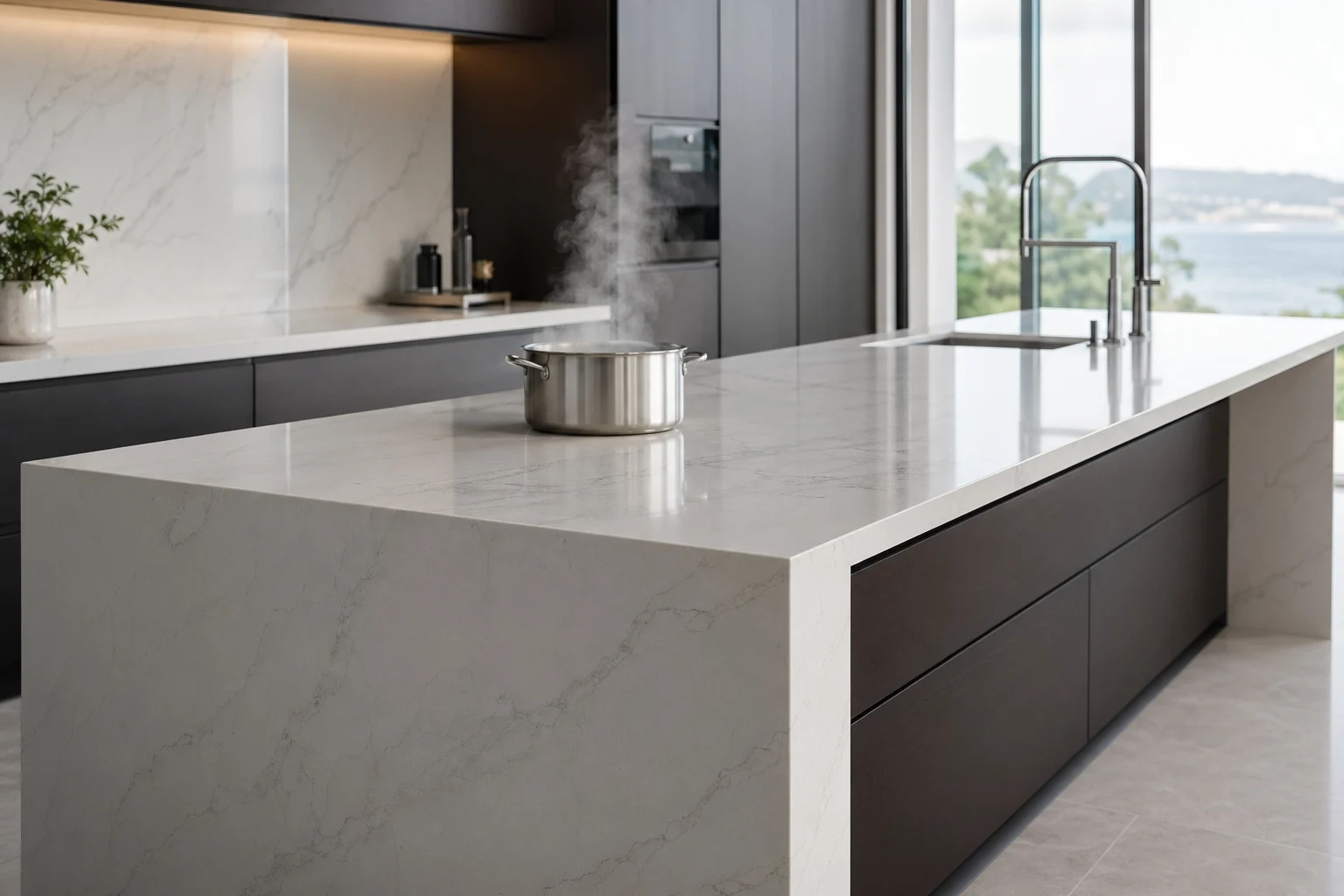
An invisible induction cooktop is a hidden cooking system installed beneath a compatible countertop, where electromagnetic induction heats the cookware instead of exposing visible burners on the surface. In practical terms, that means modern homeowners get a cleaner-looking kitchen, a more flexible island or worktop, and a cooking experience that blends technology with minimalist design. For a complete overview, see induction cooktop how-to guides.
Beyond the novelty factor, most homeowners search this topic because they want to know whether the concept is actually useful. The short answer is yes: it can improve visual aesthetics, free up workspace, and simplify cleaning, especially in modern kitchens built around seamless islands and open-plan layouts. At the same time, it is not a universal fit, because performance, usability, and cost depend heavily on countertop material, installation quality, and cookware compatibility.
Cost is the second major concern behind this topic, and for good reason. An invisible induction cooktop typically involves more than the cooktop module itself: homeowners may also need a compatible countertop, professional installation, electrical preparation, and in some cases induction-ready cookware or protective accessories. That is why this category often appeals first to design-led remodels and premium kitchen projects rather than entry-level renovations.
Design fit is the third key question, because even the most visually stunning hidden cooktop must still work in real homes, with real cooking habits, and real countertop limitations. Below, this guide moves from definition to mechanism, from benefits to costs, and from design compatibility to practical trade-offs so you can decide whether an invisible induction cooktop truly fits your kitchen and your lifestyle.
What Is an Invisible Induction Cooktop?
An invisible induction cooktop is a hidden induction cooking system installed beneath a compatible countertop surface, typically porcelain or stone, that heats cookware directly while keeping the cooking area visually seamless.
To understand the heading more clearly, the important idea is that the technology is not “burnerless” cooking in a magical sense. Instead, it uses the same induction principle found in standard induction cooktops, but the hardware sits below the worktop rather than above it. As a result, the kitchen surface looks like one continuous slab, with cooking zones either subtly marked, digitally controlled, or visually unmarked until needed.
For modern homeowners, this matters because the cooktop becomes part of the kitchen architecture rather than a separate appliance. The kitchen island can serve as a prep station, serving zone, dining area, and cooking surface in one integrated design. That design flexibility is one reason invisible induction cooktops are increasingly associated with premium kitchens, small-space optimization, and minimalist interiors.
Gaggenau induction cooktop review
Is an Invisible Induction Cooktop the Same as a Standard Induction Hob?
No, an invisible induction cooktop is not the same as a standard induction hob, because it differs in installation method, surface appearance, and countertop dependency.
To connect this difference back to the heading, both systems rely on electromagnetic induction to heat suitable cookware, but a standard induction hob places visible cooking zones on top of a glass-ceramic surface. By contrast, an invisible induction cooktop hides the induction modules under the countertop, so the user cooks on the slab itself. That makes the invisible version more design-driven, but also more dependent on material thickness, heat transfer limits, and installation precision.
In daily use, the difference affects how people interact with the kitchen. A standard induction hob is easier to identify and use immediately, while an invisible induction cooktop offers a cleaner aesthetic and multi-use work surface. In other words, one prioritizes conventional usability, while the other prioritizes seamless integration and architectural elegance.
How to install an induction cooktop
What Components Make Up an Invisible Induction Cooktop System?
There are five main components in an invisible induction cooktop system: induction modules, a compatible countertop, controls, power infrastructure, and induction-compatible cookware.
To break that system down more clearly, the induction modules sit beneath the countertop and generate the electromagnetic field. The countertop must be made from a compatible material and thickness that allows energy transfer without compromising durability or performance. Controls may be hidden, integrated, or smartphone-based depending on the brand and installation. The electrical system must support the appliance load, just as it would for a conventional induction setup. Finally, cookware must contain ferromagnetic material so the pan—not the countertop—becomes the primary heated object.
Because all five elements work together, homeowners should think of invisible induction as a system purchase, not just a cooktop purchase. That distinction helps explain why the category is exciting from a design standpoint but also more demanding from a planning and budgeting standpoint.
How Does an Invisible Induction Cooktop Work Through a Countertop?
An invisible induction cooktop works by placing induction elements beneath a compatible countertop and using electromagnetic energy to heat induction-ready cookware through the slab.
To explain the mechanism more clearly, induction does not heat in the same way as gas flames or radiant electric coils. Instead, the system creates a magnetic field that interacts with the metal base of a suitable pan. The pan becomes the main point of heat generation, which then transfers heat to food. In an invisible induction installation, the induction hardware remains below the surface, while the pan sits on top of the countertop above the hidden zone.
This means the countertop is not the primary heat source, but it still plays a critical role. It must allow effective transmission while maintaining structural performance and daily usability. That is why manufacturers and design sources consistently emphasize compatible porcelains, stones, or specified slab constructions rather than treating every countertop material as interchangeable.
Does the Countertop Heat Up, or Does the Pan Heat First?
The pan heats first, not the countertop, because induction targets the cookware directly; however, the countertop can warm up over time from transferred heat and prolonged cooking.
To clarify that point, many invisible cooktop descriptions highlight that the surface stays cooler than traditional gas or electric cooking. That is broadly true in principle, because the pan is the main recipient of energy. However, “cool to the touch” should never be interpreted as “never warms at all.” Editorial coverage and product discussions note that the slab may gradually heat during use, especially after several minutes of active cooking or with high heat and larger cookware.
For homeowners, the practical takeaway is straightforward: invisible induction may reduce exposed hot-surface risk compared with some conventional options, but it still requires safe habits. You should assume the zone around an actively used pan may become warm, use proper cookware placement, and follow the manufacturer’s safety guidance rather than relying on aesthetics alone.
Which Countertop Materials and Thicknesses Support Induction Cooking Best?
There are three practical material groups most often associated with invisible induction: porcelain-based surfaces, certain engineered or specified stone slabs, and manufacturer-approved countertop systems with controlled thickness requirements.
To make that grouping useful, the key variable is not beauty alone but heat-transfer compatibility. Some sources explicitly position porcelain and specially designed stone surfaces as ideal because they combine durability with the ability to work over under-counter induction modules. At the same time, thickness matters: The Kitchn notes that countertops may need to be thinner than some homeowners expect in order to support effective heat transfer.
That means homeowners should never assume an existing slab will automatically work. The best approach is to evaluate material type, slab thickness, support structure, and brand-specific installation specs together. In this category, the countertop is not just décor; it is part of the cooking system itself.
Best built-in induction cooktops

What Are the Main Benefits of an Invisible Induction Cooktop for Modern Homeowners?
Yes, an invisible induction cooktop offers meaningful benefits for modern homeowners, mainly because it improves aesthetics, saves usable surface space, and simplifies everyday cleaning.
To expand on those benefits, the strongest advantage is visual integration. Without visible burners, grates, or black glass zones interrupting the slab, the kitchen looks calmer and more intentional. That matters in homes where the kitchen opens into dining and living areas, because the countertop reads as furniture-grade architecture rather than appliance-heavy workspace.
The second advantage is space efficiency. When not actively cooking, the same surface can be used for meal prep, entertaining, serving, or even casual dining. Better Homes & Gardens highlights this as a major upside, especially in smaller kitchens where reclaiming counter area makes a visible difference in usability.
The third advantage is maintenance simplicity. Since there are no grates or raised burner assemblies, the countertop is easier to wipe clean. Bellus also emphasizes easy cleaning as a core benefit, noting that a microfiber wipe can handle everyday spills efficiently.
Can an Invisible Induction Cooktop Improve Kitchen Aesthetics and Space Efficiency?
Yes, an invisible induction cooktop can improve both aesthetics and space efficiency because it creates a seamless visual line, reduces appliance clutter, and allows one surface to serve multiple functions.
To see why this matters in real homes, consider the kitchen island. In many modern layouts, the island acts as the social center of the room. A traditional cooktop introduces visible hardware, splits the surface visually, and limits how easily the space transitions from prep to entertaining. An invisible induction system preserves a continuous countertop appearance, so the island remains elegant and adaptable when cooking is finished.
This is especially valuable for minimalist, luxury, and open-plan interiors, where homeowners care as much about visual calm as they do about appliance performance. That is why design publications and brands often frame invisible induction as not merely a cooking product, but a kitchen design strategy.

How Do Safety, Cleaning, and Energy Efficiency Compare in Daily Use?
An invisible induction cooktop is generally stronger on cleaning and visual safety than gas or electric, while energy efficiency and speed are often positioned as stronger than traditional gas and radiant electric systems.
To compare these factors more practically, cleaning is the clearest win. A flat slab is easier to wipe than gas grates and easier to keep visually uncluttered than a standard hob with framed zones. Safety is more nuanced: there is no open flame, and the surface is not heated in the same direct way as gas or electric coils, but invisibility also means users must stay aware of active zones. Better Homes & Gardens specifically notes that families should pay attention to the fact that there is no obvious visual cue of heat the way there is with visible burners.
On performance, several sources describe induction cooking as fast and efficient. Bellus emphasizes faster heating, while Infinity Surfaces positions invisible induction as more efficient than gas and electric cooking. In real life, performance can still vary by installation, cookware, surface, and user familiarity, so the efficiency promise is strongest when the full system is designed correctly.
How Much Does an Invisible Induction Cooktop Cost?
An invisible induction cooktop is usually a premium investment, with entry pricing around $3,000 for the cooktop category and total installed project costs often rising well beyond that once countertop and installation requirements are included. Source Source
To make the cost issue easier to understand, the table below summarizes the main budget buckets homeowners should expect in a real project.
| Cost area | What it usually includes | Budget implication |
|---|---|---|
| Cooktop system | Hidden induction modules and controls | BHG notes invisible cooktops typically start around $3,000 |
| Countertop | Compatible porcelain/stone surface, fabrication, finishing | Can significantly increase total project cost |
| Installation | Professional fitting, cabinetry coordination, electrical preparation | The Kitchn reports all-in totals can reach roughly $5,000 to $8,000 |
| Cookware/accessories | Induction-ready pans, possible protective items | Adds extra cost if current cookware is not compatible |
The financial lesson is simple: invisible induction is rarely a “swap one appliance and done” upgrade. Instead, it behaves more like a kitchen system decision that intersects with materials, fabrication, appliance planning, and renovation sequencing.
What Costs Should Homeowners Budget for the Unit, Countertop, and Installation?
There are four major cost groups homeowners should budget for: the cooktop unit, the compatible countertop, professional installation, and cookware or accessory upgrades.
To budget realistically, start with the appliance itself. Better Homes & Gardens says invisible cooktops typically start at around $3,000. Then factor in the countertop, which may need to be replaced if your current slab is incompatible in material or thickness. Next comes installation, including electrical readiness and professional coordination. Finally, if your kitchen still relies on aluminum or copper pans without magnetic bases, you may need new cookware as well.
For homeowners planning a remodel, these costs may feel more manageable because the work can be folded into a larger kitchen budget. For homeowners hoping for a quick appliance upgrade, the total can feel disproportionately high relative to a standard induction cooktop. That difference is central to smart decision-making in this category.

Is an Invisible Induction Cooktop Worth the Higher Upfront Cost?
Yes, an invisible induction cooktop can be worth the higher upfront cost for design-focused homeowners, space-conscious remodels, and premium kitchens, but not for every budget or cooking style.
To judge value fairly, homeowners should look at three factors: design return, space return, and cooking return. Design return is strongest when the kitchen’s visual identity matters. Space return is strongest in islands and smaller kitchens where every inch of surface matters. Cooking return depends on how often you cook, how comfortable you are with induction, and whether your expectations match the system’s real-world learning curve.
In contrast, the value proposition weakens if your main goal is simply to boil water and cook efficiently at the lowest possible price. In that case, a standard induction cooktop usually delivers a better cost-to-performance ratio. Invisible induction shines most when aesthetics and multi-function design are part of the purchase logic, not just raw cooking power.
How Well Does an Invisible Induction Cooktop Fit Different Countertop Designs?
An invisible induction cooktop fits best in countertop designs that prioritize seamless surfaces, compatible slab materials, and kitchen layouts where one worktop needs to serve multiple functions.
To connect design fit back to real planning, the cooktop works most naturally in contemporary kitchens with strong visual continuity. Islands, waterfall edges, handleless cabinetry, and open-plan spaces all benefit from the reduced visual clutter of hidden cooking zones. The design logic is strongest when the homeowner wants the countertop to look like a furniture-grade surface rather than a visibly technical appliance area.
However, design fit is not just about beauty. It also depends on technical harmony between slab type, slab thickness, cabinet structure, ventilation strategy where relevant, and workflow preferences. A stunning invisible setup only succeeds when the aesthetic concept and the technical assembly are planned together.
Which Kitchen Layouts Work Best for Islands, Compact Kitchens, and Open-Plan Homes?
There are three kitchen layouts where invisible induction tends to fit best: island-centered kitchens, compact kitchens that need more usable surface, and open-plan homes that prioritize visual calm.
In island-centered kitchens, the advantage is social and architectural. The island can function as a prep area, dining surface, and cooking zone without feeling visually segmented. In compact kitchens, the benefit is spatial efficiency, because the surface can be reclaimed for prep and serving when not actively used for cooking. In open-plan homes, the benefit is aesthetic continuity, since the kitchen becomes less appliance-dominant when viewed from surrounding living areas.
That said, layout fit also depends on user behavior. If a household cooks heavily, uses multiple pans at once, or prefers clear visual burner boundaries, a conventional induction layout may still feel more intuitive. The best layout is the one that supports both your kitchen design and your cooking rhythm.

Can You Retrofit an Invisible Induction Cooktop into an Existing Countertop?
Yes, you can sometimes retrofit an invisible induction cooktop into an existing countertop, but only if the slab material, thickness, structure, and access conditions meet the brand’s installation requirements.
To evaluate retrofit potential properly, homeowners need to ask four questions. Is the current countertop made from a compatible material? Is the thickness within acceptable limits for heat transfer? Is there enough cabinet access and structural support below for module installation and servicing? And is the electrical system ready for the load? If the answer to any of these is no, replacement or major modification may be necessary.
In many real projects, retrofit turns out to be less straightforward than expected. That is why invisible induction is often easier to execute in planned remodels or new-build kitchens than in piecemeal upgrades. The concept is flexible, but not infinitely forgiving.
How Does an Invisible Induction Cooktop Compare with Gas, Electric, and Standard Induction Cooktops?
An invisible induction cooktop wins on visual minimalism and surface integration, standard induction is usually strongest on practicality and value, gas remains familiar for flame-based cooking, and radiant electric tends to trail on efficiency and design flexibility.
To make the comparison easier, the table below shows how the main cooktop categories differ in the areas homeowners care about most.
| Cooktop type | Strongest advantage | Main compromise | Best fit |
|---|---|---|---|
| Invisible induction | Seamless design, reclaimed workspace, premium look | Higher cost, more installation complexity, learning curve | Design-led remodels and luxury minimalist kitchens |
| Standard induction | Fast heating, good efficiency, easier purchase path | Visible hob remains on surface | Most homeowners wanting performance and value |
| Gas | Familiar flame control, widespread cookware compatibility | More cleaning, lower efficiency, open flame | Users strongly attached to flame cooking |
| Radiant electric | Familiarity and broad availability | Slower response, less efficient, hotter visible surface | Basic replacement situations |
To deepen that comparison, invisible induction and standard induction are technological relatives, but they are not equal in buying logic. Standard induction is easier to source, easier to understand, and usually cheaper to install. Invisible induction, by contrast, is a more architectural decision: you choose it not only for cooking, but also for how you want the room to look and function when you are not cooking.
Against gas and radiant electric, invisible induction benefits from the general strengths of induction: speed, efficiency, and easier cleaning. Still, the invisible format introduces its own trade-offs around surface compatibility, hidden-zone awareness, and total project cost. So the right answer is not “best overall,” but “best for specific priorities.”
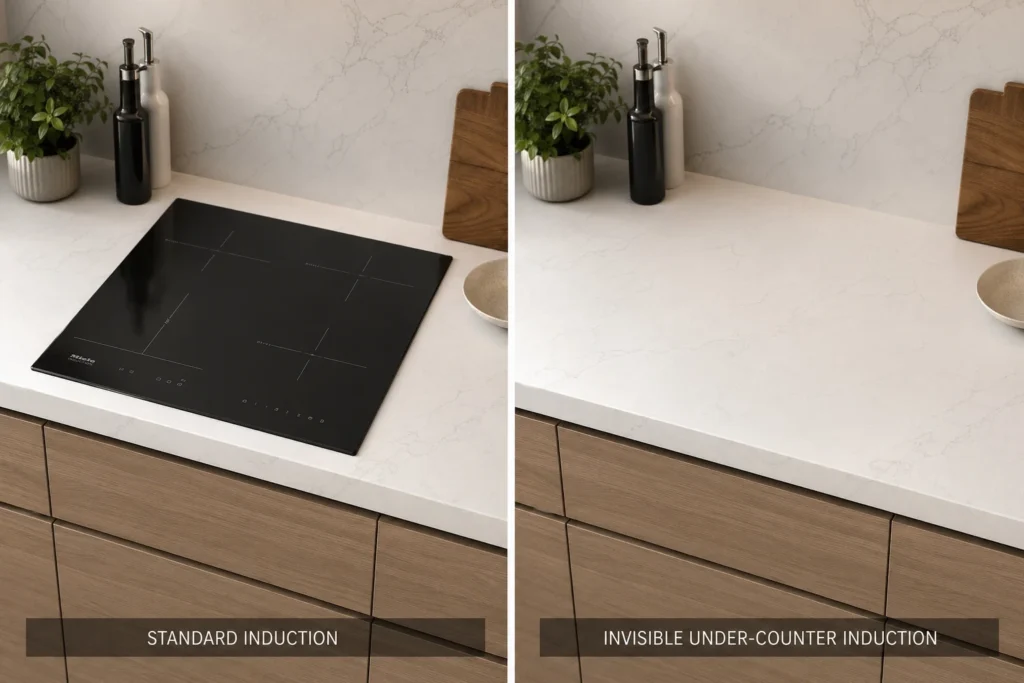
Which Option Is Better for Performance, Maintenance, and Visual Minimalism?
An invisible induction cooktop is best for visual minimalism, standard induction is better for balanced performance and usability, and gas remains preferable only for homeowners who specifically want visible flame cooking.
To compare the three most important criteria, performance is usually strongest in standard induction because it offers direct induction speed without the extra variable of countertop transmission. Maintenance is easiest with invisible induction because the surface stays clean and uninterrupted. Visual minimalism is unquestionably the domain of invisible induction, since it removes the look of a separate cooktop almost entirely.
That means the best option depends on what you value most. If you want the cleanest look, choose invisible induction. If you want strong everyday performance with fewer planning constraints, standard induction is typically the smarter buy. If you want traditional flame cues above all else, gas still has emotional and functional appeal for some cooks.
Who Should Choose an Invisible Induction Cooktop, and Who Should Not?
There are two broad user groups here: homeowners who should seriously consider invisible induction, and homeowners who should probably choose a more conventional cooktop.
The first group includes design-focused homeowners, luxury remodelers, owners of compact kitchens who want every inch of worktop back, and people building open-plan kitchens where visual coherence matters. These users gain the most from the hidden format because the product solves both aesthetic and spatial problems at once.
The second group includes budget-sensitive buyers, heavy everyday cooks who want maximum predictability, homeowners with incompatible existing countertops, and anyone who wants the simplest possible replacement path. For these users, standard induction often delivers most of the cooking benefits without the same project complexity.
SUPPLEMENTARY CONTENT
What Less-Discussed Factors Should Homeowners Know Before Buying an Invisible Induction Cooktop?
Homeowners should know about cookware precision, service access, countertop thickness limits, and real-world learning curves before buying an invisible induction cooktop.
To move beyond the headline benefits, this category deserves a more nuanced view. Much of the marketing focuses on beauty, speed, and innovation, which are real strengths. However, the buying experience becomes much smarter when you also account for the less glamorous details: how exact pan placement needs to be, what happens if the system ever requires servicing, how slab thickness affects performance, and whether your household will adapt comfortably to cooking on a surface with hidden zones.
These “micro” questions may not define the trend, but they often define satisfaction after installation. For many homeowners, the invisible cooktop is a brilliant design choice. For others, it becomes a case where the image of innovation is stronger than the day-to-day fit.
Do You Need Special Cookware, Pan Sizes, or Pan Placement Habits?
Yes, an invisible induction cooktop requires induction-compatible cookware, and it often works best when pan size and placement align closely with the hidden cooking zones.
To make that practical, the first requirement is simple: cookware must be ferromagnetic, just as it must be for standard induction. That means aluminum and copper pans without magnetic bases will not work properly. The second requirement is less obvious: because the cooking zones are hidden, users may need a short learning period to place pans accurately and consistently over the active area. Some systems use audio cues or optional markings to help locate burners.
For households used to highly visual cooktops, this adjustment can feel unusual at first. It is not necessarily a flaw, but it is a behavior change. In other words, invisible induction rewards users who are comfortable combining design minimalism with a bit of operational precision.
What Installation Limits, Repair Access Issues, and Service Challenges Can Occur?
Yes, installation and servicing can be more challenging with an invisible induction cooktop because the system depends on countertop specs, under-counter access, and professional integration.
To expand on that challenge, traditional cooktops are easier to identify, remove, and replace because they occupy a clearly defined cutout and remain visually exposed. Invisible systems, by contrast, are embedded into a broader countertop and cabinet assembly. That can mean tighter tolerances, more dependency on the installer’s skill, and potentially more complexity if a module needs inspection, recalibration, or replacement later.
This does not mean the system is impractical. It means homeowners should ask service-related questions before committing: Who handles repairs? Can the modules be accessed without disturbing the countertop? Are spare parts and local support available? Good answers to those questions often separate a smooth ownership experience from a frustrating one.
Are Thick Countertops, Heavy Multi-Pan Cooking, or Boost Modes a Performance Trade-Off?
Yes, they can be trade-offs, because thicker countertops may reduce heat transfer efficiency, and demanding multi-pan use can expose the limits of a hidden, material-dependent setup.
To understand the trade-off, remember that invisible induction adds one more variable between the module and the pan: the countertop itself. When that slab becomes too thick or less compatible, performance may decline. Similarly, in heavy cooking sessions where multiple pans run at high power, system behavior can feel more sensitive than that of a straightforward exposed induction hob. Performance discussions reported by The Kitchn show that real-world experiences vary, suggesting installation quality and user expectations matter substantially.
For homeowners who mostly simmer, sauté, boil occasionally, and value design, these trade-offs may be minor. For intensive home cooks who routinely manage several burners at once, performance predictability may matter more than visual purity. That is one of the clearest dividing lines between aspirational appeal and practical fit.
What Common Myths About Safety, Durability, and Everyday Use Should Be Clarified?
There are three myths that need clarification: the countertop never gets warm, invisible induction is automatically safer in every situation, and it works exactly like a normal visible cooktop with no learning curve.
To correct the first myth, the countertop may stay cooler than gas or radiant electric in principle, but it can still warm during extended cooking. To correct the second myth, invisibility removes flame and supports a cleaner surface, yet it also requires stronger user awareness because the active zone is not visually obvious. To correct the third myth, hidden-zone cooking often involves an adjustment period for pan placement, controls, and expectations.
The most accurate way to think about invisible induction is this: it is neither hype nor magic. It is a legitimate induction-based solution with strong design advantages, meaningful practical upside, and clear constraints that homeowners should weigh before investing.