

A Duxtop induction cooktop is a strong choice for home cooks who want fast heating, compact design, and easier temperature control without committing to a full built-in range. For most buyers, the best model is not simply the most expensive one; it is the one that matches cookware, cooking habits, kitchen space, and budget. Duxtop’s official positioning highlights portability, precision, safety features, and compatibility with standard home use, which makes the brand especially appealing for apartments, smaller kitchens, and backup-burner setups. For a complete overview, see induction cooktop brand reviews.
To begin with, this buying guide also answers the first major secondary intent behind the title: what a Duxtop induction cooktop actually is and who should buy one. That matters because many users search the brand name while still comparing induction cooking with gas, electric hot plates, or other portable burners. Reviews and demos consistently frame Duxtop as a practical option for beginners, small-space cooks, and people who want a flexible countertop solution rather than a permanent appliance.
Next, the article addresses the second key intent: which Duxtop models are worth comparing before purchase. Search results for this topic commonly surface product listings, reviews, and videos around models such as the 9600LS, 9100MC, and 8100MC, showing that users do not just want a general brand overview—they want help deciding between specific models, interfaces, and value tiers.
In addition, the final major intent is practical: buyers want to know whether a Duxtop induction cooktop will work with their cookware, outlet, and real cooking routine. That includes questions about magnetic cookware, cast iron versus stainless steel, timers, safety shutoff, portability, and even niche use cases like RVs or temporary kitchens. Below, the main content answers the buying decision directly, and the supplementary section expands into advanced, micro-context questions that support topical authority.
What Is a Duxtop Induction Cooktop and Who Is It Best For?
A Duxtop induction cooktop is a portable countertop induction burner designed for fast, precise, and space-saving cooking at home.
Best portable induction cooktop
Best 2-burner induction cooktops
To understand this heading more clearly, it helps to connect the product definition to the actual buying decision. A Duxtop induction cooktop is not just a small electric appliance; it is a compact cooking surface that heats compatible cookware through induction rather than through exposed flame or a conventional glowing coil. That distinction matters because it shapes almost every practical benefit people care about: quicker boil times, easier cleanup, auto-pan detection, and better suitability for smaller kitchens or temporary cooking setups. Duxtop’s official site emphasizes rapid heating, precise temperature control, sensor-touch usability on some models, and safety features such as overheat protection and automatic shutoff, which positions the product squarely for everyday home use rather than only for niche enthusiasts.
Is a Duxtop Induction Cooktop a Good Choice for Home Cooks?
Yes, a Duxtop induction cooktop is a good choice for home cooks because it heats quickly, saves counter space, and offers practical control and safety features.
Because this question sits at the center of the buying intent, the answer must be direct. First, Duxtop models are built around portability, which makes them useful for apartments, smaller kitchens, studio spaces, and as a secondary burner during busy meals. Second, the brand repeatedly highlights precise temperature and power control, which helps home cooks handle simple daily tasks such as boiling, simmering, reheating, sautéing, and keeping sauces steady. Third, Duxtop cooktops are marketed with safety-focused functions like overheat protection and automatic pan detection, features that reduce some of the friction people feel when moving away from gas or standard electric hot plates.
That “good for home cooks” conclusion becomes even stronger when you compare it with real-world reviews. One independent review describes the Duxtop 1800W model as a particularly strong starting point for beginners, small apartments, and users who want to avoid the hassle of gas or standard electric cooking. Another camping-focused review praises the appliance for fast heating, no fumes, and portable use with a compatible power source, which reinforces the idea that the product adapts well to flexible everyday use rather than a single kitchen scenario.
A helpful demonstration also supports the performance argument. A YouTube review explicitly showcases the Duxtop induction cooktop boiling water in under one minute, which aligns with the broader value proposition of fast, responsive countertop cooking.
NuWave induction cooktop review
Copper Chef induction cooktop review
Which Home Cooks Benefit Most from a Portable Induction Burner?
There are five main groups of home cooks who benefit most from a portable induction burner: beginners, small-space cooks, backup-burner users, precision-focused everyday cooks, and flexible/mobile kitchen users.

To expand the classification, beginners benefit because a Duxtop cooktop simplifies setup and removes the need for a full kitchen renovation. Small-space cooks benefit because the device can be stored away after use, freeing valuable countertop area. Backup-burner users benefit during holidays, batch cooking, or meal prep, when one extra cooking zone can make a noticeable difference. Everyday cooks who value precision benefit from models that offer multiple power and temperature levels, while mobile or flexible kitchen users benefit from portability in RVs, dorm-like spaces, or temporary cooking environments.
This grouping also explains why the keyword “for home cooks” matters in the title. The most natural buyer is not necessarily a professional chef; it is someone who wants reliable, compact, and controllable cooking at home without paying for more appliance than they will realistically use. In that sense, the Duxtop induction cooktop fits practical households better than purely aspirational shoppers.
Induction cooktop noise buzzing humming FAQ
Which Duxtop Induction Cooktop Models Should You Compare Before Buying?
You should compare three major Duxtop model paths before buying: the feature-rich 9600LS, the value-oriented 9100MC, and the simpler 8100MC, plus a double-burner option if you truly need two zones.
Because buyers usually search by brand but decide by model, comparison is the real core of the buying guide. Search results and product listings repeatedly surface the 9600LS, 9100MC, and 8100MC, which suggests these are among the most commercially relevant entry points into the Duxtop lineup. The official site also showcases additional options such as a professional portable model and a double induction cooktop, but for most households, the best first comparison happens among single-burner, 1800W home-oriented units.
What Is the Difference Between Duxtop 9600LS, 9100MC, and 8100MC?
The 9600LS wins on controls and convenience, the 9100MC looks strongest for value and versatility, and the 8100MC is the simplest budget-friendly pick.
To make the comparison easy to follow, the table below summarizes what each model is best known for based on current product and review signals.
| Model | What stands out | Best for | Key signals from sources |
|---|---|---|---|
| 9600LS | Sensor touch controls, LCD display, 20 power levels, 20 temperature levels, up to 10-hour timer | Buyers who want more control and a more polished interface | Official site highlights sensor touch, LCD, 20 levels, 10-hour timer |
| 9100MC | 1800W performance, 20 power levels, 20 temperature settings, 83% energy efficiency | Shoppers seeking strong value for everyday cooking | Walmart snippet highlights 20 power levels, 20 temp settings, 83% energy efficiency |
| 8100MC | Straightforward, compact, 1800W, standard 120V home outlet | Budget-conscious or first-time induction users | Retail snippets emphasize 120V household use and portability |
More specifically, the 9600LS is the better fit if you care about interface quality, fine control, and longer timer flexibility. The 9100MC looks attractive if you want strong day-to-day functionality without necessarily paying for the most premium-looking user interface. The 8100MC makes the most sense if you want a no-fuss entry into induction cooking and do not need the richer control set of the higher-positioned models. That means the “best” model is contextual, not absolute.

Is a Single-Burner Duxtop Better Than a Double-Burner Model for Most Kitchens?
Yes, a single-burner Duxtop is better than a double-burner model for most kitchens because it costs less, stores more easily, and already solves the most common at-home use cases.
Since many home cooks buy a portable induction cooktop as a supplemental appliance, a single-burner unit usually provides the highest return on space, simplicity, and budget. It is enough for boiling pasta, simmering sauces, pan-frying breakfast, reheating leftovers, or adding one extra active cooking zone during holidays. A double-burner model becomes more attractive only when you know in advance that you will regularly cook on two induction zones away from a full stove, or when your kitchen workflow depends heavily on a portable dual setup.
The portability argument matters here. Reviews that praise Duxtop for camping, small-space use, or flexible setup are effectively describing use cases where compact single-burner convenience is the reason to buy in the first place. If portability is one of your top criteria, a single burner is usually the smarter purchase.
What Features Actually Matter When You Choose the Best Duxtop Induction Cooktop?
The features that matter most are power control, temperature range, timer flexibility, cookware detection, safety systems, and ease of cleaning.
Because the word “best” can mislead buyers into chasing marketing instead of usefulness, this section narrows the selection to features that affect real cooking results. Duxtop’s official product language emphasizes rapid heating, precise control, auto-pan detection, overheat protection, and easy cleaning. Those benefits matter more than cosmetic design because they shape speed, consistency, safety, and everyday usability—the four areas that drive satisfaction after purchase.
Which Core Features Affect Cooking Performance, Control, and Safety?
There are three core feature groups that affect the experience most: performance features, control features, and safety features.
To break the grouping down clearly, performance features include wattage, heating responsiveness, and whether the cooktop supports a useful range of power and temperature settings. Control features include the interface type, display clarity, timer range, and how easily you can shift from gentle simmering to high-heat boiling. Safety features include overheat protection, child lock on some models, auto-pan detection, and automatic shutoff when cookware is removed.
Each group affects a different part of decision quality. Performance tells you whether the cooktop can keep up with your routine. Control tells you whether you can cook confidently and repeat results. Safety tells you whether the cooktop will fit into a household with children, distractions, or frequent stop-and-start cooking. When shoppers skip this grouping and focus only on price, they often end up either overbuying features they never use or underbuying the controls they actually need.
Does Wattage, Temperature Range, and Timer Control Change Real-World Cooking Results?
Yes, wattage, temperature range, and timer control change real-world cooking results because they influence speed, consistency, and the amount of attention your cooking requires.
The most immediate difference appears in speed. Product listings and reviews repeatedly position Duxtop’s portable induction cooktops around 1800W household performance, which is important because faster response is one of induction’s most visible benefits. A broader temperature range matters when you move from simple boiling to more delicate tasks such as holding a gentle simmer, warming sauces, or controlling splatter during shallow frying. Timer control matters when you want the cooktop to support repeatable routines rather than constant manual checking.
Reviews make this especially practical. The camping review notes that the Duxtop allows either numerical settings or heat-based settings, with temperature control spanning from 140°F to 460°F, and a timer that can run up to 170 minutes on the reviewed unit. That does not automatically turn every model into a slow-cooker replacement, but it does show why stronger control features can improve daily usability beyond simple water boiling.
Does a Duxtop Induction Cooktop Work with Your Existing Cookware and Kitchen Setup?
Yes, a Duxtop induction cooktop usually works with your existing kitchen setup if you have induction-compatible cookware and a standard 120V household outlet.
Because compatibility is often the final barrier before purchase, it deserves a direct answer. Duxtop’s official guidance says a simple magnet test can determine whether cookware is suitable, and retail listings repeatedly describe these units as working with standard North American household outlets. That means most buyers do not need special wiring, but they do need the right cookware base material and a sensible countertop setup with ventilation and stable placement.
What Cookware Is Compatible with a Duxtop Induction Cooktop?
There are two cookware groups that matter here: compatible magnetic cookware and non-compatible non-magnetic cookware.
To explain the definition more concretely, induction-compatible cookware usually includes magnetic stainless steel, enameled iron, cast iron, and other pans whose bottoms respond to a magnet. Non-compatible cookware generally includes pans without a magnetic base, even if they look visually similar. Both Duxtop’s official site and independent reviews recommend using a simple magnet test before cooking: if the magnet sticks firmly to the bottom, the pan is usually induction-ready.
This compatibility rule matters for buying confidence. A good cooktop can still disappoint if a buyer assumes every pan will work. In practice, many households already own at least some compatible cookware, especially cast iron or certain stainless steel pans, but it is still worth checking your most-used pieces before ordering the cooktop.
How to check if cookware is induction compatible

Is a Standard 120V Home Outlet Enough for Duxtop Portable Burners?
Yes, a standard 120V home outlet is enough for Duxtop portable burners in the typical North American household because these models are commonly listed for 110/120V, 15-amp use.
This is one of the brand’s biggest convenience advantages. Product listings emphasize that Duxtop portable induction burners use a 110/120V 15-amp electrical outlet, which is the standard household format in many North American homes. That reduces installation friction dramatically compared with built-in induction appliances that may require more specialized electrical planning.
A camping review adds a useful real-world example: the reviewer used the cooktop with a Jackery power station capable of supplying 15 amps or 1800 watts from a 120V outlet, which matched the cooktop’s needs and performed well in that setup. For home cooks, that confirms the broader point that the unit fits normal household power expectations, even if actual circuit capacity and overall appliance load should still be respected.
Which Duxtop Induction Cooktop Is the Best for Different Home Cooking Needs and Budgets?
The best Duxtop induction cooktop depends on three buying profiles: beginners on a budget, everyday home cooks who want balanced value, and users who want more control and convenience.
Since “best” must be contextual, the most useful way to answer this heading is by matching product type to buyer type. A basic or simpler model works best when price and ease matter most. A mid-tier or value-focused model works best when you want stronger day-to-day versatility. A more feature-rich model works best when you care about interface quality, a wider range of settings, or a longer timer. That framework helps avoid the common mistake of buying based on popularity alone.
Which Model Is Best for Beginners, Everyday Cooking, and Small Spaces?
There are three primary recommendations here: the 8100MC for beginners, the 9100MC for everyday value, and the 9600LS for small-space cooks who still want richer controls.
For beginners, the 8100MC makes sense because it keeps the concept simple: portable, household-friendly, and less intimidating than a full range of advanced controls. For everyday cooking, the 9100MC appears to offer an attractive balance of 1800W performance, multiple control levels, and good energy efficiency, making it a practical middle-ground choice for people who cook frequently but still watch budget. For smaller spaces where interface quality matters because the appliance may serve as a primary or semi-primary cooking zone, the 9600LS stands out thanks to sensor-touch controls, LCD display, and expanded adjustment levels.
The broader rationale also fits review behavior. Independent reviewers repeatedly describe Duxtop as beginner-friendly and especially useful where kitchen space is limited, which strengthens the recommendation logic above.
Which Model Offers the Best Value for Performance vs Price?
The 9100MC appears strongest on value, the 9600LS is best for feature-rich performance, and the 8100MC is the leanest low-cost option.
To compare value properly, you have to separate lowest price from best overall return. The 8100MC may win on entry cost, but a buyer who cooks often could outgrow its simpler positioning and wish they had better controls. The 9600LS may justify a higher price if you care deeply about interface refinement and timer flexibility. The 9100MC sits in the sweet spot for many households because it pairs strong everyday cooking specifications with a more accessible positioning than the premium-feeling option.
For clarity, the table below frames the value decision by buyer mindset rather than just product spec.
| Buyer mindset | Best fit | Why it makes sense |
|---|---|---|
| “I want the cheapest practical entry point.” | 8100MC | Best when simplicity and cost matter most |
| “I want the best balance of capability and budget.” | 9100MC | Best value for routine daily cooking |
| “I want more control and a more polished experience.” | 9600LS | Best for interface, setting flexibility, and convenience |
How Should You Choose the Best Duxtop Induction Cooktop Without Overbuying?
You should choose the best Duxtop induction cooktop by checking four things first: your cookware, cooking frequency, control needs, and budget ceiling.
Because overbuying usually happens when shoppers chase features instead of fit, a simple decision framework is more useful than a long spec sheet. Start by confirming your cookware with the magnet test. Then decide whether the cooktop will serve as a backup burner, a frequent daily appliance, or a near-primary cooking surface. Next, consider whether you truly need advanced controls like wider temperature steps, sensor-touch operation, or a longer timer. Finally, set a firm budget and ask whether the extra features will change how you actually cook, not just how the product sounds on paper.
This heading matters because the real win is not buying the “top” model—it is buying the right model. In small appliances, the best buying decision often comes from aligning use case and friction level rather than assuming premium always equals smarter.
What Checklist Should You Use Before Buying a Duxtop Induction Cooktop?
There are six checklist items you should use before buying: cookware compatibility, outlet readiness, kitchen space, cooking frequency, desired controls, and budget.
To turn that checklist into action, ask yourself these questions in order:
- Do my most-used pans pass the magnet test?
- Will I plug this into a standard 120V household outlet with enough circuit headroom?
- Do I need a burner I can store easily after use?
- Will I use it occasionally or several times a week?
- Do I need advanced timer and interface controls, or just fast basic heating?
- Am I paying for features I will actually use?
That checklist reduces the risk of mismatch. For example, a buyer with compatible cookware and frequent daily use may benefit from stepping up to a better interface. A buyer who only needs occasional extra burner capacity for family gatherings may be better served by a simpler single-burner unit.
Should You Buy a Duxtop Induction Cooktop Now or Consider Alternatives?
Yes, you should buy a Duxtop induction cooktop now if you want compact, fast, household-friendly cooking; however, you should consider alternatives if you need multi-burner permanence, non-compatible cookware support, or full-range capacity.
This comparison is most useful when framed by need. A Duxtop cooktop beats many basic hot plates on responsiveness, safety logic, and space efficiency. It also avoids some of the fumes, flame concerns, and bulk associated with gas-based portable options. On the other hand, a built-in induction range may be better if you need full-time multi-zone cooking, while a conventional electric hot plate may feel less restrictive if you are unwilling to replace non-compatible cookware.
In short, buy a Duxtop induction cooktop when your goal is flexible, efficient, and compact cooking with compatible pans. Consider alternatives when your needs are structurally different from what a portable induction burner is designed to do.
What Secondary Questions Matter After You Choose a Duxtop Induction Cooktop?
After you choose a Duxtop induction cooktop, the most important secondary questions involve niche use cases, alerts and troubleshooting, cookware edge cases, and pan-bottom performance.
At this point in the article, the main buying intent has already been answered. What follows expands the topical field in a more micro-semantic way. These questions matter because they help readers understand how the cooktop behaves outside ideal product-page conditions—especially in RVs, around cast iron, during pan removal, or when the unit beeps and flashes. That supplementary layer supports trust and keeps the article useful after the purchase decision.
Does a Duxtop Induction Cooktop Work Well for RVs, Campers, or Temporary Kitchens?
Yes, a Duxtop induction cooktop works well for RVs, campers, or temporary kitchens because it is portable, fast-heating, and safer-feeling than flame-based options in many compact setups.

The camping-focused review is especially useful here. It describes successful use of a Duxtop 1800W cooktop alongside a portable power station, noting quick heating, no fumes, and strong portability. The reviewer also liked the fact that there is no open flame and that the unit beeps and shuts off when no pan is present, which is particularly reassuring in tents, RVs, or improvised cooking zones where space and safety margins are tighter than in a standard kitchen.
That said, “works well” still depends on power availability and compatible cookware. Portable use becomes much easier when your electrical setup can reliably support the cooktop’s wattage and your cookware is already induction-ready.
What Do Beeping Alerts, Flashing Numbers, or Common Duxtop Error Behaviors Mean?
Beeping alerts and flashing numbers usually mean the cooktop is signaling no pan detection, a voltage-related warning, or another diagnostic condition rather than a random malfunction.
To make the answer practical, independent review content notes that some Duxtop models include low and high voltage warnings and a comprehensive diagnostic error system. Real-world use reports also mention that when a pan is removed, the unit beeps in complaint and shuts off after a short delay if cookware is not returned. In other words, beeping is often a functional safety or detection behavior, not automatically a sign that the cooktop is broken.
The most practical first checks are simple: make sure the pan is induction-compatible, centered properly, and sized reasonably for the cooking zone; confirm the outlet is stable; and verify that you have not exceeded what the circuit can comfortably support. If the behavior persists, consult the model-specific manual or official support channel before assuming product failure.
Does Cast Iron Perform as Well as Stainless Steel on a Duxtop Cooktop?
Cast iron usually wins on magnetic compatibility and heat retention, while stainless steel often feels better for lighter handling and quicker day-to-day convenience.
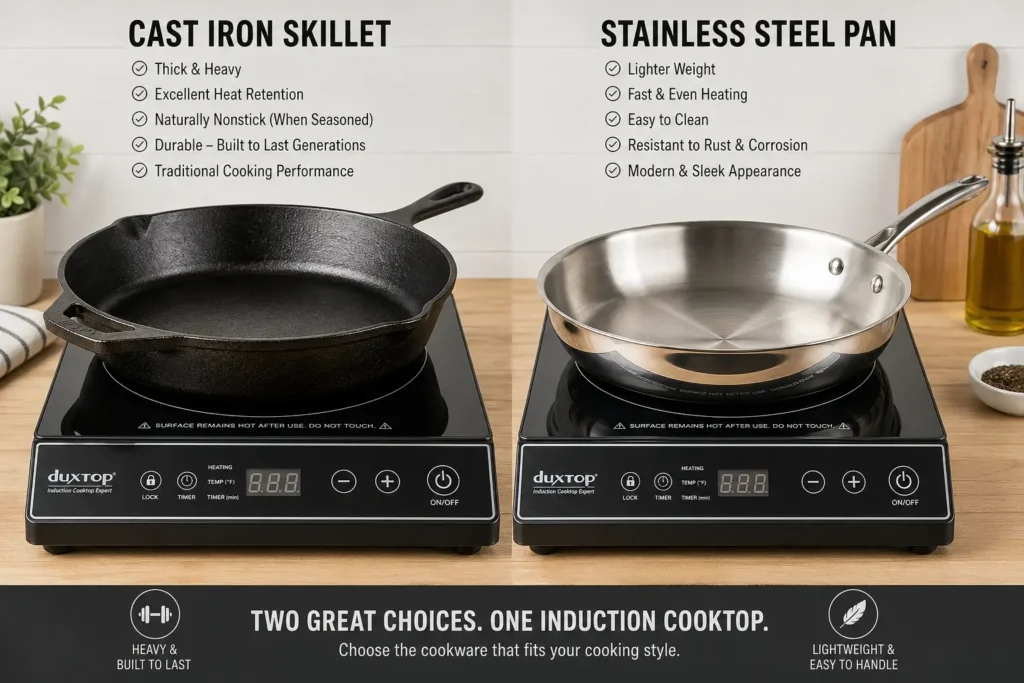
This comparison is more nuanced than a simple yes-or-no answer. Cast iron is often highly compatible with induction because it is strongly magnetic, and it can hold heat well for searing or stable cooking once hot. Stainless steel, when induction-compatible, may feel easier to lift, clean, and manage in everyday use. However, actual performance still depends on pan-bottom flatness, thickness, diameter, and quality of contact with the cooktop surface.
This is why some users report slightly different experiences even on the same cooktop. The cooking vessel is not a passive accessory in induction—it is part of the heating system itself.
What Is the Magnet Test and Why Does Pan-Bottom Design Affect Induction Performance?
The magnet test is a quick compatibility check in which a magnet is placed on the bottom of the cookware to see whether the pan can work on induction.
To explain the concept further, Duxtop’s official site and related guidance recommend the magnet test because induction depends on a magnetic connection between the cooktop’s field and the cookware base. If the magnet sticks well, the pan is usually suitable. Pan-bottom design then affects performance because a flatter, well-constructed base tends to make better contact, heat more evenly, and behave more predictably than a warped or poorly matched bottom. That is why two compatible pans can still perform differently on the same burner