

The best induction cooktops reviewed by experts in 2026 include top-rated models from Bosch, GE Profile, Frigidaire, Thermador, and KitchenAid — each evaluated for heating performance, safety features, ease of cleaning, brand reliability, and overall value. These models stand out because they deliver fast, precise, and energy-efficient cooking that gas and traditional electric cooktops simply cannot match. More importantly, every home chef — whether a first-time buyer or a seasoned kitchen enthusiast — will find a model in this guide tailored to their cooking style and budget.
Understanding what separates a good induction cooktop from a great one starts with knowing how the technology actually works. Induction cooktops use electromagnetic fields to heat cookware directly, skipping the inefficient step of heating a burner surface first. This translates to faster boil times, more precise temperature control, and a cooler, safer kitchen surface — three core advantages that have driven a surge in adoption among home cooks worldwide.
Beyond performance, choosing the right induction cooktop also depends on matching key features to your kitchen reality: the size of your countertop, your cookware collection, your cooking habits, and your budget. Knowing which attributes matter most — from burner zones and wattage to smart connectivity and power-sharing technology — makes the difference between a satisfying upgrade and a costly mismatch.
If you already know you want induction, skip ahead to the model reviews. If you’re still deciding, the next two sections will answer the question most buyers get wrong: not “which model is best” but “which model is best for your kitchen right now.”
What Is an Induction Cooktop and How Does It Work?
An induction cooktop is a type of electric cooking surface that uses electromagnetic induction — a process where alternating current passes through a copper coil beneath the glass surface, generating a magnetic field that directly excites iron molecules in compatible cookware to produce heat. Unlike gas burners or radiant electric coils, the cooktop surface itself never becomes the heat source; only the pot or pan heats up.
Specifically, this means that when you place a magnetic pan on an induction zone and activate it, heat is generated inside the cookware itself within seconds — not transferred from a hot element through glass or air. The result is a cooking surface that responds almost instantaneously to power adjustments and loses virtually no energy to the surrounding environment. According to the U.S. Department of Energy, induction cooking is approximately 84% energy efficient, compared to 74% for standard electric and just 40% for gas, making it the most thermally efficient domestic cooking technology available.
Induction cooktop overview and guide
Are Induction Cooktops Worth Buying for Home Kitchens?
Yes, induction cooktops are absolutely worth buying for home kitchens for at least three compelling reasons: superior energy efficiency, faster cooking speed, and significantly improved safety compared to gas and standard electric alternatives.
To expand on why these benefits matter in a real kitchen context: the energy efficiency advantage translates directly to lower electricity bills over time, especially for households that cook daily. The speed advantage is tangible — a high-powered induction burner rated at 3,700 watts with a boost function can bring six quarts of water to a rolling boil in under six minutes, compared to roughly nine to twelve minutes on a standard gas burner. The safety advantage is perhaps the most underappreciated: because the glass surface only warms slightly from residual pan heat (not from direct heating elements), the risk of accidental burns is dramatically reduced — particularly important for households with children.
On the cost side, induction cooktops do carry a higher upfront price than comparable gas or electric models. A quality 30-inch induction cooktop typically runs between $800 and $2,500, while a comparable gas cooktop may cost $400 to $1,200. However, when long-term energy savings, reduced maintenance, and lower kitchen cooling costs (since induction generates far less ambient heat) are factored in, the total cost of ownership over five to eight years often favors induction.
What Types of Cookware Are Compatible with Induction Cooktops?
Induction cooktops are compatible with four main categories of cookware: magnetic stainless steel, cast iron, enameled cast iron, and carbon steel — all of which contain enough ferromagnetic material to respond to the electromagnetic field beneath the cooktop surface.
The fastest compatibility test is the magnet test: hold a standard refrigerator magnet to the bottom of your pan. If it sticks firmly, your cookware will work on induction. If it slides or doesn’t adhere, it won’t. Cookware that is incompatible with induction includes pure aluminum, copper, standard glass, and non-magnetic stainless steel alloys — all of which are commonly found in older kitchen collections.

One important nuance: some cookware is labeled “induction-ready” but performs poorly because the ferromagnetic layer on the base is too thin or inconsistently applied. For best results, look for cookware with a fully clad magnetic base at least 2–3mm thick, which ensures even heat distribution across the entire cooking zone rather than concentrated heat in the center of the pan.
What Are the Key Features to Look for in Induction Cooktop Reviews?
There are five key features every home chef should evaluate when reading induction cooktop reviews: heating performance, number of burner zones, temperature control precision, safety features, and ease of cleaning — and each of these attributes varies significantly across price tiers and brands.
Understanding each feature before reading product-specific reviews helps you cut through marketing language and focus on what actually affects your cooking experience. Here is a breakdown of each attribute and what the numbers mean in practice.
How Do Heating Performance and Boil Speed Compare Across Models?
Induction cooktops excel in heating performance, with the best models delivering rapid boil times and steady, precise simmering — but actual performance varies considerably by wattage, zone design, and whether the model includes a power boost function.
The industry benchmark used by Consumer Reports and other independent labs is time to boil six quarts of water from cold. Entry-level models rated at 1,800–2,200 watts typically achieve this in 10–14 minutes. Mid-range models operating at 3,000–3,200 watts achieve the same in 7–9 minutes. Premium models with a power boost function capable of briefly surging to 3,600–4,600 watts can hit the same benchmark in five to six minutes — a meaningful difference during a busy weeknight dinner.
Equally important is low-heat performance. Many induction cooktops perform well at high power but struggle to maintain a true simmer without cycling on and off — producing uneven results when melting chocolate, cooking delicate sauces, or holding a stock at a gentle bubble. When reading reviews, look specifically for comments on low-heat consistency, not just boil speed.
Which Safety Features Should Every Induction Cooktop Have?
Yes, induction cooktops are fundamentally safer than gas alternatives — and the best models reinforce that advantage with a suite of built-in safety features that every home chef should expect as standard.
The following safety features should be present on any induction cooktop you seriously consider:
- Child lock / control lock: Prevents accidental activation of burners or changes to heat settings while cooking is in progress
- Auto shut-off: Automatically powers down a zone after a set period of inactivity, or if a pan is removed from the surface
- Residual heat indicator: Alerts you (via LED display or icon) when a zone is still warm enough to cause burns even after being turned off — critical since the glass surface doesn’t visually glow red like an electric coil
- Pan detection lock: Prevents a zone from activating power if no compatible cookware is detected on the surface
- Overheat protection: Automatically reduces or cuts power if internal components or the glass surface reach unsafe temperatures

Among these, the residual heat indicator is the single most important safety feature for everyday use, particularly in households with children or elderly family members. Consumer Reports consistently rates cooktops without a clear, bright residual heat indicator lower on their safety assessment, regardless of other performance scores.
Are Induction Cooktops Easy to Clean Compared to Other Cooktop Types?
Yes, induction cooktops are significantly easier to clean than gas or coil electric alternatives, primarily because the smooth ceramic glass surface has no raised grates, drip bowls, or exposed heating elements that trap food debris.
In comparison: gas cooktops require removing and soaking cast-iron grates, cleaning burner caps, and scrubbing around raised flame ports — a process that can take 20–30 minutes after a messy cooking session. Coil electric cooktops require lifting the coils, removing drip pans, and cleaning the cavity beneath — similarly time-consuming. An induction cooktop, by contrast, can typically be wiped clean with a damp cloth in under two minutes for everyday spills, since the surface itself doesn’t get hot enough to bake food residue onto the glass.
For tougher, burnt-on spills, a ceramic cooktop cleaner and a non-abrasive scrubbing pad are recommended. Avoid steel wool or abrasive powders, which can permanently scratch the glass and, in severe cases, compromise the integrity of the surface. One practical tip: wipe spills while the surface is still slightly warm (not hot) — residue comes off far more easily before it fully cools and hardens.
What Are the Best Induction Cooktops Reviewed by Experts in 2026?
The best induction cooktops reviewed by experts in 2026 are the Bosch Benchmark Series, GE Profile PHP9030, Thermador CIT30YWBB, Frigidaire FFIC3026TB, and KitchenAid KICU509X — each earning high marks across independent lab tests for heating performance, brand reliability, and overall value delivered to home chefs.
Below, each recommended model is evaluated across four dimensions: core specifications, key strengths, notable trade-offs, and ideal buyer profile — giving you everything you need to match a model to your kitchen and cooking habits.
Which Induction Cooktops Are Best for Performance and Reliability?
The Bosch Benchmark Series and GE Profile PHP9030 lead the performance and reliability category, with Bosch dominating on service reliability and GE excelling on smart cooking integration — making them the top choices for home chefs who cook frequently and demand consistent results.
Bosch Benchmark NITP669SUC (30-inch)
According to Yale Appliance, which tracks service data from over 37,000 annual service calls, Bosch Benchmark induction cooktops maintain an industry-leading service rate of just 1.7% — meaning fewer than 2 in 100 units require a service call within the first few years of ownership. This is the lowest failure rate among all induction cooktop brands tracked by Yale.
| Specification | Detail |
|---|---|
| Number of Zones | 5 (including FlexInduction zone) |
| Max Wattage (Boost) | 3,600W per zone |
| Control Type | Touch slider with digital display |
| Smart Features | Home Connect WiFi |
| Price Range | $1,900–$2,300 |
The table above summarizes the core technical specifications of the Bosch Benchmark NITP669SUC, showing the zone count, maximum boost wattage, control interface type, smart connectivity option, and typical retail price range.
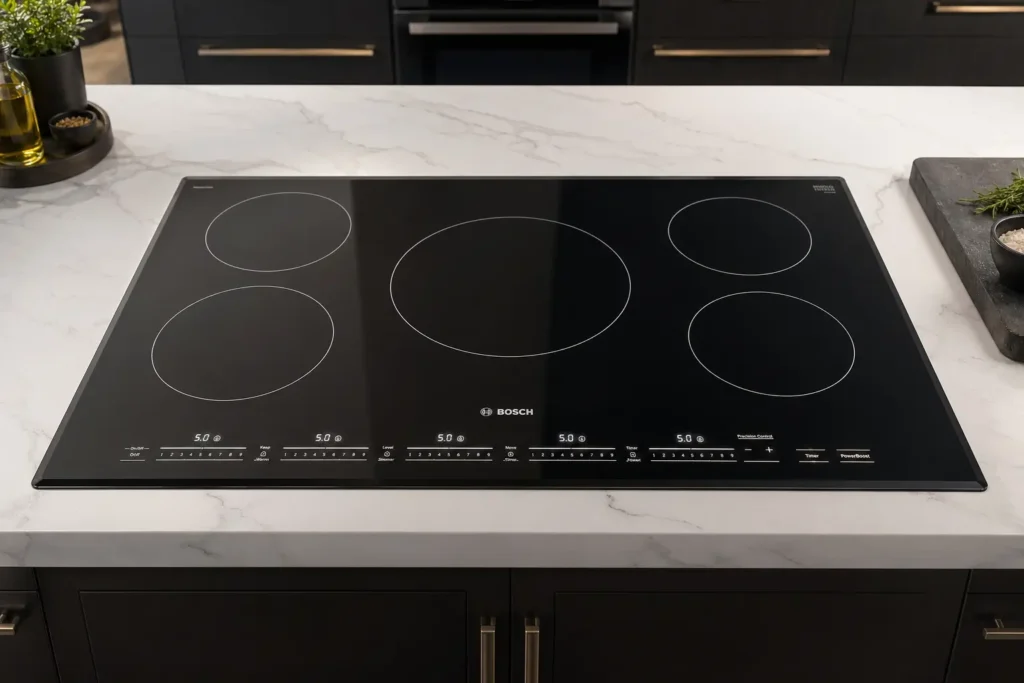
The standout feature on the Bosch Benchmark is the FlexInduction zone — a large combined zone on the left side of the cooktop that automatically detects and adjusts to pans of any size or shape placed within that area, including griddles and fish kettles. This eliminates the mismatch problem between pan size and fixed burner zone diameter that plagues many competing models. The primary trade-off: Bosch Benchmark models carry a premium price and have a longer lead time for parts if service is needed outside major metro areas.
Ideal for: Home chefs who cook five or more nights per week, value long-term reliability over cutting-edge features, and want a cooktop that performs consistently for eight to ten years without service issues.
Bosch induction cooktop reviewGE Profile PHP9030DJBB (30-inch)
The GE Profile PHP9030 earns its place in the top tier through its SyncBurners technology — which allows two adjacent zones to be bridged and operated as a single large cooking surface for griddles or roasting pans — and its Chef Connect feature, which automatically syncs the cooktop with a compatible GE over-the-range microwave to activate ventilation when cooking begins.
| Specification | Detail |
|---|---|
| Number of Zones | 4 (bridgeable to 2 large zones) |
| Max Wattage (Boost) | 3,700W |
| Control Type | Touch digital with knob assist |
| Smart Features | Chef Connect, WiFi |
| Price Range | $1,400–$1,800 |
This table presents the GE Profile PHP9030’s specifications side-by-side for quick comparison: its zone configuration, maximum boost output, dual-mode control design, smart home integration capabilities, and price positioning relative to the Bosch Benchmark above.
The combination of knob-style controls and touch digital inputs is a design choice that many home cooks prefer over pure touch-only interfaces — knobs provide tactile feedback and are easier to adjust while multitasking in the kitchen. The trade-off: GE’s service reliability rate, while solid at approximately 6–8% according to Yale Appliance data, is higher than Bosch Benchmark’s.
Ideal for: Home chefs who want smart kitchen integration, frequently cook large-format proteins (roasts, whole fish, large griddle breakfasts), and prefer a more intuitive hybrid control interface.
GE Profile induction cooktop reviewThermador CIT30YWBB Masterpiece Series (30-inch)
The Thermador Masterpiece earns its premium positioning through the Star Burner heating element design — a proprietary star-shaped induction coil configuration that Thermador claims provides 20% more even heat distribution across the cooking zone compared to standard circular coil designs. Independent tests by Reviewed.com have found the Thermador performs particularly well in low-heat precision tasks like tempering chocolate and holding beurre blanc, where even minor temperature cycling causes product failure.
| Specification | Detail |
|---|---|
| Number of Zones | 4 (including 1 PowerPlus® zone) |
| Max Wattage (Boost) | 4,600W (PowerPlus zone) |
| Control Type | Touch with LED display |
| Smart Features | Home Connect compatible |
| Price Range | $2,200–$2,800 |
This table outlines the Thermador Masterpiece’s key specifications, highlighting the PowerPlus zone’s exceptional 4,600W boost capacity — the highest among the models reviewed here — alongside its price positioning at the premium end of the 30-inch induction cooktop market.
Ideal for: Serious home chefs, culinary enthusiasts, and those who frequently tackle technically demanding recipes where precision at both high and low heat settings is non-negotiable.
Thermador induction cooktop reviewWhat Are the Best Budget-Friendly Induction Cooktops Worth Buying?
The Frigidaire FFIC3026TB and KitchenAid KICU509X are the best budget-friendly induction cooktops worth buying in 2025 — both delivering essential induction performance and safety features at price points well below the premium tier, without requiring significant compromises on everyday cooking quality.
Frigidaire FFIC3026TB (30-inch)
The Frigidaire FFIC3026TB is the most recommended entry-level induction cooktop for first-time buyers, earning consistent praise in consumer reviews for its True Temp Melt and Hold function — a precise low-wattage setting that maintains temperatures low enough to melt butter, chocolate, or wax without scorching. This feature addresses one of the most common complaints about budget induction cooktops: excessive low-end temperature cycling.
| Specification | Detail |
|---|---|
| Number of Zones | 4 |
| Max Wattage | 3,000W (largest zone) |
| Control Type | Touch digital |
| Price Range | $700–$950 |
The table above summarizes the Frigidaire FFIC3026TB’s specification profile, illustrating how it delivers a 3,000W maximum wattage and four-zone layout at a price point roughly half that of the Bosch Benchmark reviewed above.
The primary limitation of the Frigidaire is its auto-sizing induction zones: the cooktop is designed to detect pan placement and adjust the active heating area accordingly, but multiple long-term user reviews — including a detailed three-year assessment published on Pitmaster Club — have noted that the auto-sizing function does not always perform as advertised, sometimes heating only the central coil rather than the full zone diameter. This is worth understanding before purchase, particularly for cooks who use pans larger than 10 inches regularly.
Ideal for: First-time induction buyers, renters upgrading from an older electric cooktop on a limited budget, or households that cook moderate volumes (three to four nights per week) and want to experience induction without a significant capital outlay.
Frigidaire induction cooktop reviewKitchenAid KICU509XSS (30-inch)
The KitchenAid KICU509X occupies the mid-range price band and offers meaningful upgrades over the Frigidaire — most notably an 11-inch largest heating element (larger than most comparable models, which cap at 9–10 inches), 12 heat settings per zone for more granular temperature control, and a one-year parts and labor warranty backed by KitchenAid’s widely regarded customer service infrastructure.
| Specification | Detail |
|---|---|
| Number of Zones | 4 |
| Max Element Size | 11 inches (largest zone) |
| Heat Settings | 12 per zone |
| Warranty | 1 year (parts and labor) |
| Price Range | $1,100–$1,400 |
This table highlights the KitchenAid KICU509X’s differentiating specifications — particularly the 11-inch zone diameter and 12-step heat range — helping illustrate why it occupies the mid-range rather than the true budget tier, despite costing less than half the price of the premium Bosch and Thermador models.
Ideal for: Home chefs who have outgrown a basic induction cooktop or are upgrading from gas, want more cooking precision than entry-level models provide, and value brand support and warranty coverage.
KitchenAid induction cooktop reviewHow Do 30-Inch and 36-Inch Induction Cooktops Compare?
30-inch induction cooktops excel in versatility for standard households, while 36-inch models are optimized for high-volume cooking — and the right choice depends on your kitchen’s physical dimensions, your circuit capacity, and how many dishes you typically cook simultaneously.
Here is a direct comparison across the four most decision-relevant criteria:
| Criteria | 30-Inch Models | 36-Inch Models |
|---|---|---|
| Number of zones | Typically 4 | Typically 5 |
| Countertop cutout | ~28.5″ × 19.5″ | ~34.5″ × 19.5″ |
| Electrical requirement | 240V / 40–50 amp | 240V / 50–60 amp |
| Price range | $700–$2,800 | $1,500–$6,000+ |
| Best for | Families of 2–4, standard kitchens | Families of 4+, entertainers, open kitchens |
This comparison table contrasts 30-inch and 36-inch induction cooktops across five practical decision criteria — zone count, physical installation requirements, electrical circuit demands, price range, and ideal household profile — to help home chefs quickly identify which size class fits their kitchen.
One frequently overlooked consideration in the 30 vs. 36-inch decision is circuit capacity. Many existing residential kitchens wired for a standard 30-inch electric cooktop run on a 40-amp circuit. Upgrading to a 36-inch model often requires a licensed electrician to run a new 50–60 amp circuit — an additional cost of $300–$800 depending on panel proximity and local labor rates — that should be factored into the total budget before purchase.
- Duxtop induction cooktop review
- NuWave induction cooktop review
- Samsung induction cooktop review
- Wolf induction cooktop review
- Miele induction cooktop review
- Whirlpool induction cooktop review
- LG induction cooktop review
- Midea induction cooktop review
- Empava induction cooktop review
- IKEA induction cooktop review
- Copper Chef induction cooktop review
- JennAir induction cooktop review
- Gaggenau induction cooktop review
Which Induction Cooktop Is Right for Your Kitchen?
The right induction cooktop for your kitchen is the one that aligns with three factors simultaneously: your available countertop and electrical infrastructure, your typical cooking volume and complexity, and your total budget including installation — and no single model is the right answer for all home chefs.
The following decision framework, organized by buyer profile, summarizes the recommendations from this review into a practical selection guide.
| Buyer Profile | Recommended Model | Why It Fits |
|---|---|---|
| First-time buyer, limited budget | Frigidaire FFIC3026TB | Lowest entry cost, essential features, easy to learn |
| Mid-range buyer, wants more precision | KitchenAid KICU509X | Larger zones, 12 heat settings, solid warranty |
| Performance-focused, reliability priority | Bosch Benchmark NITP669SUC | Industry-lowest service rate, FlexZone, 10-year+ durability |
| Smart kitchen integrator | GE Profile PHP9030 | Chef Connect, SyncBurners, hybrid controls |
| Culinary enthusiast, precision cooking | Thermador CIT30YWBB | PowerPlus 4,600W, star-coil even heating, premium build |
| Large household or entertainer | Any 36-inch model (Bosch/GE) | 5 zones, bridge capability, maximum flexibility |
This decision table maps six distinct home chef buyer profiles to specific recommended models, summarizing the primary reason each model fits that profile — serving as a quick-reference guide after reading the full model reviews above.
Does Kitchen Size and Layout Affect Which Induction Cooktop You Should Buy?
Yes, kitchen size and layout directly affect which induction cooktop you should buy, because physical installation constraints — countertop cutout dimensions, cabinet clearances, and existing electrical circuit capacity — can eliminate certain models from consideration before performance factors even enter the picture.
Before purchasing, measure and confirm the following:
- Countertop cutout dimensions: Measure the existing cutout width and depth precisely. Most 30-inch models require approximately 28.5″ × 19.5″, but this varies by brand — always verify the specific model’s installation guide
- Cabinet depth: Standard base cabinets are 24 inches deep; most cooktops require a minimum 22–23 inch depth for the cooktop body plus wiring clearance below
- Circuit breaker capacity: Locate your home’s electrical panel and confirm the dedicated cooktop circuit’s amperage (typically stamped on the breaker). A 40-amp circuit supports most 30-inch models; 36-inch models generally require 50–60 amps
- Ventilation: Induction produces less airborne grease and combustion byproducts than gas, but adequate ventilation (a range hood rated for at least 400 CFM for a 30-inch cooktop) is still recommended for air quality and moisture control
Consulting a licensed electrician before finalizing your purchase — particularly if upgrading from gas or moving to a larger cooktop size — is strongly recommended. Electrical upgrades that are discovered after purchase can delay installation by weeks and add unexpected costs.
Are Expensive Induction Cooktops Really Better Than Mid-Range Models?
The honest answer: premium models earn their price tag in two situations — when you’re running four burners at once during a dinner party, and when you’re doing precision work like tempering chocolate or holding a beurre blanc. For everything else, a $1,400 GE Profile does the job.
The 1.7% vs 8% service rate gap between Bosch and mid-range brands is real. Over ten years, that’s the difference between a cooktop that just works and one you’ve called a technician about twice.
The real performance differences in premium models come down to four areas:
- Power boost ceiling: Premium models (Thermador, Bosch Benchmark) reach 4,600W boost output; mid-range models typically cap at 3,000–3,700W — meaningful for high-heat searing and rapid boiling, less relevant for everyday pasta or stir-fry
- Low-heat precision: Lab tests consistently show premium models maintain more stable temperatures at the lowest settings, with less cycling on/off — critical for tempering, fondue, or holding delicate sauces
- FlexZone / bridge capabilities: Premium models offer more flexibility in combining zones for large cookware — a genuine advantage for frequent entertainers, less relevant for daily family cooking
- Long-term reliability: Yale Appliance service data consistently shows Bosch Benchmark and Gaggenau (both Bosch Group brands) have 1.7–2.5% service rates, versus 6–10% for some mid-range and budget brands — a meaningful factor over a 10-year ownership horizon
The sweet spot for most home chefs — those cooking four to five nights per week across a range of recipes — sits squarely in the $1,400–$1,800 range: specifically, the GE Profile PHP9030 or KitchenAid KICU509X, both of which offer premium-adjacent performance without the premium-tier price tag or the wait for specialized parts if service is required.
Induction cooktop price guideHow Do Induction Cooktops Compare to Gas and Electric Alternatives?
Induction cooktops outperform gas on energy efficiency and safety, surpass radiant electric on speed and precision, but require compatible cookware and a higher upfront investment — making the comparison less about which technology is objectively “best” and more about which trade-offs align with your cooking priorities and kitchen infrastructure.
The antonym relationship between induction and gas cooking is foundational to understanding why induction has grown so rapidly in adoption: where gas relies on open-flame combustion, induction uses electromagnetic induction; where gas heats the air and surrounding cookware equally, induction heats only the cookware; where gas produces CO₂, NOₓ, and particulate matter as combustion byproducts, induction produces zero indoor emissions. These are not incremental differences — they represent fundamentally different relationships between the cooking surface and the food.
A 2020 study published in Environmental Science & Technology found that gas stoves leak methane even when turned off, contributing to indoor air quality degradation over time. A 2023 study from Stanford University estimated that cooking with gas indoors — even with ventilation — exposes household members to NO₂ levels exceeding EPA outdoor air quality standards during peak cooking periods. Induction eliminates this exposure pathway entirely.

The energy consumption benchmark comparison across cooktop types reinforces the efficiency case for induction: induction achieves approximately 84% thermal efficiency (energy transferred to food versus energy consumed), versus 74% for radiant electric and 32–40% for gas — a gap that compounds meaningfully over years of daily use.
Does Induction Cooking Produce EMF Radiation — Is It Safe?
Yes, induction cooktops do produce electromagnetic fields (EMF) during operation — but the levels measured at normal cooking distances are well within international safety guidelines and pose no documented health risk to the general population under standard use conditions.
The EMF produced by induction cooktops is classified as extremely low frequency (ELF-EMF), operating at 20–100 kHz. The International Commission on Non-Ionizing Radiation Protection (ICNIRP) sets public exposure limits at 1,000 µT (microtesla) for this frequency range. Induction cooktops, measured at a distance of 30 cm from the surface — approximately the distance from the cooking zone to a person’s torso while standing at a standard kitchen counter — typically emit 0.5–5 µT, according to measurements published by the European Commission’s Scientific Committee on Emerging and Newly Identified Health Risks (SCENIHR).
At 30 cm, even the highest-powered boost-mode induction zones remain well below 1% of the ICNIRP public exposure limit. The one population group for whom additional caution is sometimes recommended is individuals with implanted cardiac devices (pacemakers or ICDs), as some older implant models may be sensitive to strong localized EMF. Anyone with an implanted cardiac device should consult their cardiologist and the device manufacturer’s guidance before using an induction cooktop at close proximity.
What Is Power Sharing Technology and Why Does It Matter?
Power sharing technology is a system architecture built into multi-zone induction cooktops where the total available electrical power is distributed dynamically across all active cooking zones rather than being fixed per zone — and it matters because it determines how the cooktop behaves when you’re running multiple burners at high heat simultaneously.
Here is how power sharing works in practice: a 30-inch induction cooktop on a 240V/40-amp circuit has a maximum power draw of approximately 9,600 watts. If the cooktop has four zones each rated at 3,000W, the sum of all zones (12,000W) exceeds the circuit capacity. Without power sharing, the cooktop either limits each zone independently (restricting boost functions when multiple zones are active) or trips the circuit breaker when all zones are used at high power simultaneously.
With power sharing — as implemented on Bosch, Miele, and Gaggenau models — the cooktop intelligently allocates available wattage across zones based on real-time demand. If three zones are running at medium-low and one needs a boost, the system diverts available capacity to the boost zone without restricting the others unnecessarily. This is particularly beneficial during complex cooking sessions — holiday dinners, dinner parties, elaborate multi-course meals — where multiple pots are active simultaneously at varying heat requirements.
For home chefs who rarely run more than two burners simultaneously, power sharing provides limited practical benefit. For those who regularly cook four-burner meals, it is a genuinely valuable feature worth seeking out — and one that is rarely highlighted prominently in mainstream cooktop reviews.
Can Smart Induction Cooktops with WiFi Connectivity Actually Improve Cooking?
Yes, smart induction cooktops with WiFi connectivity can meaningfully improve cooking in specific use cases — but the value of smart features is highly dependent on how you cook and whether you use a compatible smart home ecosystem, making them a useful bonus rather than a reason alone to choose a model.
The smart features currently available on connected induction cooktops fall into three practical categories:
Remote monitoring and control: Apps like Bosch’s Home Connect and GE’s SmartHQ allow you to monitor cooktop status from another room, adjust heat levels, and receive alerts when a zone has been left on. For cooks who frequently move between kitchen and living areas during long simmer sessions, this is genuinely useful — particularly the “zone still active” alert, which functions as a secondary safety net beyond the auto shut-off timer.
Recipe-guided cooking modes: Some models, including the GE Profile series, offer integration with recipe apps that automatically adjust cooking zone temperatures based on recipe steps — essentially guided cooking where the cooktop follows a preset temperature curve. In practice, this feature works best for standardized recipes and less well for intuitive or freestyle cooking. Early adopter reviews are mixed: users who follow recipes closely find it helpful; experienced cooks generally find it restrictive.
Smart home integration: Connecting your cooktop to a broader smart home platform (Google Home, Amazon Alexa, Apple HomeKit) enables voice control of basic functions and creates automation possibilities — for example, triggering the range hood fan when a cooktop zone activates. This is a genuine quality-of-life improvement for smart home enthusiasts, but adds no functional value for cooks who don’t operate within that ecosystem.
The honest assessment: WiFi-enabled induction cooktops from Bosch and GE Profile are the market leaders in smart functionality, and both execute it well. However, these smart features should be evaluated as an enhancement to an already strong cooktop — not as a primary purchase driver. A model with outstanding heating performance and proven reliability will serve you better over a decade than a smart-featured model with mediocre burner performance and higher service rates.
Choosing the right induction cooktop ultimately comes down to honest self-assessment: how often you cook, how many burners you need simultaneously, what your kitchen can physically and electrically accommodate, and how much long-term reliability matters relative to upfront cost. The models reviewed here — from the budget-accessible Frigidaire FFIC3026TB to the precision-focused Thermador Masterpiece — represent the strongest options across every tier of the 2025 market.
One last thing worth saying: the best induction cooktop is usually the one you actually install. Don’t let the perfect be the enemy of the good here. The Frigidaire at $800 and the Bosch at $2,200 are both dramatically better than the gas range they’re replacing — in speed, in safety, in cleanup time every single night.
Pick the one your kitchen can support electrically, your budget can support financially, and your cookware can support magnetically. That’s the one.