

Choosing the best LG induction cooktop means selecting the right electromagnetic burner that delivers faster boiling, precise heat control, and a safer cooking surface for your kitchen. LG currently offers two primary series — the LG Smart Series and the LG STUDIO Series — spanning 30-inch and 36-inch widths, with 4 to 5 burners and power outputs ranging from 4,300W to 6,000W. Whether you are upgrading from a gas stovetop or replacing an older electric radiant unit, LG’s induction lineup stands out as a top-tier choice backed by expert reviews and real-world user satisfaction. For a complete overview, see induction cooktop brand reviews.
Understanding what an LG induction cooktop actually is — and how electromagnetic energy replaces open flames and traditional coils — forms the foundation for making a confident purchase decision. Unlike conventional electric or gas cooktops, LG’s induction technology transfers heat directly into your cookware through copper coils beneath a smooth ceramic glass surface, leaving the surrounding area cool to the touch. This fundamental design difference explains why induction delivers faster results with greater safety.
Knowing which model fits your countertop size and cooking habits is equally critical. LG offers distinct options for 30-inch and 36-inch installations, and the differences between models go far beyond size — they include UltraHeat™ wattage, Flex Cooking Zone availability, SmoothTouch® vs. LCD display controls, and ThinQ® smart app integration. Each feature directly impacts how you cook every day.
LG makes genuinely good induction cooktops. The UltraHeat™ elements are powerful, the Flex Zone works as advertised, and the ThinQ app integration is one of the better smart appliance implementations on the market. That said, this isn’t a sponsored post. LG has real competitors — Bosch has better service reliability data, GE has stronger baking performance per Consumer Reports, and Frigidaire undercuts LG significantly on price for comparable zone counts. Whether LG is right for your kitchen depends on what you actually need.
What Is an LG Induction Cooktop and How Does It Work?
An LG induction cooktop is an electric cooking appliance that uses electromagnetic energy generated by copper coils beneath a ceramic glass surface to heat cookware directly, without warming the surrounding cooktop area. This core principle — heating only the pot or pan, not the surface — makes LG induction fundamentally different from both gas burners and traditional electric radiant cooktops.
To understand why this matters, it helps to look at exactly what happens when you place a compatible pan on an LG induction burner. The moment the cookware makes contact with the glass surface, an alternating magnetic field produced by the copper coil beneath induces an electrical current inside the ferromagnetic base of the pan. That current generates heat inside the pan itself — not from an external flame or glowing coil. The result is near-instant heat response and extraordinary precision across every power level.
The practical consequences of this technology are significant. Because the cooktop surface itself never becomes the heat source, the glass surrounding your pan stays relatively cool during cooking. Spilled sauce does not bake onto a scorching surface, because there is no scorching surface to speak of. This also means that accidental contact with the cooktop — by a child’s hand or a stray kitchen towel — carries far lower burn risk than gas or electric alternatives.
Samsung induction cooktop review Whirlpool induction cooktop reviewWhat Types of Cookware Are Compatible with LG Induction Cooktops?
LG induction cooktops are compatible with cookware made from ferromagnetic materials, meaning pots and pans whose bases contain iron or magnetic stainless steel. The most common compatible materials include cast iron, enameled cast iron, magnetic stainless steel, and certain carbon steel cookware. Aluminum, copper, glass, and non-magnetic stainless steel will not work on an induction surface because they do not respond to magnetic fields.
The simplest compatibility test requires nothing more than a household magnet. If the magnet sticks firmly to the bottom of your pan, that pan will work on any LG induction cooktop. LG itself confirms this test across its product documentation for models including the CBIH3013BE, CBIH3617BE, and the CBIS3618BE STUDIO series. Many modern cookware brands now label their products as “induction-ready,” making shopping easier for first-time induction buyers.
It is worth noting that cookware with warped or uneven bases may perform less efficiently on induction, since consistent contact between the flat ceramic surface and the pan base is important for optimal heat transfer. Flat-bottomed, heavy-gauge pans — particularly cast iron and tri-ply stainless — tend to deliver the best performance on LG induction elements.
How to check if cookware is induction compatibleIs an LG Induction Cooktop Safer Than a Gas Stovetop?
Yes, an LG induction cooktop is safer than a gas stovetop in three critical ways: no open flame, a cooler cooking surface, and automatic shut-off when cookware is removed. Each of these features directly reduces the most common kitchen hazards associated with gas cooking.
Gas stovetops rely on an open flame that can ignite nearby materials, leak unburned gas if a burner fails to light, and remain dangerous even after the knob is turned off if the gas valve does not fully close. LG induction eliminates all of these risks because there is no combustion involved at any stage. The energy source is electrical, the heat is contained within the pan, and the cooktop surface around the active burner remains cool enough that accidental contact causes minimal harm.

LG’s induction models also include a Control Lock feature that prevents unintended activation — a particularly important safety feature in households with young children. According to LG’s product specifications for models like the CBIH3013BE and CBIH3617BE, the control lock prevents any burner from being switched on unless the lock is deliberately disengaged. Combined with the cool-touch surface and absence of gas lines, LG induction cooktops represent a measurably safer cooking environment than any open-flame alternative.
How to install an induction cooktopWhat Are the Best LG Induction Cooktop Models to Choose From?
LG offers six primary induction cooktop models organized across two series — the LG Smart Series and the LG STUDIO Series — available in 30-inch and 36-inch widths, with 4 or 5 burners and wattage ranging from 4,300W to 6,000W. The table below summarizes the key specifications across the main lineup to help you identify the right fit before diving into individual model comparisons.
| Model | Series | Width | Burners | Max Wattage | Controls | Flex Zone | Smart (ThinQ) |
|---|---|---|---|---|---|---|---|
| CBIH3013BE | Smart | 30″ | 4 | 4,300W | SmoothTouch® | No | Yes |
| CBIH3017BE | Smart | 30″ | 4 | 5,000W | Backlit SmoothTouch® | Yes | Yes |
| CBIS3018BE | STUDIO | 30″ | 4 | 5,000W | LCD 7″ | Yes | Yes |
| CBIH3613BE | Smart | 36″ | 5 | 4,300W | SmoothTouch® | No | Yes |
| CBIH3617BE | Smart | 36″ | 5 | 5,000W | Backlit SmoothTouch® | Yes | Yes |
| CBIS3618BE | STUDIO | 36″ | 5 | 6,000W | LCD 7″ | Yes | Yes |
The table above maps each model by series, cooktop width, burner count, peak UltraHeat™ wattage, control type, Flex Zone availability, and ThinQ® smart connectivity — the six factors most relevant to purchasing decisions.
Which LG Induction Cooktop Is Best for a 30-Inch Countertop?
For a 30-inch countertop installation, LG offers three models — the CBIH3013BE, CBIH3017BE, and CBIS3018BE — all featuring four burners but differing meaningfully in wattage, control style, and cooking zone flexibility.
CBIH3013BE (Smart, 30″) is the entry-level 30-inch Smart model. It features four induction elements, a 4,300W UltraHeat™ power element, and front-facing SmoothTouch® glass controls. The controls appear hidden when the cooktop is off, giving a clean, minimalist look to any countertop. This model does not include a Flex Cooking Zone, making it best suited for households that primarily cook with standard round pots and pans and want a straightforward, reliable induction experience at a more accessible price point.
CBIH3017BE (Smart, 30″) steps up with a more powerful 5,000W UltraHeat™ element and adds the Flex Cooking Zone, which combines the two left-side burners into a single continuous cooking surface. This configuration accommodates griddles, fish pans, and elongated cookware that would not sit evenly on a single round element. The backlit LED SmoothTouch® controls improve visibility in dimly lit kitchens. This model is the better choice for home cooks who frequently use non-standard cookware shapes or want the additional power headroom for large-batch cooking.
CBIS3018BE (STUDIO, 30″) brings LG’s premium design language to the 30-inch format. The 7-inch LCD color touchscreen replaces the standard glass touch controls, offering a more intuitive and visually rich interface. The dual center element operates at 5,000W and supports Flex Zone functionality. The STUDIO designation also signals premium materials and a design-forward aesthetic with a more refined finish. This model suits buyers who want the best-looking and most feature-rich 30-inch cooktop LG produces, and who are willing to invest in the premium tier.
Best 30-inch induction cooktopsWhich LG Induction Cooktop Is Best for a 36-Inch Countertop?
For a 36-inch installation, LG offers three models — the CBIH3613BE, CBIH3617BE, and CBIS3618BE — all featuring five burners, with escalating power and feature sets across each tier.
CBIH3613BE (Smart, 36″) provides five induction elements with a 4,300W UltraHeat™ center element and SmoothTouch® glass controls. Like its 30-inch Smart counterpart, it does not include a Flex Cooking Zone, but the addition of a fifth burner gives substantially more simultaneous cooking capacity than any 30-inch model. This is the right choice for larger households that cook multiple dishes at once and want a capable five-burner cooktop without the added cost of STUDIO-tier features.
CBIH3617BE (Smart, 36″) upgrades to a 5,000W UltraHeat™ element and includes the Flex Cooking Zone, combining the two left elements into a continuous cooking area. The backlit LED controls provide excellent visibility, and ThinQ® connectivity enables remote monitoring and smart hood synchronization. For most buyers looking at 36-inch models, the CBIH3617BE represents the best balance of performance, features, and value within the Smart Series.
CBIS3618BE (STUDIO, 36″) is LG’s flagship induction cooktop — and arguably its most impressive. The dual center element reaches 6,000W, making it one of the most powerful residential induction burners on the market. The 7-inch LCD display provides full-color touch controls with precise feedback, and the STUDIO finish elevates the visual design of any kitchen. With the Flex Cooking Zone active on both left elements, this model can accommodate an extraordinary range of cookware simultaneously. It is the definitive choice for serious home cooks, entertainers, and anyone building a premium kitchen around LG appliances.
LG Smart Series vs. LG STUDIO Series: Which One Should You Choose?
The LG Smart Series wins on value and practicality, while the LG STUDIO Series leads on power, design, and premium features — making the right choice dependent on your budget and kitchen priorities.
The Smart Series, including models like the CBIH3017BE and CBIH3617BE, delivers excellent induction performance through LG’s proven UltraHeat™ technology, backlit SmoothTouch® controls, and ThinQ® smart connectivity. The controls have a distinctive design quality of their own — appearing completely invisible when the cooktop is off, creating a sleek, uncluttered surface. For most households, the Smart Series provides every feature needed for exceptional daily cooking without the premium price associated with the STUDIO line.
The STUDIO Series differentiates itself in three meaningful ways. First, the 6,000W dual center element on the 36-inch CBIS3618BE delivers noticeably faster boiling and searing capability than any Smart Series model. Second, the 7-inch LCD color display offers a more intuitive and visually engaging control experience — particularly useful when managing multiple burners with different power levels simultaneously. Third, the STUDIO aesthetic, including premium materials and a more refined overall finish, is designed to serve as a visual centerpiece in upscale kitchen designs.
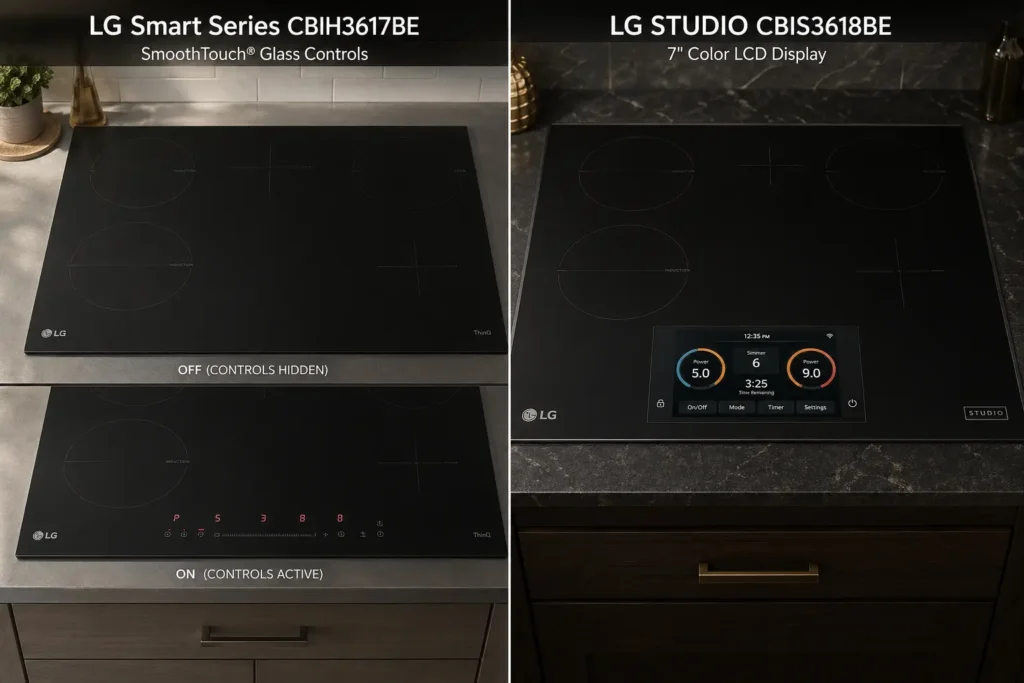
For most kitchens: CBIH3017BE (30″) or CBIH3617BE (36″). Flex Zone, 5,000W boost, backlit controls, ThinQ. That’s everything the majority of home cooks need. The STUDIO upgrade buys you a 7-inch LCD and 6,000W on the flagship 36″ model. If you’re building around LG appliances and want the kitchen to look the part, it’s worth it. If you just want to cook well, the Smart Series does the job at a lower price.
How Do LG Induction Cooktops Deliver Faster Cooking Performance?
LG induction cooktops deliver faster cooking performance primarily through the UltraHeat™ element, which reaches up to 6,000W and transfers electromagnetic energy directly into cookware — eliminating the heat-up delay inherent in gas burners and electric radiant coils. The result is water boiling faster, oil reaching searing temperature more quickly, and precise simmering achieved with less waiting and less guesswork.

The physics behind this speed advantage are straightforward. In a gas or electric radiant system, the heat source must first raise the temperature of either a metal coil or the cookware bottom through contact conduction. In LG’s induction system, the magnetic field induces current inside the cookware itself, meaning the pan begins generating its own heat from the first moment of activation. There is no intermediate surface to heat up, and no energy wasted warming the surrounding air or cooktop glass.
Specifically, LG’s UltraHeat™ element — available at 4,300W, 5,000W, or 6,000W depending on the model — is calibrated to bring a standard pot of water to a rolling boil significantly faster than comparable gas burners. At the same time, the precision of electromagnetic control allows the same element to hold a delicate sauce at a true, steady simmer — a heat level notoriously difficult to maintain on high-output gas burners that tend to run hot even at their lowest settings.
The Flex Cooking Zone, available on the CBIH3017BE, CBIH3617BE, CBIS3018BE, and CBIS3618BE, adds another dimension of speed and flexibility. By combining two adjacent left-side elements into a single continuous induction zone, this feature allows a griddle or elongated pan to receive even, simultaneous heat across its full length — something that would require two separately managed burners on any other cooktop. For cooking tasks like searing a large cut of meat or making breakfast for multiple people simultaneously, the Flex Zone delivers a meaningful speed and convenience advantage.

According to LG’s product documentation, each Flex Zone element provides up to 3,700W of independent power, meaning both zones together can deliver up to 7,400W of combined electromagnetic output across the continuous cooking area.
Is LG a Reliable Brand for Induction Cooktops Compared to Other Brands?
LG gets strong marks in consumer satisfaction surveys and independent reviews — House Digest and Consumer Reports both rate it well. But “most recommended” isn’t the same as “most reliable,” and the distinction matters when you’re buying something that lives in your kitchen for a decade. The honest comparison: Bosch Benchmark has Yale Appliance’s lowest documented service rate at 1.7%. LG’s figures aren’t published at that level of specificity. LG is a solid choice — just don’t treat “5 out of 9 reviews liked it” as a reliability guarantee.
The data supporting LG’s leadership position is specific and credible. According to a 2025 analysis by House Digest, which examined customer reviews from Lowe’s, Home Depot, and Wayfair alongside expert evaluations, LG and Samsung emerged as the top expert choices for induction cooking appliances — with LG holding the edge by a clear margin in overall expert endorsements. Consumer Reports independently confirms that LG induction ranges perform consistently well in standardized tests measuring boil speed, simmer precision, and baking evenness.
Market behavior reflects this reputation. According to buying guide data compiled by StoveShield in early 2026, LG induction range searches increased 50% year-over-year, indicating that consumer trust and awareness of LG’s induction lineup are growing rapidly as more households transition away from gas cooking.
Compared to Samsung, LG holds an advantage in expert consensus and kitchen appliance-specific reputation, while Samsung remains competitive in feature sets and pricing. Both brands deliver strong ThinQ and SmartThings integration respectively, but LG’s UltraHeat™ technology and Flex Zone implementation have received more consistent praise across independent test environments.
Compared to GE and Frigidaire, LG operates at a higher technology tier. Frigidaire earns strong marks for customer satisfaction at accessible price points and is frequently recommended for budget-conscious buyers entering the induction market. GE profiles well in Consumer Reports testing for baking performance. However, neither brand matches LG’s breadth of smart features, design quality across both standard and premium tiers, or the UltraHeat™ power range that extends to 6,000W in the STUDIO Series.
For buyers considering long-term reliability, one important data point deserves attention: induction module replacements across all brands can cost $400 or more per element, making extended warranty coverage worth serious consideration regardless of which brand you choose. LG’s ThinQ UP feature — which delivers ongoing software updates and new features to connected cooktops — offers an additional layer of long-term value not available from most competing brands.
Induction cooktop price guideWhat Are the Hidden Trade-Offs of Switching to an LG Induction Cooktop?
Switching to an LG induction cooktop involves three primary trade-offs: cookware replacement costs, higher repair expenses per element, and a learning curve for heat level adjustment — none of which are dealbreakers, but all of which deserve consideration before purchasing.
The most immediate trade-off for many buyers is cookware compatibility. If your current kitchen relies heavily on aluminum, copper, or non-magnetic stainless steel pots and pans, those items will not function on any induction surface — LG or otherwise. Replacing a full cookware set with induction-compatible alternatives represents an upfront cost that should factor into your total budget calculation alongside the cooktop itself.
How Much Does It Cost to Repair an LG Induction Cooktop Element?
One thing worth saying plainly: if an induction module fails, replacement runs $400+ per element. That’s not unique to LG — it’s the cost of induction electronics generally. But it means an extended warranty is worth considering, especially on STUDIO-tier pricing.
The upside: induction cooktops have fewer failure points than gas. No igniters, no valves, no burner caps to corrode. With flat-bottomed compatible cookware and normal use, these units run 10–15 years in real-world reports — longer than LG’s official 7-year quote.
This repair cost reality has a practical implication for buyers: extended warranty coverage is worth serious consideration for any LG induction cooktop purchase, particularly for higher-end STUDIO models where the cooktop itself represents a significant investment. A multi-year extended warranty from LG or a retailer like Best Buy can cap out-of-pocket repair costs at a fraction of the per-element replacement price.
It is also worth noting that induction cooktops generally have fewer mechanical failure points than gas ranges — no igniter systems, no gas valves, no open-flame components to degrade over time. The induction module itself, when properly maintained and used with flat-bottomed compatible cookware, is designed for long-term reliability. LG officially quotes appliance lifespans in the 7-year range, while real-world user reports compiled by StoveShield in 2026 suggest 10 to 15 years with proper use and maintenance.
Does an LG Induction Cooktop Make Noise During Cooking?
Yes, LG induction cooktops can produce a low buzzing or humming sound at lower heat settings — a characteristic of electromagnetic induction technology that is present across most brands, not unique to LG. This noise originates from the alternating magnetic field interacting with the cookware base, causing microscopic vibrations in the metal that produce an audible hum.
Verified purchaser reviews on Best Buy for the LG CBIH3013BE note that “there is a buzzing noise at low heat levels which is a bit annoying” — describing it as a minor inconvenience rather than a significant functional problem. The noise level is generally low and becomes less noticeable as heat settings increase. In a typical kitchen environment with ambient background noise, most users do not find it disruptive during normal cooking.
Two practical steps help minimize this noise. First, using cookware with flat, heavy-gauge bases — particularly cast iron and multi-ply stainless steel — reduces vibration compared to thin-bottomed pans that flex more easily under the magnetic field. Second, slightly increasing the power level from the lowest setting often reduces the buzzing frequency, since the noise tends to peak at specific low-power resonance points.
Induction cooktop noise buzzing humming FAQHow Energy-Efficient Is an LG Induction Cooktop Compared to Gas?
LG induction cooktops are approximately three times more energy-efficient than gas stovetops and 5 to 10 percent more efficient than electric radiant cooktops, according to LG’s own technical specifications confirmed across the CBIH and CBIS model lines. This efficiency advantage stems directly from the fundamental principle of induction: heat is generated inside the cookware itself, meaning virtually no energy is lost warming the surrounding air, cooktop surface, or kitchen environment.
In practical terms, this efficiency gap translates to lower utility costs over time, particularly for households that cook frequently. A gas burner operating at 10,000 BTU converts a significant portion of that energy into ambient heat that warms the kitchen rather than the food. An LG induction element operating at equivalent output delivers nearly all of its energy directly into the pot — a measurably more efficient energy pathway that compounds into real savings across months and years of use.
This efficiency profile also aligns with broader shifts in residential energy standards. As more municipalities and building codes move toward reducing or eliminating gas appliances in new construction, induction cooktops are increasingly positioned as the forward-compatible cooking technology. LG’s investment in its induction lineup — and the 50% year-over-year growth in LG induction search interest documented in 2025-2026 — reflects both consumer awareness of these energy benefits and growing regulatory momentum behind electric cooking.
Can You Use an LG Induction Cooktop with ThinQ App for Smart Kitchen Integration?
Yes, all current LG induction cooktop models — including the full Smart Series and STUDIO Series — support the LG ThinQ® app, enabling remote monitoring, smart appliance synchronization, and ongoing feature updates via Wi-Fi connectivity. This integration positions LG induction cooktops as active participants in a connected kitchen ecosystem rather than standalone appliances.

The ThinQ app does two things that actually matter: it alerts you when a burner’s been left on, and it syncs with LG range hoods to auto-activate ventilation when you start cooking. Both are genuinely useful. Everything else — monitoring power levels from your phone, receiving “feature updates” — is nice to have but unlikely to change how you cook. Don’t choose a model primarily because of the app.
The ThinQ UP feature extends this value over time. Unlike conventional appliances that remain static after purchase, ThinQ UP-enabled LG cooktops receive software updates that can introduce new features and performance enhancements after the initial purchase. For buyers investing in a premium cooktop, this ongoing software support represents meaningful added value — ensuring that the appliance continues to improve rather than becoming technologically dated within a few years of purchase.