

When comparing Gaggenau, Miele, and Thermador on professional-grade performance, Gaggenau leads in surface freedom and precision control, Miele excels in long-term reliability and sensor intelligence, and Thermador delivers the best overall value within the luxury segment. These three German-engineered brands represent the absolute pinnacle of residential induction technology — yet they are built around fundamentally different philosophies of what “professional cooking” means in a private kitchen. For discerning home chefs, interior designers, and luxury homeowners, choosing between them is not simply a matter of specifications — it is a decision about how you cook, how you live, and how your kitchen reflects your identity. For a complete overview, see induction cooktop comparisons.
To make that decision with confidence, you first need to understand what “professional-grade performance” actually means as a measurable standard — not just a marketing claim. Specifically, the criteria that separate truly professional induction cooktops from merely expensive ones include: raw heating power, thermal precision, surface flexibility for multi-pan cooking, control intelligence, and build quality engineered for long-term demanding use.
Beyond raw performance, each brand distinguishes itself through a unique set of technological capabilities. Gaggenau’s full-surface zoneless induction, Miele’s TempControl sensor automation, and Thermador’s Freedom Induction platform each represent a different answer to the same fundamental question: how do you bring professional kitchen capability into a domestic space?
Finally, price alone does not determine which cooktop is right for you. Below, this article systematically compares all three brands across every dimension that matters — from power output and surface design to smart integration and long-term ownership costs — so you can identify which luxury induction hob genuinely delivers on its promise of professional-grade performance.
What Does “Professional-Grade Performance” Actually Mean in a Luxury Induction Cooktop?
“Professional-grade performance” in a luxury induction cooktop is defined by five measurable criteria: maximum power output (wattage), thermal precision across all heat levels, surface flexibility for simultaneous multi-cookware use, control intelligence, and build quality engineered for sustained high-demand cooking. These are not aesthetic descriptors — they are functional benchmarks borrowed directly from commercial kitchen standards.
To understand why this definition matters, consider the difference between how the term is used in marketing versus how it applies in practice. Many cooktops are marketed as “professional” simply because they feature stainless steel trim or a high price tag. True professional-grade performance, however, means the cooktop can sustain a rolling boil on a 10-liter stockpot while simultaneously holding a beurre blanc sauce at exactly 65°C on an adjacent pan — without either task compromising the other. That is the standard of a professional kitchen, and it demands both high wattage and granular heat precision working in concert.
Specifically, induction technology is uniquely suited to meeting this standard. Unlike traditional electric cooking, which heats the glass surface and transfers heat to the pan, induction uses electromagnetic energy to excite the ferrous metal in the cookware directly — making the pan itself the heating element. The result is a dramatic reduction in heat loss, faster response times when power is adjusted, and a cooler ambient surface that improves both safety and kitchen comfort. According to data cited by Yale Appliance, one of the United States’ most prominent luxury appliance retailers, induction cooktops respond to power changes roughly four times faster than traditional radiant electric surfaces — a characteristic that is foundational to professional-grade cooking performance.
Furthermore, the gap between a professional-grade induction cooktop and a standard one becomes most visible in two specific scenarios: high-heat searing, where maximum wattage determines how quickly a pan reaches Maillard reaction temperatures, and low-heat precision, where the number and granularity of power levels determines whether a delicate sauce can be held without scorching. Both Gaggenau and Miele offer 17 discrete power levels on their flagship models, while Thermador’s Freedom Induction operates with a similarly refined power management system. The distinction between brands emerges not in the number of levels, but in how intelligently each system manages those levels in real cooking conditions.
Thermador induction cooktop review Wolf induction cooktop reviewHow Do Gaggenau, Miele, and Thermador Compare in Heating Power and Precision?
Gaggenau leads on maximum per-element power output and cooking sensor intelligence, Miele excels in automated thermal precision through its TempControl technology, and Thermador delivers competitive wattage with a strong booster function suited to high-volume home cooking.
Heating power and precision form the core of any professional-grade performance claim. To evaluate them meaningfully across these three brands, it is necessary to look at both peak output and sustained performance — because a cooktop that reaches high temperatures quickly but cannot hold a precise low temperature is not truly professional in its capabilities.
Gaggenau induction cooktop reviewDoes Gaggenau Deliver More Power Than Miele on Its Full-Surface Induction?
Yes, Gaggenau’s full-surface induction delivers a higher maximum per-element power output than Miele’s comparable models, with the Gaggenau CX 480 and CX 490 series reaching up to 5.5 kW on large cookware elements, supported by individual booster functions for both pots and pans. This gives Gaggenau a measurable advantage in high-heat tasks such as rapid boiling, deep-frying, and searing large cuts of protein.
However, raw wattage is only one dimension of the comparison. Miele’s flagship induction cooktops counter with TempControl — a cooking sensor integrated directly into the cooking zones that continuously monitors pan temperature and automatically adjusts the power level to prevent overheating. In practical terms, this means Miele achieves a form of automated precision that reduces the margin for human error, particularly in delicate preparations such as tempering chocolate, reducing stocks, or holding hollandaise sauce at a stable temperature. Where Gaggenau gives the chef maximum manual control across 17 power levels, Miele partially automates the precision loop on behalf of the cook.
In terms of low-heat performance, Gaggenau’s cooking sensor function — available on the 400 Series — similarly monitors pot temperature and adjusts output to prevent boiling over, addressing the same use case as Miele’s TempControl from a slightly different technological approach. The key distinction is that Gaggenau’s system is opt-in and cook-directed, while Miele’s TempControl activates more automatically as part of the zone’s default behavior.

| Criterion | Gaggenau | Miele | Thermador |
|---|---|---|---|
| Max power per element | Up to 5.5 kW | Up to 4.4–5.0 kW | Up to 4.6 kW (Power Boost) |
| Power levels | 17 | 17 | Variable (Freedom platform) |
| Precision sensor | Cooking sensor (opt-in) | TempControl (automated) | Auto pan detection |
| Booster function | Yes (pots + pans) | Yes | Yes (Power Boost) |
The table above compares peak heating power and precision control features across all three flagship induction platforms.
Induction cooktop price guideIs Thermador Freedom Induction as Precise as Gaggenau’s Cooking Sensor Function?
Thermador’s Freedom Induction is comparably precise in pan detection and surface management, but it does not offer the same granular cooking sensor automation as Gaggenau’s system for temperature-critical preparations. Thermador’s primary technological strength lies in its automatic cookware recognition — the surface detects the position, size, and shape of any induction-compatible pan placed anywhere on the cooking area, and activates only the zones directly beneath the cookware. This eliminates the risk of accidentally heating empty surfaces and provides significant flexibility in pan placement.
However, Thermador’s precision model is fundamentally spatial rather than thermal. The Freedom platform manages where heat is applied with great sophistication, but it does not monitor pan temperature in real time the way Gaggenau’s cooking sensor or Miele’s TempControl does. For high-heat applications — rapid boiling, flash frying, wok-style cooking — Thermador’s Freedom Induction performs with full confidence. For precision low-heat applications requiring continuous temperature monitoring, Gaggenau and Miele’s sensor technologies offer an additional layer of assurance.
According to a comparative analysis published by Yale Appliance, Gaggenau is described as representing “the future of cooking” in the premium induction segment, with its sensor-assisted cooking functions cited as a primary differentiator in professional-use scenarios.
Which Brand Offers the Best Cooking Surface Design for Professional Use?
Gaggenau offers the most expansive and flexible cooking surface for professional use, supporting up to six cookware items anywhere on a fully zoneless full-surface platform; Thermador’s Freedom Induction provides comparable zoneless flexibility at a wider size option; and Miele’s FlexInduction offers intelligent zone-merging that significantly improves on traditional fixed-zone designs without fully eliminating zone boundaries.
Surface design is the most immediately visible differentiator between these three brands, and it has direct implications for how naturally the cooktop accommodates a professional cooking workflow — where multiple preparations at different temperatures must coexist simultaneously.
Best 36-inch induction cooktopsWhat Is the Difference Between Gaggenau Full-Surface Induction and Thermador Freedom Induction?
Gaggenau Full-Surface Induction and Thermador Freedom Induction are both zoneless induction platforms, meaning neither confines cookware to pre-defined heating zones — but they differ significantly in surface size options, pan memory capability, and cooking mode intelligence.
Gaggenau’s CX 480 (30-inch) and CX 490 (36-inch) full-surface models offer a single uninterrupted black ceramic glass surface on which up to five or six cookware items respectively can be placed in any position. A critical professional-use feature is Gaggenau’s pan memory function: when a cook moves a pan from one area of the surface to another, the cooktop automatically recognizes the pan and retains its previous power level and timer settings. This mirrors the intuitive workflow of a professional kitchen, where pans are constantly repositioned across a flat-top range. Additionally, Gaggenau’s Professional cooking mode divides the surface into three pre-set heat areas — high, medium, and low — mirroring the layout of a commercial flat-top grill, while Dynamic cooking mode allows the cook to define their own heat map.
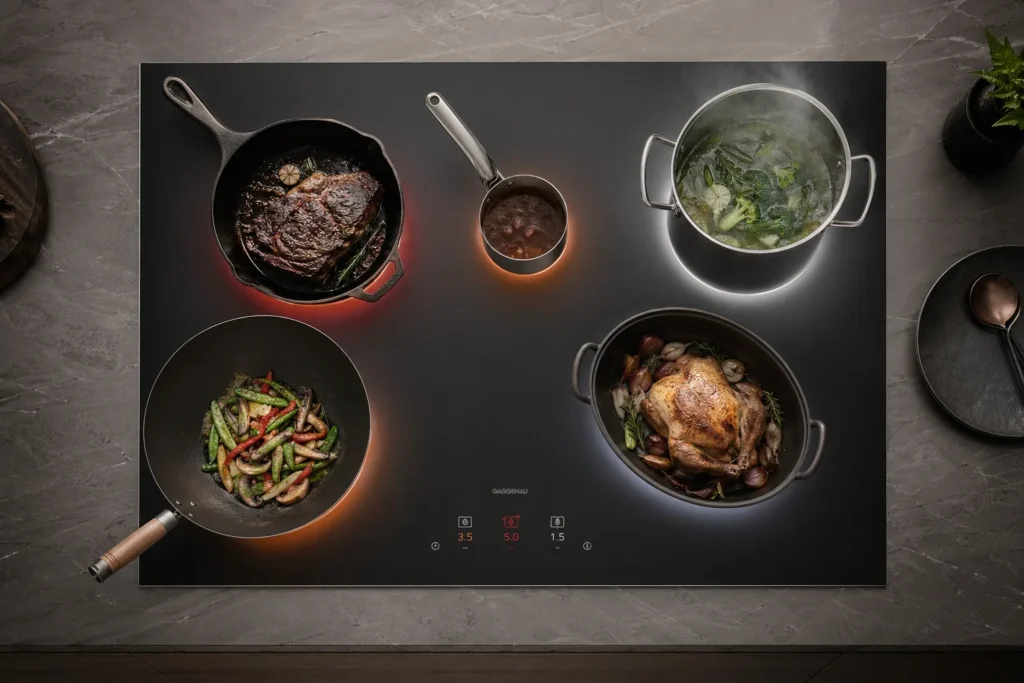
Thermador’s Freedom Induction, available in a 36-inch configuration, similarly detects and heats cookware regardless of position but supports up to four to five pans simultaneously. Its automatic pan detection system activates beneath whatever cookware is placed on the surface without requiring any manual zone selection. However, Thermador’s Freedom platform does not feature a pan memory function equivalent to Gaggenau’s — if a pan is moved, the user must reset the power level for that cookware.
In summary, Gaggenau’s full-surface platform is more sophisticated in its cooking-workflow intelligence (pan memory, Professional mode, Dynamic mode), while Thermador’s Freedom Induction offers strong automatic detection with a slightly simpler interaction model.
Does Miele’s FlexInduction Suit Professional Home Chefs Better Than a Fixed-Zone Cooktop?
Yes, Miele’s FlexInduction significantly improves on a traditional fixed-zone cooktop for professional home chefs by allowing two adjacent cooking zones to be merged into a single extended heating area, accommodating oversized cookware such as fish kettles, griddle pans, or paella dishes. This addresses one of the most persistent limitations of standard induction cooktops in a professional cooking context.
Specifically, Miele’s FlexInduction technology allows the two zones on one side of the cooktop to be combined into a single zone of approximately 38 × 21 cm, large enough to accommodate professional-sized rectangular pans or a bridge setup for two smaller pans sharing a single heat source. For the majority of professional home cooking scenarios — roasting, braising, large-format entertaining — this provides meaningful flexibility beyond what a traditional four-zone cooktop offers.
However, it is important to understand the boundary of FlexInduction’s flexibility. Unlike Gaggenau or Thermador’s full-surface platforms, Miele’s FlexInduction still operates within defined zones. The cook cannot freely position cookware anywhere on the surface; they must work within the merged or individual zone boundaries. For a chef who regularly cooks with six pans in motion simultaneously, this is a genuine constraint. For a chef who cooks with two to four pans and values Miele’s TempControl precision above all else, FlexInduction represents an excellent balance of flexibility and automation.
Miele induction cooktop reviewHow Do Gaggenau, Miele, and Thermador Compare in Control Interface and Smart Integration?
Gaggenau leads in control interface distinctiveness with its iconic TFT touch display and front-mounted knob system; Miele offers the most polished touchstrip interface with seamless TempControl integration; and Thermador provides reliable smart home connectivity through the shared Home Connect platform, prioritizing ease of use over interface complexity.
Control interface design is where each brand’s philosophical approach to cooking becomes most tangible. The way a cooktop communicates with the cook — and how that cook adjusts power, monitors temperature, and integrates the appliance into a broader kitchen ecosystem — directly affects the day-to-day professional cooking experience.
What Makes Gaggenau’s TFT Touch Display and Knob System Unique Among Luxury Induction Brands?
Gaggenau’s control interface is unique among luxury induction brands because it combines a large full-surface TFT touch display with the brand’s signature front-mounted precision control knobs — a pairing that provides both high-information feedback and direct, tactile control that no other luxury induction brand replicates at this level.

Specifically, the full-surface TFT display on the Gaggenau CX 480 and CX 490 spans the entire front edge of the cooktop, presenting a clear graphical interface through which the cook can scroll through 17 power levels, set individual timers per pan, monitor the cooking sensor function, adjust ventilation settings for a connected hood, and navigate Home Connect smart features. The display’s visual language is designed to be intuitive during the active flow of cooking — large, legible icons with minimal navigation steps.
In contrast, the 400 Series’ front-mounted knobs represent Gaggenau’s most distinctive design signature. Rather than relying exclusively on a touch interface, Gaggenau offers high-precision rotary knobs mounted through the front face of the cabinetry — completely separate from the cooktop surface itself. This preserves the full uninterrupted cooking area while providing the tactile feedback of a physical control. For a cook operating with wet hands or in motion across a busy kitchen, a physical knob offers an ergonomic advantage that a touch surface alone cannot replicate. This design is, as Gaggenau positions it, the only luxury minimalist knob interface of its kind in the market.
Furthermore, Gaggenau’s Home Connect integration allows the cooktop to communicate wirelessly with compatible ventilation hoods, automatically adjusting extraction speed in response to the cooktop’s current power output — a feature that meaningfully simplifies kitchen management during complex multi-course cooking.
Which Brand Has Better Smart Home Integration — Gaggenau Home Connect, Miele@Home, or Thermador?
Gaggenau Home Connect and Thermador share the same underlying BSH Group smart platform and are comparably capable in terms of app-based remote monitoring and appliance communication, while Miele@Home offers a more proprietary but equally polished ecosystem tailored specifically to Miele appliance owners.
Gaggenau and Thermador both operate on the Home Connect platform — a BSH Group infrastructure that connects cooktops, ovens, dishwashers, and ventilation systems through a single application. For a kitchen equipped entirely with BSH-family appliances (Gaggenau, Thermador, Bosch, or Siemens), Home Connect enables cross-appliance communication: the cooktop can automatically signal the hood to increase extraction, the oven can be preheated remotely, and usage data can be tracked across the full appliance suite. This ecosystem is particularly valuable for luxury kitchen builds where multiple integrated appliances are specified together.
Miele@Home operates on a separate proprietary platform but achieves comparable functionality within the Miele appliance ecosystem. Miele’s smart integration includes remote monitoring, usage diagnostics, and automatic reordering of consumables through the Miele Shop. For a kitchen equipped exclusively with Miele appliances, the @Home ecosystem provides a similarly seamless connected experience. However, because it is proprietary to Miele, it does not communicate with appliances from other brands — a relevant consideration for mixed-brand kitchen builds.
In practical terms, the smart integration advantage goes to whichever brand aligns with the rest of your kitchen ecosystem. For a full Gaggenau or mixed BSH kitchen, Home Connect is the stronger choice due to its cross-brand compatibility. For a pure Miele kitchen, Miele@Home provides equivalent depth within its own ecosystem.
| Feature | Gaggenau | Miele | Thermador |
|---|---|---|---|
| Smart platform | Home Connect (BSH) | Miele@Home | Home Connect (BSH) |
| Cross-brand compatibility | Yes (BSH family) | No (Miele only) | Yes (BSH family) |
| Hood integration | Yes (auto extraction) | Yes | Yes |
| Remote monitoring | Yes | Yes | Yes |
| App interface | Home Connect app | Miele app | Home Connect app |
The table above summarizes smart home integration capabilities and ecosystem compatibility for each brand’s flagship induction platform.
Gaggenau vs Miele vs Thermador: Which Brand Offers the Best Value at Its Price Point?
Gaggenau offers the highest performance ceiling at the highest price, Miele delivers the strongest long-term reliability record at a slightly lower investment, and Thermador provides the most accessible entry point into the full-surface induction category with meaningful package discount advantages.
Price in the luxury induction segment is not a simple function of specification count — it reflects brand heritage, manufacturing precision, warranty coverage, and the ecosystem value of the appliance within a wider kitchen build. Understanding value at each price point requires looking beyond the sticker price to total ownership experience.
Gaggenau’s flagship full-surface induction cooktops sit at the top of the residential induction market, with the CX 480 and CX 490 series priced between approximately $6,000 and $10,000 depending on configuration and retailer. This is justified by the cooktop’s manufacturing pedigree — hand-assembled in Germany with tolerances borrowed from commercial kitchen equipment — and supported by a warranty of up to 7 years on select models, one of the most comprehensive in the luxury appliance category. For a buyer whose kitchen is a primary investment in lifestyle and culinary identity, Gaggenau represents the definitive expression of residential induction.
Miele’s comparable full-surface and FlexInduction models are priced approximately 10–20% below Gaggenau at equivalent specification levels, making them a meaningful alternative for buyers who prioritize reliability data over brand prestige. Miele is consistently ranked as the least-serviced major appliance brand sold by large luxury retailers — a distinction that carries real long-term financial significance. According to Yale Appliance’s service data, Miele products require fewer repairs over their operational lifespan than virtually any other premium appliance brand, translating to a lower total cost of ownership despite a higher upfront price than Thermador.
Thermador occupies the most strategically interesting position in this comparison. As a sister brand to Gaggenau within the BSH Group, Thermador is manufactured to a high standard — but with a more accessible price point, typically 30–40% below comparable Gaggenau models. Thermador’s most significant value advantage is its package discount program, through which buyers who purchase multiple Thermador appliances (cooktop, oven, refrigerator, dishwasher) receive substantial rebates — effectively reducing the per-appliance cost significantly. For a full kitchen renovation where multiple luxury appliances are being specified simultaneously, Thermador’s ecosystem pricing can make it the financially optimal choice without meaningfully compromising performance.

Which Luxury Induction Cooktop Is Best for Professional-Grade Performance — Our Final Verdict
Gaggenau is best for discerning home chefs who demand the absolute pinnacle of cooking surface technology and design integration; Miele is best for buyers who prioritize long-term reliability, automated precision, and the lowest total cost of ownership; and Thermador is best for buyers who want full-surface induction performance within a complete luxury kitchen ecosystem at a more accessible price point.
To arrive at this verdict, the following summary table captures how each brand performs across the five professional-grade criteria established at the start of this article.
| Criterion | Gaggenau | Miele | Thermador |
|---|---|---|---|
| Heating power | ⭐⭐⭐⭐⭐ | ⭐⭐⭐⭐ | ⭐⭐⭐⭐ |
| Thermal precision | ⭐⭐⭐⭐⭐ | ⭐⭐⭐⭐⭐ | ⭐⭐⭐ |
| Surface flexibility | ⭐⭐⭐⭐⭐ | ⭐⭐⭐ | ⭐⭐⭐⭐ |
| Control interface | ⭐⭐⭐⭐⭐ | ⭐⭐⭐⭐ | ⭐⭐⭐ |
| Value at price point | ⭐⭐⭐ | ⭐⭐⭐⭐ | ⭐⭐⭐⭐⭐ |
The table above scores each brand from 1–5 stars across the five professional-grade performance criteria defined in this article. Ratings reflect a synthesis of published specifications, retailer data, and comparative industry analysis.
Choose Gaggenau if you are building a luxury kitchen where the cooktop is the architectural and culinary centerpiece, you cook with multiple pans simultaneously on a regular basis, and you want the most technologically advanced and visually distinctive induction platform available. The pan memory function, Professional and Dynamic cooking modes, front-mounted knob interface, and flush-mount installation make Gaggenau the unambiguous leader for the cook who demands everything.
Choose Miele if long-term reliability is your primary concern, you value automated thermal precision through TempControl, and you are building a kitchen around Miele’s broader appliance ecosystem. Miele’s track record for requiring fewer service interventions than any other luxury brand means it delivers the lowest friction ownership experience over a 10–15 year kitchen lifecycle.
Choose Thermador if you are furnishing a full luxury kitchen suite simultaneously and want to leverage package pricing for meaningful savings, you value the Freedom Induction platform’s zoneless flexibility, and you are comfortable with a slightly less refined control interface in exchange for a significantly lower total kitchen investment.
Tóm lại, all three brands deliver genuine professional-grade induction performance by any objective standard. The question is not which brand is capable enough — it is which brand’s particular expression of capability aligns most precisely with how you cook, how your kitchen is designed, and what you value most in a long-term kitchen investment.
Is a Luxury Induction Cooktop Still Worth It Compared to Professional Gas and Teppanyaki Alternatives?
Yes, a luxury induction cooktop is worth the investment compared to professional gas alternatives for the vast majority of home cooking scenarios — offering superior precision, energy efficiency, and safety — while a small number of specific culinary techniques genuinely favor open-flame gas or dedicated teppanyaki surfaces.
This supplementary question matters because induction, however advanced, is not universally superior to every cooking technology for every application. A thorough luxury kitchen decision requires understanding where induction’s advantages are definitive and where they genuinely fall short.
How Does the Gaggenau Essential Induction Compare to a Traditional Luxury Cooktop Setup?
The Gaggenau Essential Induction represents a fundamentally different category from any traditional luxury cooktop — it eliminates the distinction between cooktop and countertop entirely by integrating induction modules beneath a continuous Dekton stone worktop surface, leaving only a small LED indicator dot, the worktop itself, and a front-mounted control knob visible.
Specifically, this design is not a cooktop installed in a counter — it is a worktop that cooks. The Essential Induction is engineered exclusively for integration with Cosentino’s Dekton ultra-compact stone surfaces, available in over 60 finishes, which serve simultaneously as cooking surface, food preparation area, serving platform, and dining surface. When not in use, the cooking zone is visually indistinguishable from the surrounding countertop, transforming the kitchen island into a completely uninterrupted architectural surface.
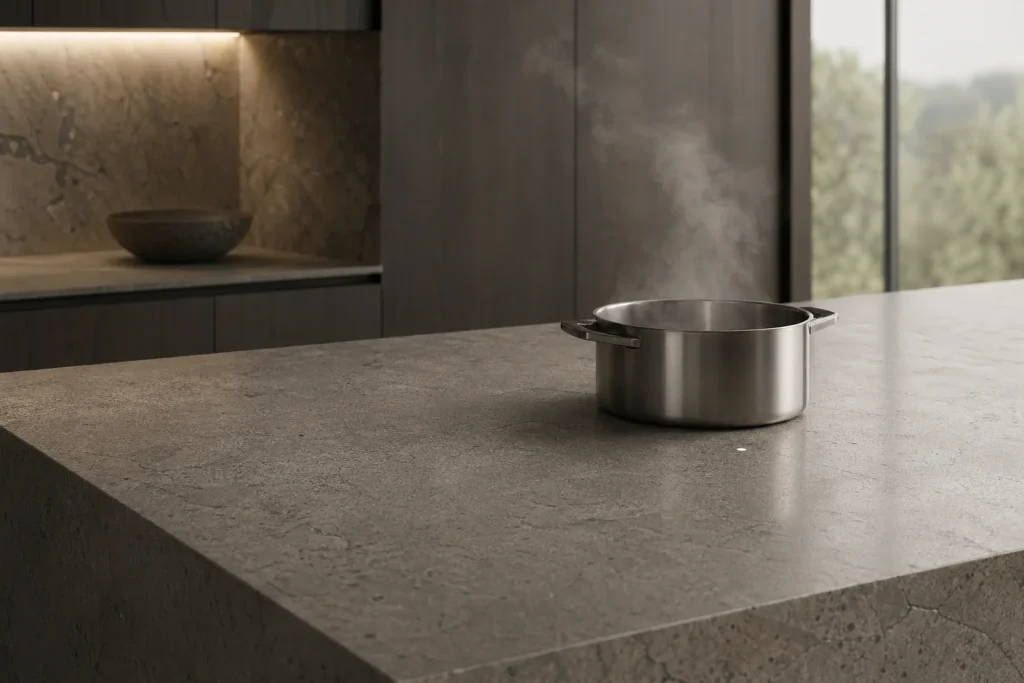
For open-plan kitchens where the cooking area doubles as a social and entertaining space, this is a transformative capability. However, it comes with meaningful constraints: the Dekton surface requires compatible magnetic surface protectors for existing cookware to ensure induction conductivity, and the installation is architecturally permanent — replacing the Essential Induction later requires replacing the countertop itself.
What Is the Total Cost of Ownership of a Gaggenau vs Miele Induction Cooktop Over 10 Years?
Over a 10-year ownership period, Miele’s total cost of ownership is likely to be lower than Gaggenau’s despite comparable upfront pricing — primarily because Miele’s documented service reliability means fewer repair interventions, less downtime, and lower maintenance costs over the appliance lifecycle.
Specifically, Yale Appliance’s service data — among the most comprehensive published by any luxury appliance retailer in the United States — consistently places Miele as the brand requiring the fewest service calls per unit sold. For an appliance category as mechanically complex as an induction cooktop, this reliability advantage compounds meaningfully over time. A single major service intervention on a Gaggenau cooktop outside of warranty coverage can cost $400–$800 or more depending on the component — a sum that, if avoided entirely through Miele’s more reliable engineering, partially offsets Miele’s initial purchase premium relative to Thermador.
Gaggenau’s 7-year warranty partially addresses this concern for early ownership periods, but once warranty coverage expires, Gaggenau’s repair costs — reflective of its German-manufactured components and specialized service technician requirements — tend to be among the higher in the category.
Can Gaggenau Vario Modular Cooktops Replace a Full Professional Kitchen Suite?
Yes, Gaggenau’s Vario 400 Series modular system can functionally replace a full professional kitchen suite in a residential setting — by combining full-surface induction modules with gas wok burners, Teppan Yaki accessories, and integrated ventilation into a single continuous cooking line that mirrors the layout and capability of a commercial kitchen pass.
Specifically, the Vario 400 Series is designed around a modular principle where individual cooking elements — full-surface induction panels in 30″ or 36″ widths, single gas burners, wok stations, Teppan Yaki plates, and downdraft or ceiling ventilation — can be combined in any sequence across a continuous countertop run. This means a chef who requires both the precision of induction and the open-flame capability of gas for wok cooking does not need to choose between them — they can have a custom-configured suite that addresses every culinary technique in a single cohesive installation.
This capability positions Gaggenau Vario not as a cooktop category choice, but as a kitchen architecture decision — one that is typically made in collaboration with a kitchen designer or architect and specified as part of a complete luxury kitchen build.
Which Luxury Induction Brand Is Best Suited for Interior Designers and Luxury Kitchen Architects?
For interior designers and luxury kitchen architects, Gaggenau is the preferred specification choice due to its flush-mount installation system, cabinetry-integrated front-mounted knob option, Essential Induction worktop integration, and the Vario modular platform’s ability to create bespoke cooking line configurations that serve as architectural features in their own right.
Specifically, Gaggenau’s 400 Series is designed to be installed completely flush with the surrounding countertop surface — eliminating the raised frame visible on standard cooktop installations and creating a seamless visual plane from counter edge to counter edge. The front-mounted knobs, positioned through the face of the cabinetry rather than on the cooktop surface itself, further eliminate visible controls from the cooking plane, allowing the black ceramic glass surface to read as a pure architectural element. For designers working in minimalist, contemporary, or high-modernist kitchen aesthetics, this installation approach is difficult to replicate with Miele or Thermador.
Miele is the preferred choice for designers prioritizing a quieter, more integrated aesthetic where the cooktop recedes into the kitchen composition rather than serving as a focal point. Miele’s ContourLine design language — characterized by flush-mounted controls and clean horizontal form — integrates naturally into transitional and contemporary kitchen styles without demanding the visual prominence of Gaggenau’s more expressive design.
Thermador, while entirely capable aesthetically, is more often specified by designers working on high-performance kitchen projects where the full package ecosystem discount allows a larger portion of the project budget to be allocated to other architectural elements — countertops, cabinetry, or lighting — without compromising on cooking performance.