
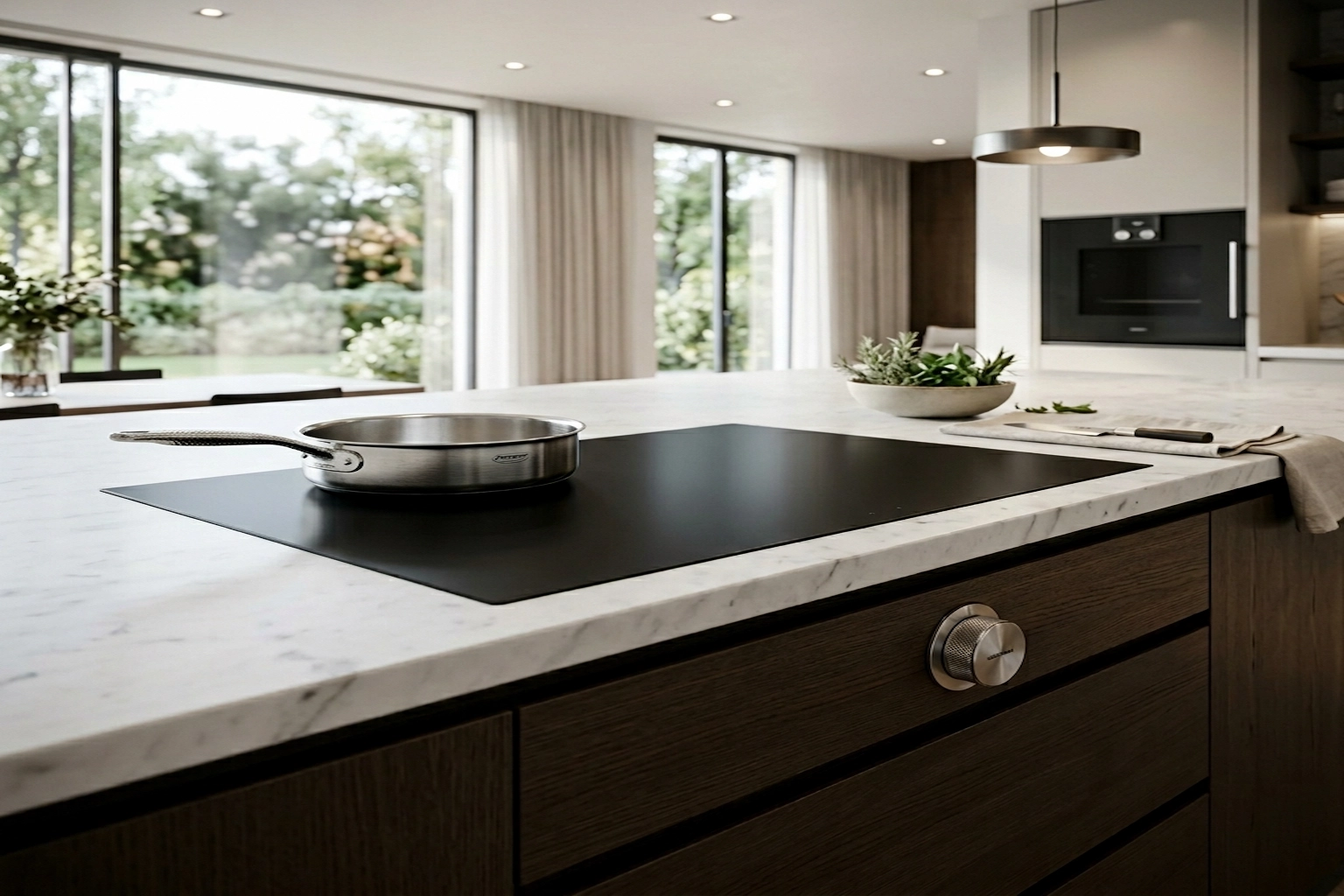
Yes, the Gaggenau induction cooktop is worth the premium price — for the right buyer — because it delivers the most advanced full-surface zoneless cooking platform available in residential kitchens, backed by precision German engineering, a warranty of up to 7 years, and a design language so architecturally refined that no competing brand replicates it at an equivalent level. At a price point ranging from approximately $6,000 to $10,000 depending on configuration, the Gaggenau induction cooktop is unambiguously an investment — but one that returns measurable value in cooking capability, kitchen aesthetics, and long-term appliance reliability for those who demand the absolute best. For a complete overview, see induction cooktop brand reviews.
To evaluate that claim with honesty, you first need to understand what the Gaggenau induction cooktop actually is and how its three distinct product lines — the 200 Series Flex Induction, the 400 Series Full-Surface Induction, and the revolutionary Essential Induction — differ from each other in technology, installation requirements, and target use case. Each series addresses a different buyer profile, and choosing the wrong one is the most common mistake made in the luxury induction category.
Beyond product definition, the core of any serious review must examine the standout features that justify Gaggenau’s price premium: its full-surface zoneless platform with pan memory, its Professional and Dynamic cooking modes, its cooking sensor function that monitors pot temperature in real time, and its iconic TFT touch display paired with front-mounted precision control knobs. These are not incremental improvements over standard induction cooktops — they are category-defining capabilities.
Finally, no honest review can avoid a balanced examination of real pros and cons, and a direct verdict on whether the premium price is justified — and critically, for whom it is and is not the right choice. Below, this article works through each of these dimensions systematically, so you can make your decision with complete information.
What Is the Gaggenau Induction Cooktop and Which Series Should You Know About?
The Gaggenau induction cooktop is a line of professional-grade residential induction hobs manufactured in Germany by Gaggenau Hausgeräte GmbH, a subsidiary of BSH Group, with a brand heritage dating to 1681 — making it one of the oldest appliance manufacturers in the world, and the only luxury kitchen brand that can credibly claim both centuries of craft tradition and cutting-edge electromagnetic cooking technology.
To understand which series suits your needs, it is essential to examine how the three Gaggenau induction lines differ from each other in surface design, control interface, installation type, and price position.
Gaggenau vs Miele vs Thermador luxury comparison Miele induction cooktop review Thermador induction cooktop reviewWhat Are the Key Differences Between the Gaggenau 200 Series and 400 Series Induction Cooktops?
The Gaggenau 200 Series and 400 Series induction cooktops differ across four fundamental dimensions: surface flexibility, control interface, installation method, and price — with the 400 Series representing a categorically more advanced cooking platform in every respect.
Best 36-inch induction cooktopsSpecifically, the differences between the two series can be understood as follows:
The Gaggenau 200 Series features Flex Induction technology, which divides the cooking surface into defined zones that can be merged together to accommodate larger cookware. This means the cook works within a structured zone framework — two zones can be combined into one extended heating area using FlexInduction, enabling the use of elongated pans, fish kettles, or griddles. The 200 Series control interface is clean and minimalist, using a touchstrip design that is elegant without demanding the spatial and cabinetry integration of the 400 Series. For buyers who want genuine Gaggenau quality in a smaller or more conventionally configured kitchen, the 200 Series delivers excellent performance at a more accessible entry price within the Gaggenau range.
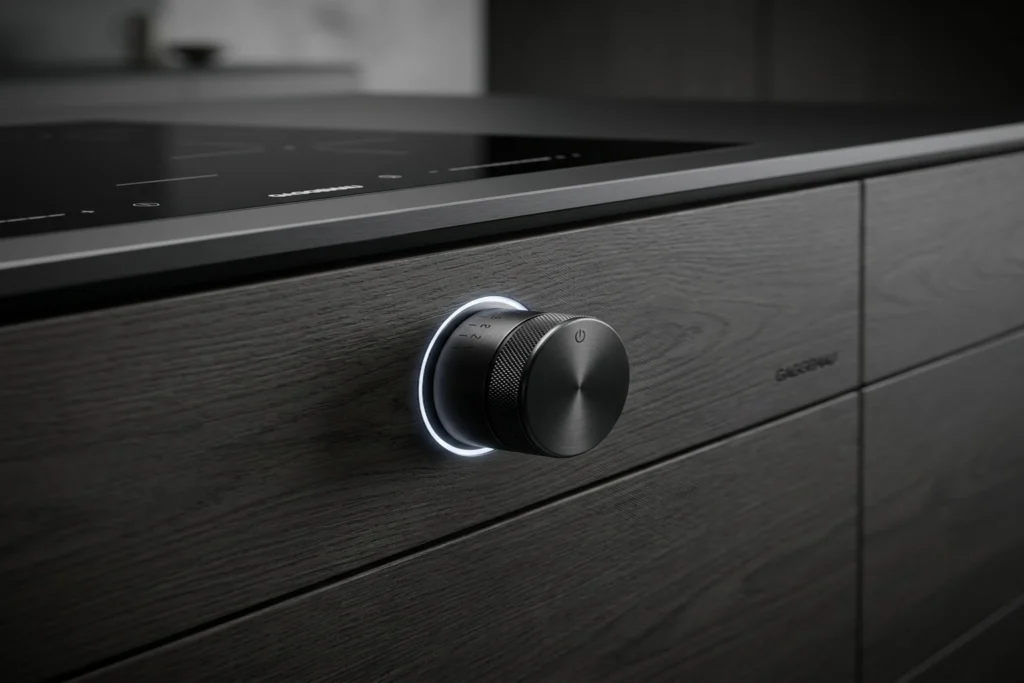
The Gaggenau 400 Series, by contrast, is built around an entirely different cooking philosophy. Its flagship models — the CX 480 (30-inch) and CX 490 (36-inch) — feature a single uninterrupted full-surface induction platform with no fixed cooking zones whatsoever. The cook places up to five or six pans respectively in any position on the surface, and the cooktop automatically detects each cookware item and activates electromagnetic energy only beneath it. The 400 Series additionally includes Gaggenau’s pan memory function (the cooktop remembers each pan’s power level and timer settings even when the pan is moved), Professional and Dynamic cooking modes, a full-surface TFT touch display, and the option of front-mounted precision control knobs integrated through the cabinetry face — a design feature unique to Gaggenau in the entire luxury appliance market. Installation of the 400 Series is designed to be fully flush-mount — the cooktop sits perfectly level with the surrounding countertop, with no visible frame or step.
| Feature | 200 Series (Flex Induction) | 400 Series (Full-Surface) |
|---|---|---|
| Surface type | Defined zones (mergeable) | Fully zoneless |
| Max simultaneous pans | 4 | 5–6 |
| Pan memory function | No | Yes |
| Professional/Dynamic modes | No | Yes |
| Control interface | Touchstrip | TFT display + optional front knob |
| Installation | Standard | Flush-mount |
| Price position | Entry-level Gaggenau | Flagship |
The table above compares the core technical differences between the Gaggenau 200 Series and 400 Series induction cooktops across six key performance and design criteria.
What Makes the Gaggenau Essential Induction a Category of Its Own?
The Gaggenau Essential Induction is not a cooktop in the conventional sense — it is a worktop that cooks, representing an entirely new product category that eliminates the physical boundary between cooking surface and countertop by integrating induction modules invisibly beneath a continuous Dekton ultra-compact stone surface.
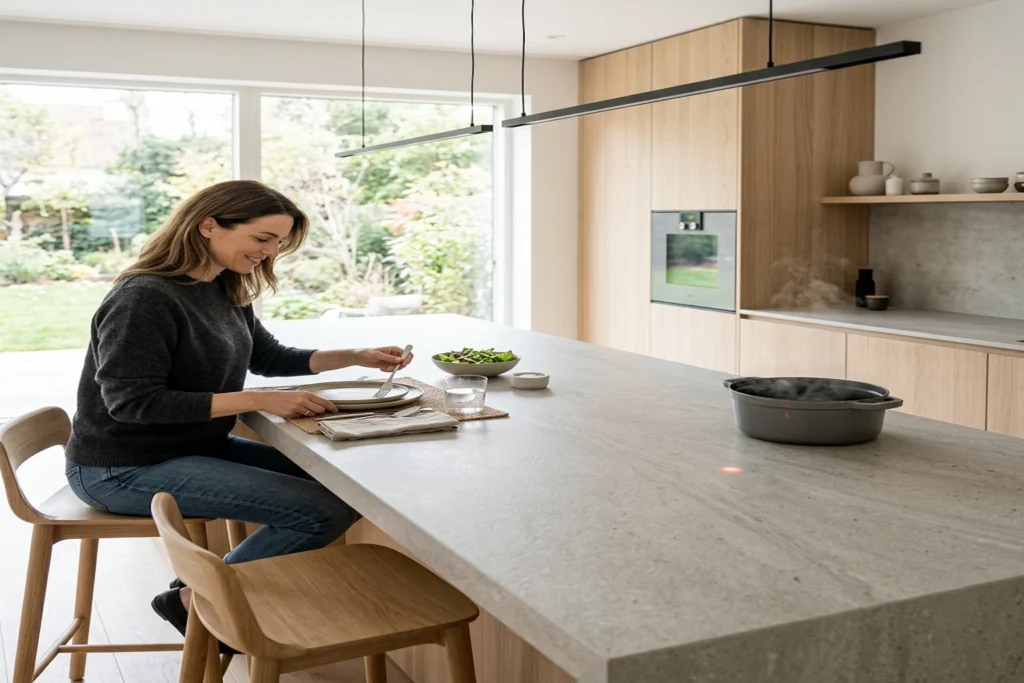
Specifically, the Essential Induction reduces the visible cooking apparatus to just three elements: a small LED dot that indicates the active cooking zone and warns of residual heat, the Dekton stone worktop surface itself, and a front-mounted precision control knob — the same iconic Gaggenau knob found on the 400 Series, available in stainless steel or black. When the cooktop is not in active use, the LED dot disappears, and the surface is visually and tactilely indistinguishable from the surrounding countertop. The kitchen island transforms into a completely uninterrupted architectural plane suitable for food preparation, serving, dining, and social use.
Furthermore, the Essential Induction is engineered exclusively for integration with Cosentino’s Dekton ultra-compact surface — available in over 60 finishes, designs, and colors — which provides the stain resistance, heat resistance, and conductivity characteristics required for the induction modules beneath to function optimally. To ensure cookware compatibility, Gaggenau provides removable magnetic surface protectors that fit beneath existing pots and pans, guaranteeing induction conductivity through the stone surface while protecting both cookware and the Dekton finish.
For buyers designing open-plan kitchens where the cooking island doubles as a social, entertaining, and dining space, the Essential Induction is a transformative architectural solution — one that no other brand in the luxury appliance market currently offers.
What Are the Standout Features of the Gaggenau Full-Surface Induction Cooktop?
There are five standout features of the Gaggenau full-surface induction cooktop that collectively define its professional-grade performance claim: the full-surface zoneless platform with pan memory, the Professional and Dynamic cooking modes, the cooking sensor function, the TFT full-surface touch display, and the Home Connect ventilation integration. Together, these features constitute a cooking environment that meaningfully exceeds what any standard premium induction cooktop — or any competing luxury brand — provides as a complete package.
To understand why each of these features matters in real cooking conditions, it is necessary to examine them individually in depth.
How Does the Full-Surface Zoneless Design Change the Way You Cook?
Yes, the full-surface zoneless design fundamentally changes the way you cook — by eliminating the spatial constraints of fixed cooking zones and replacing them with a completely free, fluid cooking surface that mirrors the workflow of a professional commercial kitchen range.
Specifically, on a conventional induction cooktop — even a high-quality one — the cook must match cookware size to a pre-defined zone diameter and position pans within those zones to activate heating. On the Gaggenau full-surface platform, this constraint disappears entirely. A cook can place a 26 cm sauté pan, a 14 cm saucepan, a 32 cm braising dish, a wok adapter, and two further pans simultaneously anywhere on the surface — repositioning them freely as the cooking workflow evolves — and the cooktop continuously tracks each cookware item, adjusting its electromagnetic field to heat only the area directly beneath each pan.
Furthermore, the pan memory function is the feature that most directly translates the professional kitchen experience into a domestic context. In a restaurant kitchen, a chef slides pans across a flat-top range without losing track of each item’s temperature setting — the range holds a constant heat map that the chef navigates intuitively. Gaggenau’s pan memory replicates this behavior on an induction surface: move a pan from position A to position B, and the cooktop automatically recognizes the pan at its new location and reinstates the same power level and timer it was set to before the move. This means the cook can reposition cookware in response to changing priorities — pulling a sauce off high heat, rotating a sear to a cooler area — without needing to re-input settings each time.
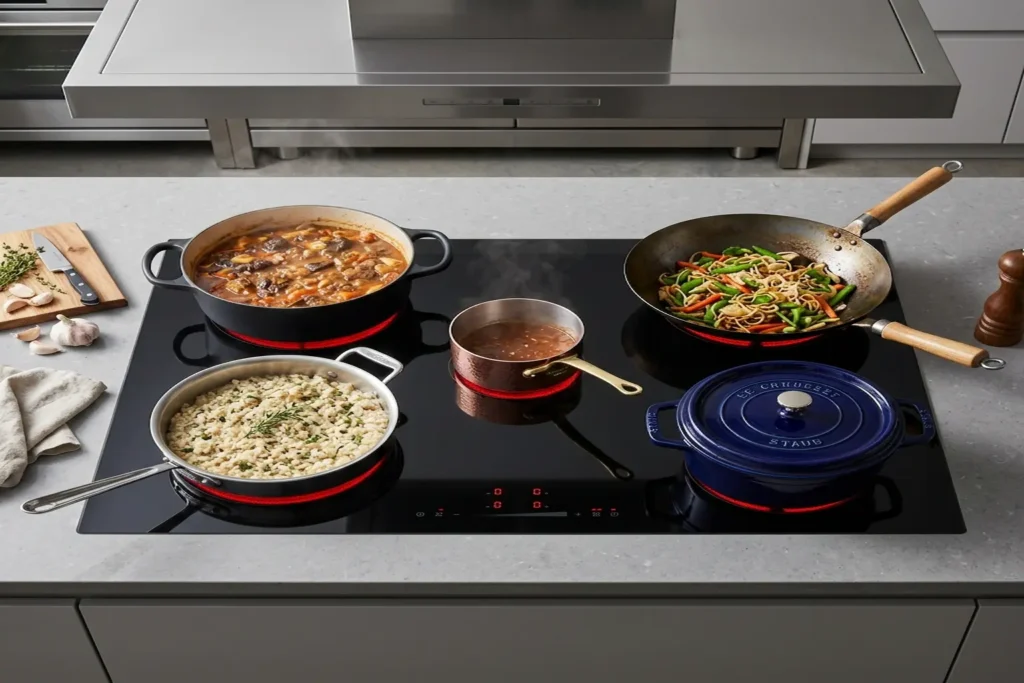
Additionally, Gaggenau’s Professional cooking mode divides the full surface into three predefined heat areas — high (front), medium (center), and low (back) — mirroring the classic layout of a commercial flat-top grill. The cook simply moves pans between areas to change their heat exposure, without touching any control. Dynamic cooking mode allows the cook to personally define their own heat map across the surface, creating a customized temperature layout that suits a specific menu or cooking style. Both modes reduce the cognitive load of managing multiple simultaneous preparations — a hallmark of professional kitchen design philosophy applied directly to a domestic cooktop.
What Is the Gaggenau Cooking Sensor Function and How Does It Improve Precision?
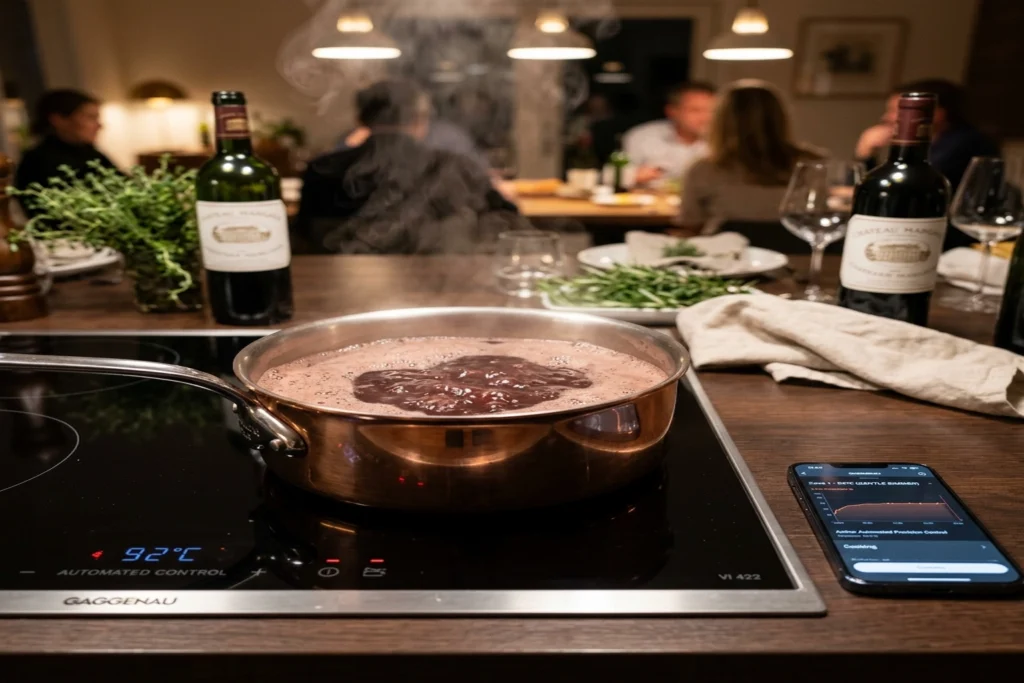
The Gaggenau cooking sensor function is an automated thermal monitoring system integrated into the full-surface induction platform that continuously reads the temperature of cookware placed on the surface and adjusts the power output in real time to maintain a stable cooking temperature — preventing boil-overs, scorching, and overheating without requiring constant manual supervision.
Specifically, the cooking sensor works by detecting heat signatures transmitted through the glass ceramic surface from the base of the cookware. When the sensor detects that a pot is approaching its target temperature — such as the threshold at which a stock will begin to boil — it automatically reduces power output to hold the liquid at a sustained simmer rather than allowing it to roll into a full boil and overflow. For the home chef managing a multi-course dinner while simultaneously hosting guests, this function is not merely convenient — it is the operational equivalent of having a kitchen assistant monitoring the stovetop.
In terms of precision, the cooking sensor function is particularly valuable for three categories of preparation: long simmering (stocks, braises, reductions), temperature-sensitive sauces (hollandaise, beurre blanc, chocolate tempering), and dairy-based preparations (custards, béchamel) where even brief overheating causes irreversible texture damage. In each of these cases, the sensor’s real-time power modulation provides a level of consistency that is genuinely difficult to achieve through manual monitoring alone — particularly in a busy kitchen environment.
Furthermore, the cooking sensor function integrates with Gaggenau’s Home Connect platform to allow remote monitoring via smartphone — so the cook can verify that a stock is still simmering at the correct temperature from another room without returning to the kitchen to check manually.
What Are the Real Pros and Cons of Owning a Gaggenau Induction Cooktop?
There are 5 major advantages and 5 genuine limitations to owning a Gaggenau induction cooktop — evaluated honestly across the criteria of cooking performance, design, price, installation, and long-term ownership — with the balance of pros and cons differing significantly depending on the buyer’s kitchen design, cooking habits, and budget.
To make this evaluation genuinely useful, the following sections present both sides with equal rigor. A premium appliance review that only highlights advantages is not a review — it is marketing. The goal here is to give you the complete picture.
What Are the Main Advantages of Choosing a Gaggenau Induction Hob?
There are 5 primary advantages of choosing a Gaggenau induction hob, spanning cooking technology, design integration, warranty coverage, smart connectivity, and brand reliability.
Advantage 1 — The most advanced cooking surface technology in residential induction: The Gaggenau full-surface zoneless platform, combined with pan memory, Professional mode, Dynamic mode, and the cooking sensor function, represents the current technological ceiling of what residential induction can deliver. No competing brand in the luxury segment — not Miele, not Thermador, not Wolf — offers this specific combination of features in a single integrated platform. For a serious home chef, this is not a marginal improvement over standard induction; it is a qualitative leap in cooking capability.
Advantage 2 — A design language that functions as kitchen architecture: The Gaggenau 400 Series flush-mount installation, combined with the front-mounted precision control knobs integrated through the cabinetry, creates a cooking surface that reads as a pure architectural element rather than an appliance. The black ceramic glass surface, installed flush with the surrounding countertop, eliminates the visual disruption of a raised frame. No visible controls appear on the cooking plane itself. For interior designers and luxury homeowners who treat the kitchen as a designed space rather than a functional room, this aesthetic capability is genuinely irreplaceable.
Advantage 3 — Warranty coverage of up to 7 years: Gaggenau offers one of the most comprehensive warranty packages in the luxury appliance category, with coverage of up to 7 years on select models. For an appliance at this price point, the warranty provides meaningful financial protection during the critical early-ownership period and signals confidence in the product’s long-term reliability.
Advantage 4 — Home Connect ecosystem integration: Gaggenau’s Home Connect platform enables the cooktop to communicate with compatible ventilation hoods — automatically adjusting extraction speed in response to the cooktop’s current power output — and connects to a wider BSH appliance ecosystem that includes ovens, dishwashers, and refrigeration. For a fully integrated Gaggenau or BSH-family kitchen, this connectivity eliminates manual hood adjustment and provides a unified smart kitchen management interface.
Advantage 5 — Brand heritage and German manufacturing precision: Gaggenau has been manufacturing kitchen appliances since 1681 — a heritage that no competing luxury brand approaches. The brand’s products are hand-assembled in Germany to tolerances derived from commercial kitchen equipment manufacturing standards. For a buyer who values provenance, craftsmanship, and the knowledge that their appliance was built with exceptional care, Gaggenau’s manufacturing heritage is a genuine differentiator.
What Are the Drawbacks and Limitations of the Gaggenau Induction Cooktop?
There are 5 genuine drawbacks to the Gaggenau induction cooktop that buyers must evaluate honestly before committing to a purchase at this price level.
Drawback 1 — The highest price point in the residential induction category: The Gaggenau 400 Series full-surface induction cooktop is priced between approximately $6,000 and $10,000 depending on size and configuration — placing it at the absolute top of the residential induction market. For buyers whose budget is constrained, or who do not cook frequently enough to use the platform’s advanced features regularly, this price point is difficult to justify against the performance of Miele or Thermador alternatives that deliver professional-quality induction cooking at 20–40% lower cost.
Drawback 2 — High repair costs after warranty expiration: Gaggenau’s German-manufactured components and the requirement for BSH-certified service technicians mean that post-warranty repair costs are among the highest in the category. A single major component replacement — a TFT display, an induction module, or a control board — can cost $400–$800 or more depending on the specific part and labor involved. Buyers should factor this into the total cost of ownership calculation, particularly beyond the 7-year warranty window.
Drawback 3 — Installation demands professional expertise and significant cabinetry modification: The flush-mount installation of the 400 Series requires a kitchen designer and cabinetry contractor with specific experience in Gaggenau installations. The front-mounted knob system requires precision routing of holes through the face of the base cabinetry, and the electrical specification — typically requiring a dedicated high-amperage circuit — must be confirmed before the appliance is ordered. This installation complexity adds meaningful cost and lead time to the kitchen project, and errors made during installation are difficult and expensive to correct.
Drawback 4 — The Essential Induction is permanently tied to Dekton countertops: The Essential Induction’s integration with Dekton stone is architecturally extraordinary but also architecturally constraining. Because the induction modules are embedded beneath the worktop itself, replacing the cooktop in the future requires replacing the entire countertop. For buyers who anticipate remodeling their kitchen within a 10–15 year horizon, this permanence may be a deterrent — or at minimum, a decision that requires very deliberate long-term planning.
Drawback 5 — Induction technology cannot replicate open-flame gas for specific culinary techniques: The Gaggenau induction cooktop, however advanced, cannot produce the direct open flame required for techniques such as wok hei (the high-heat, flame-charred characteristic of authentic wok cooking), charring peppers directly over a burner, or flambéing at the cooktop. For cooks whose repertoire includes these specific techniques regularly, the Gaggenau Vario modular system — which allows induction and gas modules to be combined in a single cooking line — is the solution, but it represents an additional investment and installation consideration beyond the induction cooktop alone.
Is the Gaggenau Induction Cooktop Worth the Premium Price? Our Verdict
Yes, the Gaggenau induction cooktop is worth the premium price — for buyers who cook seriously and regularly, are building or renovating a luxury kitchen where design integration matters, and are making a long-term investment in a cooking platform they intend to use for 15–20 years. It is not worth the premium price for buyers whose cooking patterns do not engage the platform’s advanced features, or whose budget makes the Miele or Thermador alternatives more financially sensible.
Induction cooktop price guideSpecifically, the Gaggenau value proposition is strongest when evaluated across three dimensions simultaneously:
- Performance value: The full-surface zoneless platform, pan memory, cooking sensor, and Professional/Dynamic cooking modes deliver a cooking experience that genuinely exceeds what any other residential induction brand provides. If you cook with multiple pans daily, host regularly, or approach cooking as a serious culinary practice, you will use these features — and they will materially improve your results and your enjoyment of the process.
- Design value: If your kitchen is designed as an architectural space — particularly if it features open-plan living, a kitchen island as a social focal point, or a minimalist aesthetic — Gaggenau’s flush-mount installation, front-mounted knob system, and Essential Induction worktop integration provide design value that is simply unavailable from any other brand.
- Long-term ownership value: A 7-year warranty, a brand with over three centuries of manufacturing heritage, and a product built to commercial kitchen tolerances means the Gaggenau cooktop is designed to perform for decades. Amortized over a 20-year ownership period, the price premium over a Miele or Thermador alternative narrows considerably.
The following table summarizes the Gaggenau value verdict across five criteria to provide a clear comparative overview.
| Criterion | Score (out of 5) | Notes |
|---|---|---|
| Cooking performance | ⭐⭐⭐⭐⭐ | Category-leading across all professional-use metrics |
| Design & aesthetics | ⭐⭐⭐⭐⭐ | Unmatched flush-mount + front knob integration |
| Features & technology | ⭐⭐⭐⭐⭐ | Pan memory, cooking sensor, Professional mode |
| Value at price point | ⭐⭐⭐ | Justified for serious buyers; excessive for casual use |
| Long-term ownership | ⭐⭐⭐⭐ | 7-year warranty; high post-warranty repair costs |
The table above presents a five-criteria value assessment of the Gaggenau induction cooktop, scored from 1–5 stars, to support a clear and balanced purchase decision.
Who Should Buy the Gaggenau Induction Cooktop?
There are four buyer profiles for whom the Gaggenau induction cooktop represents a clear and confident recommendation.
Profile 1 — The serious home chef: If you cook ambitious multi-course meals regularly, entertain frequently, and view the kitchen as the creative center of your home, the Gaggenau full-surface platform will engage every capability you bring to it. The pan memory function, cooking sensor, and Professional mode are not showroom features — they are daily-use tools for a cook who works with four or more pans simultaneously on a regular basis.
Profile 2 — The luxury homeowner making a once-in-a-generation kitchen investment: If you are building or renovating a kitchen with a 20-year horizon in mind — a kitchen you intend to be the definitive version of your home — the Gaggenau cooktop is the right choice. Its build quality, warranty, and design integration will remain relevant and functional for decades, and it will not require replacement or upgrading within the timeframe of a single kitchen cycle.
Profile 3 — The interior designer or architect specifying a luxury kitchen: For design professionals working on high-end residential projects where the kitchen is an architectural feature, Gaggenau’s flush-mount installation, front-mounted knob system, and Essential Induction worktop integration offer design capabilities that are uniquely specifiable. No other brand gives a designer this level of control over the visual and tactile experience of the cooking surface.
Profile 4 — The buyer building a full Gaggenau or BSH ecosystem kitchen: If you are specifying Gaggenau or BSH-family appliances across the entire kitchen — ovens, refrigeration, ventilation, dishwasher — the Home Connect integration and cross-appliance communication of the Gaggenau cooktop adds meaningful connected-kitchen value that amplifies the overall ecosystem investment.
Who Should Consider Alternatives Instead of Gaggenau?
There are three buyer profiles for whom a Miele, Thermador, or other premium alternative is the more rational choice than the Gaggenau induction cooktop.
Alternative Profile 1 — The buyer whose budget favors Miele: If long-term reliability is your primary criterion and you want to minimize the probability of requiring any service intervention over the cooktop’s lifespan, Miele is the stronger choice. Miele’s documented service reliability — consistently rated the lowest service call frequency among all major luxury appliance brands by retailers such as Yale Appliance — translates to a lower friction ownership experience over 10–15 years, and its TempControl sensor function delivers automated cooking precision that rivals Gaggenau’s cooking sensor for most daily-use scenarios.
Alternative Profile 2 — The buyer whose cooking does not engage full-surface zoneless features: If your cooking primarily involves two to three pans simultaneously, and you do not entertain at a scale that demands managing five or six cooking preparations at once, the advanced capabilities of Gaggenau’s full-surface platform will be underutilized. In this scenario, a Miele FlexInduction cooktop — which allows zone merging for larger cookware while delivering excellent Miele build quality — provides 80–90% of the practical cooking capability at a meaningfully lower price.
Alternative Profile 3 — The buyer renovating a full kitchen suite simultaneously: If you are specifying a cooktop, oven, refrigerator, dishwasher, and ventilation system simultaneously, Thermador’s package discount program — which provides substantial rebates when multiple Thermador appliances are purchased together — makes the overall kitchen investment significantly more efficient financially. Thermador’s Freedom Induction cooktop delivers full-surface zoneless performance comparable to the Gaggenau 400 Series at approximately 30–40% lower cost, and the package savings on the remaining appliances can be substantial enough to fund other kitchen priorities, such as cabinetry, countertops, or lighting, without compromising on professional-grade cooking performance.
What Should You Know Before Installing and Maintaining a Gaggenau Induction Cooktop Long-Term?
Before committing to the purchase of a Gaggenau induction cooktop, buyers must understand four critical dimensions of the long-term ownership experience that extend beyond the performance and design review: installation requirements, warranty structure, modular expandability, and the Thermador alternative as a budget-conscious option within the same technology family. These are the questions that arise after the purchase decision is made — and answering them in advance prevents costly surprises during the kitchen build and beyond.
How to install an induction cooktopWhat Are the Installation Requirements for a Gaggenau 400 Series Flush-Mount Induction Cooktop?
The Gaggenau 400 Series flush-mount installation requires a minimum of three specialized preparations before the cooktop arrives on site: a dedicated high-amperage electrical circuit, precision cabinetry modification for the front-mounted knob system, and a countertop cutout manufactured to Gaggenau’s exact specifications.
Specifically, the electrical requirement for the Gaggenau CX 480 and CX 490 series typically demands a dedicated 240V circuit with an amperage rating confirmed by the cooktop’s specific model documentation — generally between 40 and 50 amps depending on configuration. This circuit must be installed by a licensed electrician before the cooktop is delivered, and the panel capacity of the home’s electrical system must be verified to confirm it can accommodate the additional load.
The front-mounted knob system of the 400 Series requires the cabinetry contractor to route precisely dimensioned holes through the face of the base cabinet drawer or door panel — typically 38–40 mm in diameter — at an exact height specified by Gaggenau’s installation guidelines. These holes must be cut before the cabinetry is installed, as retroactive modification after installation is significantly more difficult. Any error in knob positioning is visible and permanent, making it essential that the cabinetry contractor has prior experience with Gaggenau-specific installations.
The countertop cutout must be machined to Gaggenau’s published dimensions with tolerances of ±1 mm to achieve the flush surface line that defines the 400 Series aesthetic. Stone countertop fabricators must receive these specifications directly from the Gaggenau product documentation — and ideally from a Gaggenau-certified installer — before cutting begins.
How Does the Gaggenau Warranty Work and What Does It Cover?
The Gaggenau warranty provides coverage of up to 7 years on select models, covering manufacturing defects in materials and workmanship across the cooktop’s primary functional components — including the induction modules, TFT display, control electronics, and glass ceramic surface.
Specifically, Gaggenau’s warranty structure varies by market and product line. In the United States, the standard warranty on Gaggenau appliances is typically 2 years full coverage — parts and labor — with extended warranty options available through Gaggenau’s retailer network for an additional cost. The “up to 7 years” warranty coverage referenced in Gaggenau’s marketing materials reflects the maximum extended warranty package available in certain markets and through specific authorized retailers, and buyers should confirm the exact coverage terms for their region and purchase channel before completing their order.
In terms of what the warranty covers, Gaggenau’s standard warranty addresses defects arising from normal use — component failure, electronic malfunction, and manufacturing imperfections. It does not cover damage resulting from improper installation, unauthorized modifications, or the use of non-induction-compatible cookware that cracks the glass surface. Given the specialized installation requirements of the 400 Series, it is particularly important that installation is performed by a Gaggenau-authorized installer — because installation errors that cause appliance damage are typically excluded from warranty coverage.
After warranty expiration, service calls for Gaggenau cooktops require BSH-certified technicians using Gaggenau-specific replacement parts sourced from Germany. This supply chain — while ensuring genuine component quality — results in higher labor and parts costs than standard appliance service. Buyers planning for a 15–20 year ownership horizon should budget accordingly for post-warranty maintenance.
Can the Gaggenau Vario 400 Series Be Expanded or Reconfigured After Installation?
Yes, the Gaggenau Vario 400 Series modular system can be expanded after initial installation — by adding additional cooking modules to an existing cooking line — provided that the original kitchen design anticipated this expansion in its countertop layout, electrical provisioning, and cabinetry configuration.
Specifically, the Vario 400 Series is built on a modular architecture in which individual cooking elements — full-surface induction panels, single gas burners, gas wok modules, Teppan Yaki plates, and downdraft ventilation units — are manufactured as discrete modules in standardized widths (typically 15 cm increments) that can be combined in any sequence across a continuous countertop run. A buyer who installs a 30-inch full-surface induction module initially can, in principle, add a flanking gas wok module or Teppan Yaki unit at a later date — provided the countertop has been pre-cut with sufficient space, and the electrical and gas supply lines for the additional module were roughed in during the original installation.
However, retroactive expansion of a Vario 400 installation that was not originally designed for expansion is a major renovation project, not a simple appliance addition. The countertop must be re-cut, the additional electrical or gas connections must be installed, and the cabinetry below must be modified to accommodate the new module’s ventilation and installation requirements. For this reason, buyers who anticipate eventually wanting a hybrid induction-and-gas cooking line are strongly advised to plan the full configuration from the outset — consulting with a Gaggenau-certified kitchen designer before finalizing the countertop dimensions and rough-in specifications.
Is Thermador a Viable Budget Alternative to the Gaggenau Induction Cooktop?
Yes, Thermador is a viable and technically credible budget alternative to the Gaggenau induction cooktop — particularly for buyers who want full-surface zoneless induction performance but cannot justify Gaggenau’s flagship price point, or who are specifying a complete kitchen suite and want to leverage Thermador’s package discount program.
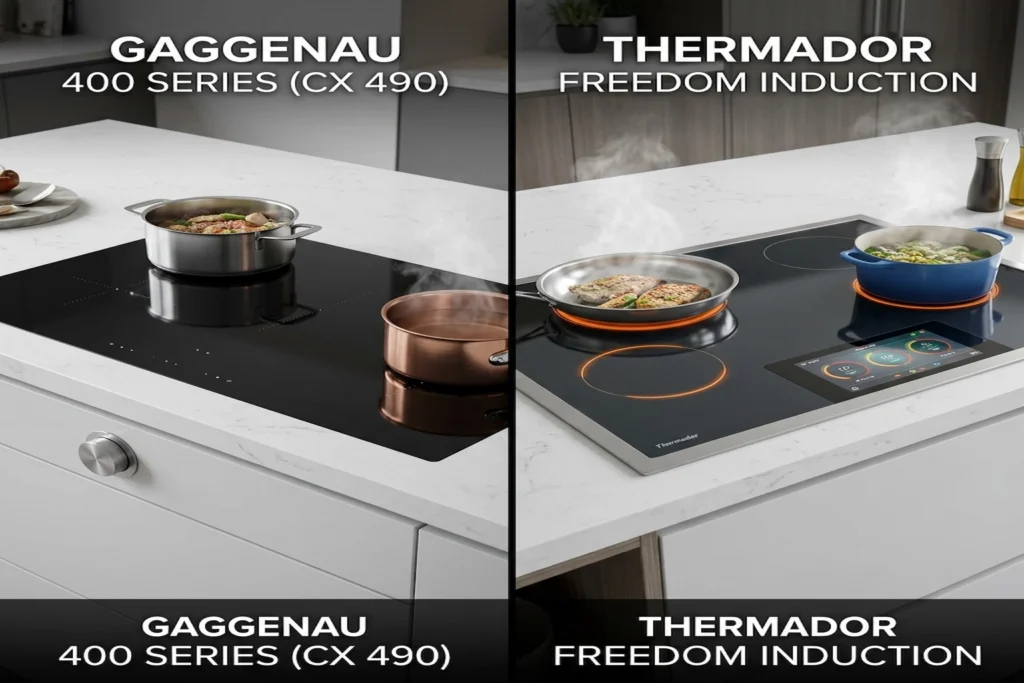
Specifically, Thermador and Gaggenau share the same parent company — BSH Group — and Thermador’s Freedom Induction cooktop is built on a technology platform that draws from the same engineering foundation as Gaggenau’s full-surface induction. The Thermador Freedom Induction delivers genuine zoneless cooking capability, automatic pan detection anywhere on the surface, and a Home Connect smart integration platform identical to Gaggenau’s — at a price point approximately 30–40% below comparable Gaggenau configurations.
The most significant financial advantage Thermador offers is its package discount ecosystem: buyers who purchase a Thermador cooktop, oven, refrigerator, and dishwasher simultaneously through an authorized retailer qualify for substantial rebates that can reduce the effective per-appliance cost significantly — in some cases by $1,000–$2,000 per appliance or more depending on the total package value. For a complete luxury kitchen renovation where multiple appliances are being specified simultaneously, this package pricing can make Thermador the financially optimal choice without meaningfully compromising the quality or performance of the individual appliances.
Where Thermador falls short of Gaggenau is in the specific features that define the 400 Series’ professional-grade performance ceiling: Thermador’s Freedom Induction does not offer Gaggenau’s pan memory function (power settings are not retained when pans are moved), does not provide Gaggenau’s Professional or Dynamic cooking modes, and does not offer a flush-mount installation with front-mounted cabinetry-integrated knobs. For buyers whose cooking and design priorities engage these specific capabilities, the Gaggenau premium is earned. For buyers who primarily value zoneless surface flexibility and smart connectivity — and can invest the package savings in other kitchen priorities — Thermador is an entirely rational alternative.