
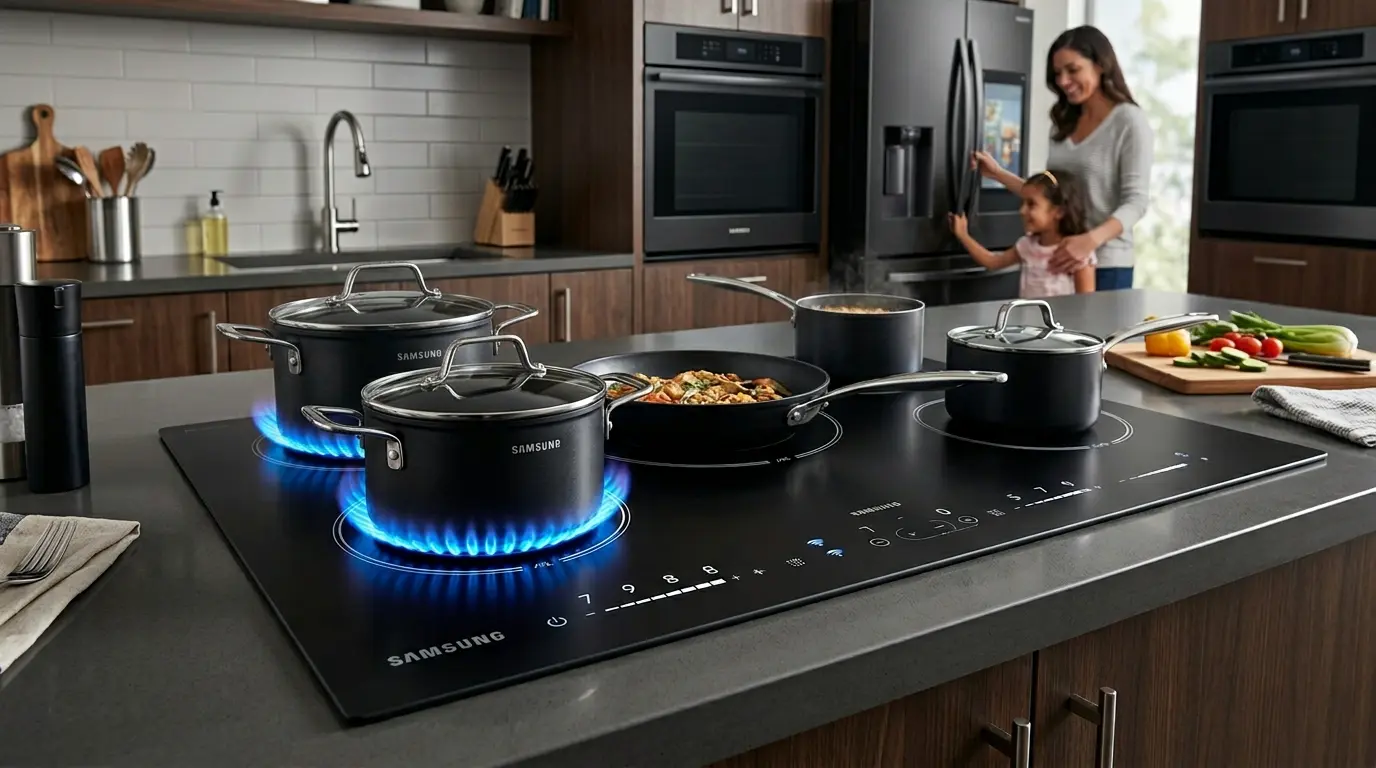
Choosing the right Samsung induction cooktop comes down to matching size, cooking capacity, and feature set to the way you actually cook at home. For most households, the best choice is not simply the biggest or smartest model, but the one that fits the kitchen footprint, supports everyday meal prep, and delivers the right balance of burners, control, and convenience. Samsung’s induction lineup is centered around 30-inch and 36-inch sizes, with 4 or 5 burners and a mix of standard and smart features, which makes comparison the most useful path to a confident decision. For a complete overview, see induction cooktop brand reviews.
A second buying question is whether 30-inch or 36-inch better suits your household. In practical terms, 30-inch cooktops usually work well for smaller kitchens and average family cooking, while 36-inch models make more sense for people who use larger pans, cook multiple dishes at once, or want more layout flexibility. That means width is not just a design choice; it directly affects how easily you can cook on busy weeknights, host guests, and manage several pots at the same time.
The next layer of intent involves feature comparison. Buyers are rarely choosing on size alone. They also want to know which features matter in real use, including precise temperature control, Power Boost, Wi‑Fi connectivity, easy-clean surfaces, anti-scratch glass, and burner synchronization or flexible cooking zones. These features can meaningfully improve speed, monitoring, cleanup, and usability, but not every household benefits from every upgrade in the same way.
Finally, the smartest buying decision often depends on user profile: small-kitchen cooks, larger households, frequent home chefs, and smart-home buyers all prioritize different benefits. After covering the core comparison, this article also moves into installation, cookware compatibility, and everyday ownership considerations so readers can choose with fewer surprises. Below, the main content breaks down exactly how to compare a Samsung induction cooktop the right way.
What Is the Right Samsung Induction Cooktop for Home Cooks?
The right Samsung induction cooktop for home cooks is the model that best matches kitchen size, cooking frequency, pan capacity needs, and preferred convenience features.
To understand what “right” means in this heading, it helps to move beyond brand preference and focus on daily use. A cooktop may look premium on a product page, but if it overwhelms a smaller kitchen, adds features you will never use, or fails to support the number of pans you cook with most often, it is not the right fit. Samsung’s induction lineup gives buyers a clear comparison framework because the brand highlights two main widths—30 inches and 36 inches—along with differences in burner count, control style, and smart functionality.
What Makes a Samsung Induction Cooktop a Good Fit for Everyday Home Cooking?
A Samsung induction cooktop is a good fit for everyday home cooking when it supports your usual meal volume, fits your countertop cutout, and keeps operation simple enough for daily use.
More specifically, “everyday fit” is about routine efficiency. A household that cooks breakfast and one evening meal most days may only need a compact layout with four well-spaced burners and easy-to-clean glass. By contrast, a family that regularly cooks rice, soup, protein, and vegetables at the same time may benefit from a wider surface and more active cooking zones. Samsung positions its induction cooktops around practical benefits such as precise temperature control, energy-efficient induction cooking, and a range of user-friendly features, which aligns well with buyers who want performance without stepping into a pro-style learning curve.
A good fit also depends on friction reduction. Induction cooking is appealing because the surface is easier to wipe than a traditional coil setup, heating is fast, and heat control is more responsive than many older radiant electric cooktops. Utah Clean Energy notes that induction cooking also brings benefits such as faster cook times, easier-to-clean surfaces, less waste heat, and increased safety compared with conventional cooking approaches.
Which Root Attributes Define the Best Cooktop Choice for Home Cooks?
There are seven root attributes that define the best cooktop choice for home cooks: size, burner count, burner layout, heating power, control precision, surface maintenance, and price-to-value fit.
To make this heading practical, those attributes should be read in order of buying importance. Size affects countertop compatibility and usable workspace. Burner count and layout determine whether large pans crowd each other. Heating power and control precision shape everything from boiling speed to simmer stability. Surface maintenance matters because a cooktop is a daily-clean appliance, not a once-a-month purchase decision. Finally, price-to-value fit decides whether advanced features genuinely improve life in your kitchen or simply raise the budget.
For Samsung specifically, these root attributes show up clearly across the lineup. The brand says its induction cooktops come in 30-inch and 36-inch sizes and feature 4 or 5 induction burners, while retailer pages reinforce that size range and product variety. That makes Samsung a relatively easy category to evaluate semantically: the buying journey revolves around width, cooking-zone capacity, smart vs non-smart value, and the usability of surfaces and controls.
Induction cooktop noise buzzing humming FAQ
How to check if cookware is induction compatible
Should Home Cooks Choose a 30-Inch or 36-Inch Samsung Induction Cooktop?
For most home cooks, a 30-inch Samsung induction cooktop is enough, while a 36-inch model is better for larger households, wider pan layouts, and more frequent multi-burner cooking.
Best 30-inch induction cooktops
Best 36-inch induction cooktops
Because this heading sits at the center of the article’s search intent, the most useful answer is comparative rather than absolute. A 30-inch model wins for kitchen fit, affordability, and everyday practicality. A 36-inch model wins for workspace, simultaneous cooking, and flexibility with larger cookware. Samsung’s own category messaging frames the lineup around these two widths, while retailer pages confirm that the brand’s induction cooktops span 30 to 36 inches.
Before the detailed sub-sections, the table below gives a quick decision framework for buyers comparing width, cooking style, and kitchen constraints.
| Comparison point | 30-inch Samsung induction cooktop | 36-inch Samsung induction cooktop |
|---|---|---|
| Best for | Small to medium kitchens | Medium to large kitchens |
| Typical use case | Daily family meals, fewer large pans | Multi-dish cooking, entertaining, bigger cookware |
| Main advantage | Better fit and value | More workspace and flexibility |
| Main trade-off | Less room between pans | Higher price and larger cutout requirement |
| Buyer type | Most households | Frequent cooks and larger households |

Is a 30-Inch Samsung Induction Cooktop Enough for Most Home Kitchens?
Yes, a 30-inch Samsung induction cooktop is enough for most home kitchens because it fits standard layouts, supports everyday multi-pan cooking, and usually offers better value.
As this heading suggests, the 30-inch format is the default sweet spot for a large share of buyers. It tends to integrate more easily into common kitchen dimensions, keeps replacement or remodel planning simpler, and still gives enough functional room for regular household cooking. If your routine involves one large skillet, one saucepot, and one extra burner for sides or reheating, a 30-inch model is usually sufficient. Samsung and retailer listings show that 30-inch cooktops remain central to the lineup, not a stripped-down niche option.
The 30-inch option is also easier to justify when budget and countertop constraints matter. Paying less for the right size often creates better overall value than overspending for capacity you rarely use. That is especially true for home cooks who do not regularly use oversized pans, batch-cook on weekends, or host large groups. In short, “enough” should be measured by cooking behavior, not by the assumption that bigger always means better.
When Is a 36-Inch Samsung Induction Cooktop Worth the Extra Space and Cost?
A 36-inch Samsung induction cooktop is worth the extra space and cost when you cook often, use larger cookware, and need more comfortable burner spacing during busy meal prep.
That extra width pays off most clearly in workflow. A larger surface reduces crowding, gives big pots and sauté pans more breathing room, and makes it easier to cook several components at once without awkward handle overlap. Samsung’s 36-inch options also tend to emphasize higher-capacity positioning, with official and retailer listings highlighting 5-burner layouts, precise temperature control, and smart or premium feature sets.
This wider format is especially valuable if you meal-prep, cook for four or more people regularly, or prefer not to compromise on pan size. It is also the more logical upgrade if you are already renovating a larger kitchen and want the cooktop to feel proportionate to the space. The trade-off, however, is real: you will need a larger cutout, a bigger visual footprint, and a higher upfront price.
How Do 30-Inch and 36-Inch Models Compare in Burner Layout, Pan Capacity, and Kitchen Footprint?
A 30-inch model wins on footprint efficiency, a 36-inch model wins on pan capacity, and both can perform well if the burner layout matches your real cooking pattern.
To make the heading concrete, the first comparison point is burner layout. On a smaller surface, pan overlap matters more, so spacing can feel tighter when you use several large pieces of cookware. On a wider 36-inch cooktop, the extra room generally improves simultaneous use. The second point is pan capacity. If you often use a stockpot, a wide frying pan, and a saucepan together, the larger width becomes noticeably more comfortable. The third point is kitchen footprint, where the 30-inch option keeps more countertop available and fits more common cabinetry and remodel scenarios.
As an example of feature density on a wider model, Samsung’s 36-inch Wi‑Fi induction cooktop spec sheet lists a 5-burner cooktop, Power Boost across all 5 burners, a center 11-inch element, and a total power rating of 10.4 kW. That does not mean every buyer needs 36 inches, but it clearly shows how the larger format can support heavier cooking workloads.
What Features Should Buyers Compare Across Samsung Induction Cooktop Models?
There are six feature groups buyers should compare across Samsung induction cooktop models: cooking zones, heating power, controls, surface finish, safety functions, and fit requirements.
This heading matters because two cooktops of the same width can still feel very different in daily use. Some buyers focus too heavily on inches and ignore whether the controls are intuitive, whether the surface is easy to maintain, or whether a flexible burner arrangement would save time every day. Samsung’s lineup language highlights features such as precise temperature control, dual power burners, Wi‑Fi, ADA-compliant elements, and various user-friendly design details, which shows that feature evaluation should sit alongside size comparison.
The table below summarizes the most useful feature groups to compare before choosing a model.
| Feature group | Why it matters | Best for |
|---|---|---|
| Burner count and layout | Affects simultaneous cooking comfort | Families and frequent cooks |
| Power Boost / output | Improves boil speed and fast searing | Busy weeknight cooking |
| Controls | Shapes ease of use and precision | Daily users of all skill levels |
| Surface finish | Impacts cleaning and scratch visibility | Heavy-use kitchens |
| Safety functions | Adds peace of mind | Families with children |
| Wi‑Fi / smart tools | Improves monitoring and timer control | Smart-home users |
Which Burner and Cooking-Zone Features Matter Most for Daily Cooking?
The burner and cooking-zone features that matter most are burner count, burner spacing, high-output zones, and any synchronization or flexible-zone function that supports larger cookware.
To connect this answer back to daily life, think in terms of real meals rather than specification lists. A cooktop becomes easier to live with when the biggest burner suits your main pan, smaller zones handle saucepans efficiently, and the layout prevents cookware from fighting for space. Samsung’s category language references features such as dual power burners and zone-oriented convenience features, while certain product names explicitly call out Sync Burners. Those are not just marketing phrases; they point to how comfortably the cooktop handles normal multi-dish cooking.
For frequent home cooks, a strong center or front high-output element can be more valuable than a longer feature list elsewhere. Faster boiling, better response, and practical zone layout reduce friction at every meal. That is why burner architecture should be treated as a primary decision factor, not a small detail under price.
Which Surface, Control, and Cleaning Features Improve Everyday Use?
The surface, control, and cleaning features that improve everyday use most are responsive digital controls, clear indicators, easy-clean glass, and finishes that better hide wear.
This matters because a cooktop is touched, wiped, and cleaned constantly. Samsung’s lineup messaging emphasizes precise temperature control and user-friendly surfaces, while specific products call out Anti-Scratch Matte Glass and easy-to-clean glass ceramic surfaces. For buyers who cook daily, these are high-value features because they reduce visual wear, simplify cleanup after spills, and improve the feel of everyday operation.
A good surface also supports easier ownership psychologically, not just physically. If fingerprints, fine scratches, or messy wipe-downs make the appliance feel high-maintenance, user satisfaction drops over time. That is why shoppers who care about long-term appearance often get more practical value from surface finish choices than from niche features they may never use.

Which Safety and Fit Attributes Should Buyers Check Before Choosing a Model?
The safety and fit attributes buyers should check first are residual heat indicators, child lock options, pan sensing, electrical requirements, and cutout dimensions.
As the heading suggests, the best-looking cooktop can still be the wrong purchase if it does not fit the installation or household safety context. Samsung’s 36-inch induction spec sheet lists a Hot Surface/Residual Heat Indicator, Pan Presence & Size Sensor, Wi‑Fi connectivity, and a 240V / 40A power requirement for that model. Samsung support content also references Child Lock controls in use and reset instructions for compatible cooktops. Together, those details show that safety and fit are not secondary afterthoughts; they are part of the buying decision itself.
For families, the most important safety question is whether the model gives visible heat warnings and some form of lock protection. For remodelers, the most important fit question is whether the electrical circuit and countertop cutout align with the target model. Missing either point can turn an otherwise strong purchase into an installation headache.
Are Smart Features Worth Paying for on a Samsung Induction Cooktop?
Yes, smart features are worth paying for when you will actually use remote monitoring, timer control, and smart-home convenience; otherwise, size and burner layout usually matter more.
This heading is a classic value question, and the answer depends on three things: how often you multitask, whether you already use a smart-home ecosystem, and whether convenience features solve real kitchen problems for you. Samsung says certain compatible cooktops include built-in Wi‑Fi and can connect to the SmartThings app, where users can remotely monitor cooktop status and, for induction or electric cooktops, control some functions such as timer settings. That makes the value proposition tangible rather than abstract.

What Do Wi‑Fi, SmartThings, and Virtual Flame Actually Do?
Wi‑Fi connects the cooktop to your network, SmartThings enables remote monitoring and limited remote functions, and Virtual Flame provides a visual cue designed to make active heating easier to recognize.
To expand that answer, Samsung support is the clearest source for what smart connectivity really does. The company states that certain cooktops can sync with SmartThings, allowing users to monitor operating status and power level settings and check or change timer settings for induction and electric cooktops. In other words, the most useful smart value is not full remote cooking automation; it is status awareness and convenience.
Virtual Flame belongs more to the usability and visibility side of smart design. It is especially attractive to buyers moving from gas, because it adds a more intuitive sense of active cooking. That does not improve raw heating performance by itself, but it can improve user confidence and perceived control.

Do Smart Features Help Everyday Home Cooks or Just Add Cost?
Smart features help everyday home cooks when they reduce uncertainty, improve monitoring, and fit existing habits, but they just add cost when buyers only want core induction performance.
This is where many shoppers overbuy. If your main concern is fast boiling, precise simmering, easy cleanup, and enough burner space, then the smarter purchase may be a well-sized model with strong core features rather than the most connected one. On the other hand, if you often leave the kitchen, juggle childcare, or like checking timer and status information from your phone, then Samsung’s SmartThings integration can move from novelty to usefulness. Samsung explicitly notes that users can check whether they left the cooktop on and review current operating status from the app, which speaks directly to peace of mind.
The practical rule is simple: pay for smart features only if you can describe when you will use them this week. If you cannot, spend that budget on the right width, better surface finish, or stronger burner layout instead.
Which Home Cooks Benefit Most from Samsung Smart Features?
Samsung smart features benefit three home-cook groups most: multitaskers, smart-home users, and buyers who value remote status checks more than bare-bones simplicity.
Multitaskers benefit because app-based status checking reduces kitchen friction. Smart-home users benefit because the cooktop fits more naturally into a connected-home routine. Buyers who value reassurance benefit because remote monitoring makes it easier to confirm timers or check whether the cooktop is still active. Samsung’s support page specifically notes remote monitoring of operating status and timer control for compatible induction models, which makes these benefits concrete rather than theoretical.
By contrast, minimalist cooks who want a straightforward appliance may gain little from connectivity. For them, the real win is responsive heating, a clean layout, and an easy-to-maintain surface. That is why smart features should be evaluated as a fit decision, not a prestige decision.
Which Samsung Induction Cooktop Should Different Home Cooks Choose?
There are four main Samsung induction cooktop buyer profiles: small-kitchen cooks, everyday family cooks, frequent multi-dish cooks, and smart-home feature-first buyers.
This heading matters because the “best” cooktop changes depending on who is using it. A recommendation is only useful if it maps to the buyer’s kitchen, workload, and priorities. The most practical way to choose is to align your user profile with the right width and feature emphasis rather than chasing the most expensive model in the category.
The table below maps buyer type to the most logical Samsung induction cooktop direction.
| Buyer profile | Best direction | Why |
|---|---|---|
| Small-kitchen cook | 30-inch standard or value-focused model | Better fit, less visual bulk, enough capacity |
| Everyday family cook | 30-inch or entry 36-inch depending on cookware | Strong balance of value and usability |
| Frequent multi-dish cook | 36-inch model | More room, more comfort, better workflow |
| Smart-home buyer | Wi‑Fi-enabled Samsung induction cooktop | Better monitoring and connected convenience |
Which Cooktop Profile Fits Small Kitchens and Everyday Family Meals?
The cooktop profile that fits small kitchens and everyday family meals best is usually a 30-inch Samsung induction cooktop with practical core features and a straightforward control layout.
This profile works because it balances cooking capacity with footprint discipline. In smaller kitchens, the cooktop should not dominate the counter or force a larger renovation than necessary. For everyday family meals, what matters most is having enough useful cooking space for common meal patterns, not maximum theoretical capacity. Samsung’s 30-inch options are therefore a strong fit for buyers who want induction performance without overcommitting to width or price.
Which Cooktop Profile Fits Frequent Cooks and Larger Households?
The cooktop profile that fits frequent cooks and larger households best is a 36-inch Samsung induction cooktop with more workspace and a stronger multi-pan layout.
Frequent cooks benefit from the wider format because capacity pressure shows up every day. More space between cookware makes prep smoother, reduces crowding, and makes large pans easier to use in combination. Larger households also tend to cook multiple components in parallel, which makes the wider surface feel less like a luxury and more like a workflow upgrade. Samsung’s 36-inch products and related retailer listings consistently position this segment around greater capacity and premium convenience.
Which Cooktop Profile Fits Smart-Home Users and Feature-First Buyers?
The cooktop profile that fits smart-home users and feature-first buyers best is a Wi‑Fi-enabled Samsung induction cooktop that supports SmartThings monitoring and app-based convenience.
The reason is straightforward: this buyer does not see connectivity as optional decoration. They actively value status checks, timer changes, and integration with the habits they already have around connected devices. Samsung support states that compatible cooktops can be monitored remotely and, for induction models, allow timer-related control from the SmartThings app. For this group, smart functionality is part of the product’s utility, not just part of the spec sheet.
Which Option Delivers the Best Value for Most Home Cooks?
The option that delivers the best value for most home cooks is usually a 30-inch Samsung induction cooktop with strong core cooking features and only the smart upgrades you will actually use.
That answer reflects the article’s main logic: most homes benefit more from the right size and layout than from maximum width or feature overload. A 30-inch model tends to cover the broadest range of common household needs while staying easier to fit and justify financially. The best-value exception appears when your cooking routine consistently demands wider pan spacing or more simultaneous cooking zones; then the 36-inch option becomes the smarter value, even at a higher price.
Now that the core buying decision has been answered directly, the next section moves past the main search intent and into the extra details buyers often ask right before purchase or installation.
SUPPLEMENTARY CONTENT
What Else Should Buyers Know Before Installing and Living With a Samsung Induction Cooktop?
There are four extra factors buyers should know before installing and living with a Samsung induction cooktop: cookware compatibility, electrical fit, real-world feature trade-offs, and the difference between a cooktop and an induction range.
This section expands the article’s meaning beyond the main buying comparison. Once you know whether you need 30 inches or 36 inches, and whether smart features are worth paying for, the next questions become more technical and ownership-focused. These do not usually drive the first click from Google, but they strongly affect satisfaction after purchase.
Do Samsung Induction Cooktop Models Require Special Induction Cookware?
Yes, Samsung induction cooktop models require induction-compatible cookware because induction heating works through magnetic interaction, not direct surface heating alone.
More specifically, you need ferromagnetic cookware. Whirlpool explains that induction-compatible cookware includes materials such as enameled steel, cast iron, and stainless steel designed for induction cooking. The easiest compatibility check is the magnet test: if a magnet sticks firmly to the bottom of the pan, the cookware is generally suitable for induction. Whirlpool also notes that some pans display a stamped induction symbol on the bottom.
This matters because cookware mismatch creates false product disappointment. A buyer may think the cooktop is underperforming when the real issue is that the pan base is not magnetic enough. That is why cookware compatibility should be confirmed before installation day, not after the cooktop is already in place.
What Electrical and Cutout Requirements Can Limit Your Cooktop Choice?
The electrical and cutout requirements that can limit your cooktop choice most are voltage, amperage, countertop opening dimensions, and surrounding clearances.
As this heading implies, installation fit can eliminate a model before cooking performance even enters the conversation. Samsung’s 36-inch induction cooktop spec sheet lists a 240V / 60 Hz / 40A power source requirement and provides detailed cutout dimensions and clearance guidance. If your kitchen does not already support those requirements, the total project cost can rise quickly through electrical work or countertop modification.
That is why serious buyers should confirm three things early: the existing circuit, the available cutout or remodeling flexibility, and whether the planned cooktop width aligns with cabinet and ventilation context. Many “Which model should I buy?” questions are actually “Which model can I install without hidden costs?” questions in disguise.
What Real-World Trade-Offs Should Buyers Expect From Smart and Premium Features?
The real-world trade-offs buyers should expect from smart and premium features are higher cost, more complexity, and occasional added value that depends heavily on personal habits.
To develop that answer honestly, premium features are not inherently bad; they are simply context-sensitive. Anti-scratch surfaces, Wi‑Fi monitoring, premium control layouts, or flexible burner functions can absolutely improve the ownership experience. However, the return on that upgrade depends on frequency of use. A home cook who values app-based monitoring and a refined finish may feel the premium every day. A buyer who just wants fast boiling and simple cleanup may notice only the higher price. Samsung support and product pages show that smart features and advanced finish options exist to enhance convenience, but they do not replace the importance of fit, size, and layout.
A balanced expectation is therefore the healthiest one: premium features are best treated as quality-of-life upgrades, not as substitutes for the fundamentals.
How Is a Samsung Induction Cooktop Different From a Samsung Induction Range for the Same Household?
A Samsung induction cooktop is a built-in surface-only appliance, while a Samsung induction range combines the cooktop with an oven, making the choice depend on kitchen design and appliance strategy.
This difference matters because some households searching for a Samsung induction cooktop may actually need to compare adjacent product types. A separate cooktop works best when the kitchen already includes or plans for a wall oven, or when the design priority is a more customized built-in layout. An induction range makes more sense when the household wants a combined cooking center and simpler appliance planning. Samsung maintains separate shopping pathways for induction cooktops and induction ranges, which reflects these different kitchen intents.
In practice, the same household should choose a cooktop when layout flexibility matters most and choose a range when integrated convenience matters most. That comparison sits just outside the article’s main search intent, but it is one of the most useful final checks before buying.