
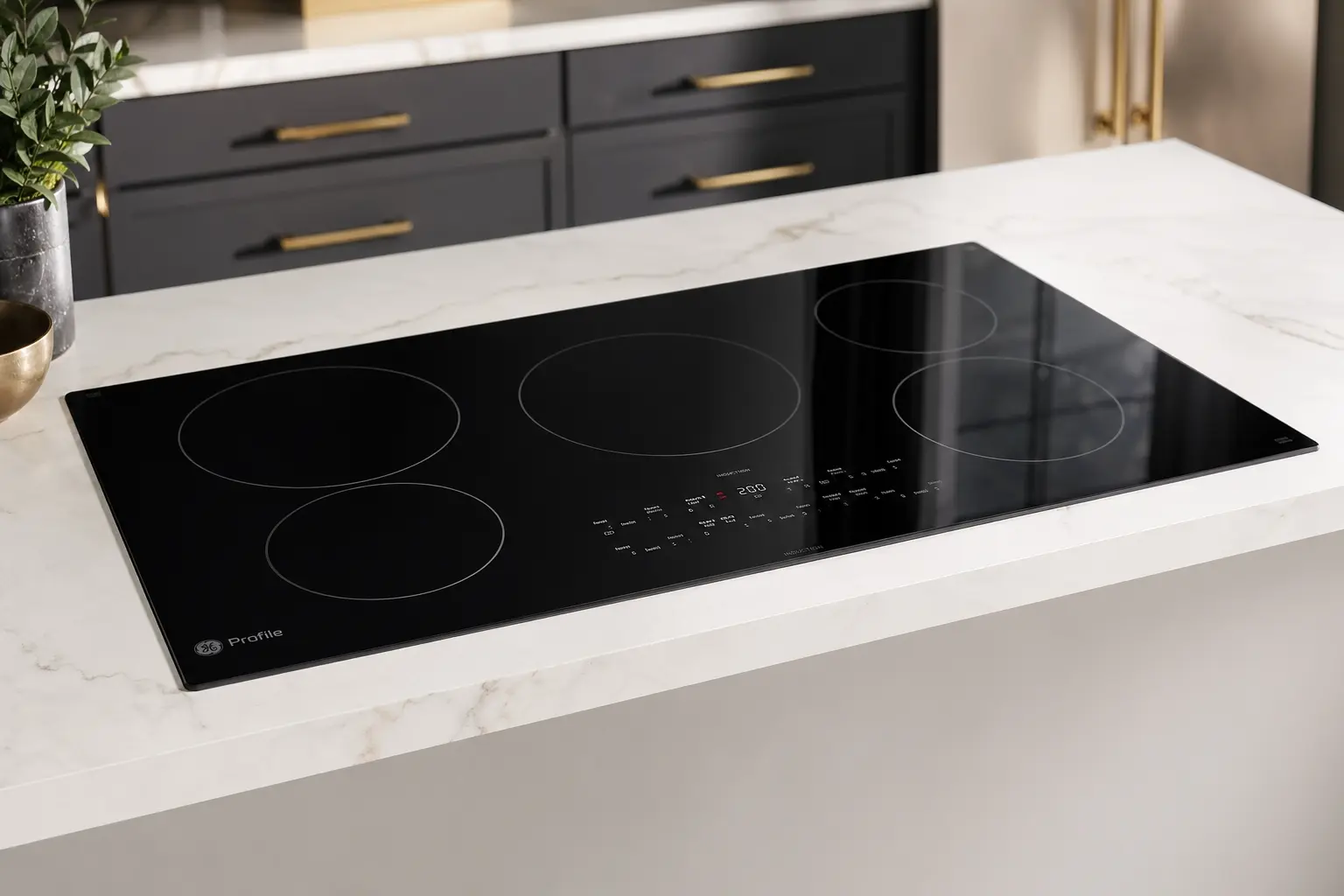
Choosing the best GE Profile Induction Cooktop comes down to three core features that set this line apart from conventional cooking surfaces: Power Boil for rapid heat delivery, Smart Controls for intuitive precision, and Precision Temperature for degree-by-degree cooking accuracy. GE Profile’s induction cooktop lineup — built on electromagnetic technology that heats cookware directly rather than the surface itself — represents the brand’s premium tier, engineered for home cooks who demand both performance and intelligence from their kitchen appliances. Whether you are upgrading from gas or replacing an aging radiant electric cooktop, the GE Profile series offers a compelling combination of speed, safety, and smart connectivity that very few competitors can match at the same price point. For a complete overview, see induction cooktop brand reviews.
Understanding which model suits your kitchen begins with knowing what GE Profile currently offers across its two primary size categories: the 30-inch and 36-inch built-in induction cooktops. Each size comes with distinct cooking zone configurations, wattage outputs, and smart feature availability — making the choice between them less about brand preference and more about how you actually cook. Beyond size, the decision hinges on whether features like SyncBurners, Chef Connect, and SmartHQ Wi-Fi integration align with your daily cooking habits.
Comparing GE Profile’s Smart Controls against standard induction panels reveals a meaningful gap in user experience. Where basic induction cooktops offer simple dial or button inputs, GE Profile’s glide touch controls allow burner-level monitoring from a smartphone app, automatic ventilation sync with compatible range hoods, and integration with wireless cooking probes — capabilities that transform a cooktop into a connected kitchen system.
Finally, the question every buyer eventually asks is whether a GE Profile induction cooktop is truly worth choosing over gas or radiant electric alternatives. The answer is yes — for most modern home cooks — provided they understand the electrical requirements, cookware compatibility, and the specific trade-offs involved. Here is a complete breakdown of everything you need to know before making your decision.
What Is a GE Profile Induction Cooktop and How Does It Work?
A GE Profile Induction Cooktop is a premium built-in cooking surface that uses high-frequency electromagnetic coils positioned beneath a smooth glass-ceramic panel to generate heat directly inside magnetic cookware — without ever heating the cooktop surface itself.
To understand why this matters, consider how conventional cooking works. A gas burner ignites a flame that heats the pan from below, losing significant energy to the surrounding air. A radiant electric coil glows red-hot and conducts heat upward through the glass surface into the pan. Induction takes an entirely different approach: an alternating electrical current runs through a copper coil beneath the glass, creating a rapidly oscillating magnetic field. When a pan with iron content is placed on the cooking zone, that magnetic field induces electrical currents — called eddy currents — directly inside the pan’s base. These currents generate heat within the cookware itself, not the glass, not the air, not the surrounding countertop.
The result is a cooking surface that stays cool to the touch even while a pan reaches 500°F. GE Profile reinforces this advantage with Auto Pan Detection, a sensor system that identifies when cookware has been placed on or removed from a cooking zone. The moment a pot is lifted, the element deactivates automatically — a safety behavior impossible to replicate with gas or radiant designs.
GE Profile sits at the premium tier of GE Appliances’ product hierarchy, positioned above the standard GE and GE Adora lines. This designation means every GE Profile induction cooktop ships with a full complement of features — including Power Boil elements, Precision Temperature Control, and touch-sensitive glide controls — rather than offering them as optional add-ons.
Frigidaire induction cooktop review Bosch induction cooktop reviewHow Does Power Boil Technology Work on GE Profile Cooktops?
Power Boil is GE Profile’s designation for its highest-output induction element, engineered to deliver maximum wattage directly into cookware for the fastest possible heat ramp-up. On the 30-inch models such as the PHP9030DTBB, the Power Boil element operates at up to 3,700 watts. On the larger 36-inch PHP9036DTBB, GE Profile includes multiple high-output elements reaching similar peak wattage across a five-zone layout.

To put that in practical terms: GE Appliances states that induction cooktops heat water in approximately half the time of a comparable radiant electric cooktop. A six-quart pot of water that might take 12 to 15 minutes to boil on a gas range reaches a rolling boil in roughly 6 to 7 minutes on a Power Boil induction element. The mechanism behind this speed is thermodynamic efficiency — because heat is generated inside the pan rather than transferred through air or glass, virtually no energy is lost in transit. Independent testing by Reviewed.com confirmed that the GE Profile PHP9036DTBB earns an “Excellent” rating in high-heat performance, one of the strongest scores in its category.
Beyond boiling pasta water, Power Boil proves valuable for high-heat searing, flash stir-frying in a carbon steel wok, and any cooking task that demands a fast, sustained temperature spike. Importantly, Power Boil does not sacrifice control for speed — the same element that rockets water to a boil can step down to a precise 140°F hold within seconds of adjustment.
What Is Precision Temperature Control and Why Does It Matter?
Precision Temperature Control is GE Profile’s feature that allows a cooking zone to maintain a specific temperature — set in single-degree increments from 100°F to 500°F — rather than operating on vague High, Medium, or Low heat bands.
On a standard cooktop, “medium heat” is a relative term. It means different things on different burners, in different pans, and at different ambient conditions. A candy recipe calling for a 235°F sugar syrup requires constant thermometer monitoring and manual adjustment on a conventional stove. Precision Temperature Control eliminates that guesswork entirely: you set 235°F, pair the cooktop with a compatible smart pan or temperature probe, and the system self-regulates to hold that exact temperature throughout the cooking process.
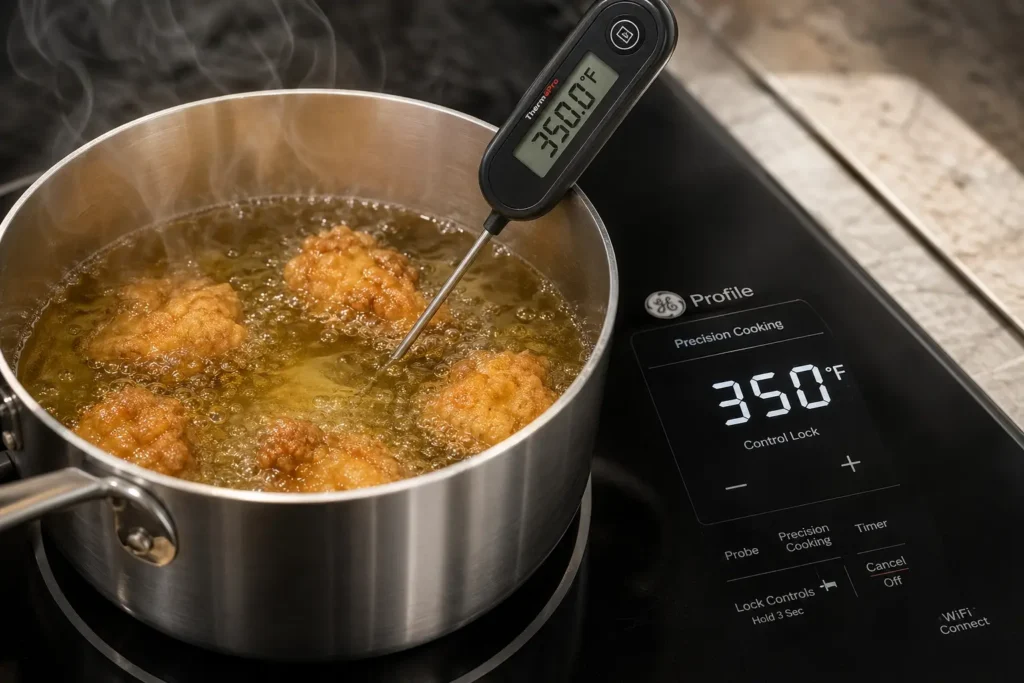
This capability has concrete applications across several cooking techniques that are notoriously difficult to execute consistently:
- Chocolate tempering requires holding melted chocolate between 88°F and 90°F — a window so narrow that most conventional burners cycle too aggressively to maintain it.
- Deep frying demands oil held at a precise 350°F or 375°F; temperature drift above or below that range degrades both food texture and oil longevity.
- Candy making involves multiple critical temperature stages (soft ball, hard crack) where even a 5°F variance can ruin a batch.
- Sous vide-style searing after vacuum cooking requires a screaming-hot pan surface held at maximum temperature for a brief, consistent contact time.
Precision Temperature Control paired with GE Profile’s optional Hestan Cue smart pan takes this a step further, allowing the pan itself to communicate actual surface temperature back to the cooktop, enabling closed-loop temperature regulation without any external thermometer.
Which GE Profile Induction Cooktop Models Are Available to Buy?
There are two primary size categories of GE Profile Induction Cooktops — 30-inch and 36-inch — with multiple model numbers across each, differentiated by finish, cooking zone count, and smart feature inclusion.
Below is a comparative overview of the main GE Profile induction cooktop models currently available through major retailers including Best Buy, Lowe’s, Home Depot, and Costco:
The table below compares the key specifications across GE Profile’s current induction cooktop lineup, helping buyers identify which model aligns with their kitchen size, cooking habits, and budget.
| Model | Size | Cooking Zones | Power Boil | SyncBurners | Wi-Fi | Approx. Price |
|---|---|---|---|---|---|---|
| PHP9030DTBB | 30″ | 4 | Yes | No | Yes | ~$1,799 |
| PHP9030BMTS | 30″ | 4 | Yes | No | Yes | ~$1,999 |
| PHP6030DWBB | 30″ | 4 | Yes | No | No | ~$1,399 |
| PHP9036DTBB | 36″ | 5 | Yes | Yes | Yes | ~$2,299 |
Across all models, the glass-ceramic surface, Auto Pan Detection, Precision Temperature Control, and 19-level heat settings are standard inclusions. The differentiating factors between models fall primarily along three axes: physical size, the presence of SyncBurners, and Wi-Fi connectivity.
What Are the Key Differences Between the 30-Inch and 36-Inch GE Profile Induction Cooktops?
The 30-inch models offer four cooking zones; the 36-inch model provides five — and that fifth zone is not simply “more room,” but specifically enables the SyncBurners feature that bridges two adjacent elements into a single extended cooking surface.
For most standard households cooking for two to four people, a 30-inch cooktop with four zones is fully sufficient. The PHP9030DTBB fits a standard 30-inch countertop cutout and operates on a 240V, 40-amp dedicated circuit. Its four elements cover the cooking scenarios most home cooks encounter daily: one Power Boil zone for rapid heating, two mid-range zones for simmering and sautéing, and one smaller zone suited for sauces or warming.
The 36-inch PHP9036DTBB makes more sense in three scenarios: households that regularly cook large meals simultaneously, kitchens where a griddle or fish pan is a frequent tool, and cooks who have already invested in or intend to invest in the SmartHQ app ecosystem and want maximum burner monitoring flexibility. The fifth element and SyncBurner capability are exclusive to the 36-inch model. Electrically, the 36-inch model requires a 240V, 50-amp circuit — which may require an electrical panel upgrade in older homes.
According to a comparative feature guide published by Reviewed.com, the GE Profile PHP9036DTBB earned the distinction of “best overall” induction cooktop in its category, praised specifically for its five-zone layout, SyncBurner functionality, and Wi-Fi integration.
Best 30-inch induction cooktopsHow Do GE Profile Induction Cooktop Prices Compare Across Retailers?
GE Profile induction cooktops are priced in the premium segment, with the 30-inch entry point around $1,399 for the non-Wi-Fi PHP6030DWBB and the 36-inch flagship reaching $2,299 for the PHP9036DTBB. Pricing is largely consistent across major retailers, though promotional timing — particularly holiday sales events and appliance bundle deals — can yield discounts of $200 to $400.
One noteworthy purchasing consideration is GE Appliances’ Fits Guarantee program: if a GE Profile induction cooktop does not fit an existing countertop cutout, GE will contribute up to $100 toward modification costs. This rebate meaningfully reduces the risk of purchasing a new cooktop in a kitchen that was previously configured for a different brand or size — a common concern when switching from gas to induction.
Induction cooktop price guideCostco periodically carries the 36-inch model with bundle pricing that includes an extended delivery service, making it a competitive option for buyers in areas within 50 miles of a warehouse location.
How Do GE Profile Smart Controls Compare to Standard Induction Cooktops?
Yes, GE Profile Smart Controls deliver a meaningfully superior user experience compared to standard induction cooktop controls — thanks to glide touch interface design, SmartHQ Wi-Fi app integration, Chef Connect automation, and wireless probe compatibility that standard induction panels simply do not offer.
Most conventional induction cooktops — even well-regarded models from Samsung or Frigidaire — provide push-button or dial controls that set power levels from 1 to 9 or operate in fixed heat bands. GE Profile’s glide touch controls allow a continuous slide motion across a smooth sensor strip, making micro-adjustments to heat levels more intuitive and faster than stepping through discrete buttons. Combined with the 19 available heat settings per zone, this gives cooks finer granularity than any gas burner can provide.
What Can You Control With the GE Profile SmartHQ App?

The GE Profile SmartHQ app, available for iOS and Android, allows remote monitoring and limited control of the cooktop’s active burner states via a home Wi-Fi connection.
Specifically, the app enables:
- Real-time burner status monitoring — view which zones are active and at what power level or temperature setting from any room in the house, or remotely if the device has internet access.
- Power level adjustment — modify heat settings on active burners without returning to the cooktop.
- Precision Temperature display — see exact set-point temperatures when operating in Precision Temperature mode.
- Notification alerts — receive alerts when a burner has been left on, or when a cooking timer expires.
- Voice control integration — SmartHQ connects with Amazon Alexa and Google Home, enabling commands like “Hey Google, turn off the front left burner.”
It is worth noting that the SmartHQ app does not override physical controls — it supplements them. GE designed the system so that the cooktop always remains functional without app interaction, preventing scenarios where a connectivity outage disrupts cooking.
What Is SyncBurners and Who Should Use It?

SyncBurners is a GE Profile-exclusive feature available on the 36-inch PHP9036DTBB that electronically links two adjacent cooking zones to operate as a single, extended induction surface.
When activated, SyncBurners treats the merged zone as one element — meaning heat output is coordinated across both areas simultaneously rather than each responding independently. This is specifically designed for oversized cookware that spans two burner positions: cast iron griddles, double-burner grill pans, large paella dishes, fish poachers, and extra-wide sauté pans that would otherwise receive uneven heat because only the zone directly beneath each element would be active.
SyncBurners is not available on any 30-inch GE Profile model. Buyers who regularly cook for large groups, prepare foods requiring long flat cooking surfaces, or work with professional-grade oversized cookware will find this feature justifies the upgrade to the 36-inch model on its own.
Is the GE Profile Induction Cooktop Worth Buying Over Gas or Radiant?
Yes, the GE Profile Induction Cooktop is worth buying over both gas and radiant electric alternatives for most modern home cooks — because it wins on heating speed versus radiant, precision and safety versus gas, and ease of cleaning versus both — provided the buyer’s kitchen can accommodate the 240V electrical requirement and their cookware is magnetically compatible.
This is not a one-dimensional comparison. Each cooking technology has genuine strengths, and the right choice depends on how a buyer weighs speed, control, safety, and ongoing operating cost. The following table outlines a three-way comparison across the criteria that matter most to home cooks researching an upgrade.
The table below compares GE Profile Induction against gas and radiant electric cooktops across seven key performance and usability dimensions:
| Criteria | GE Profile Induction | Gas Cooktop | Radiant Electric |
|---|---|---|---|
| Heat-up speed | ⚡ Fastest | Fast | Slowest |
| Temperature precision | ✅ Degree-accurate | ❌ Approximate | Moderate |
| Surface safety | ✅ Stays cool | ❌ Open flame | ❌ Hot coils |
| Cleaning | ✅ Smooth wipe | ❌ Grates & burners | Moderate |
| Energy efficiency | ✅ ~85% efficient | ~40% efficient | ~70% efficient |
| Cookware flexibility | Magnetic only | Universal | Universal |
| Installation cost | Higher (electrical) | Gas line required | Standard 240V |

What Are the Pros and Cons of GE Profile Induction Cooktops?
Based on verified purchaser reviews aggregated from Best Buy, independent lab testing from Reviewed.com, and reliability data from Yale Appliance, here is an honest assessment of the GE Profile induction cooktop’s real-world performance:
Pros:
- Speed advantage over gas: GE Appliances’ own testing shows induction boils water approximately 50% faster than radiant, and meaningfully faster than most residential gas configurations.
- Cool-to-touch surface: Because only the cookware heats up, spills on the glass surface do not bake on. A paper towel placed between the glass and a pan will not scorch — the glass simply does not reach combustion temperatures.
- 19-level heat settings: More granularity than any gas burner, enabling precise control over low-and-slow cooking as well as high-heat searing.
- Smart connectivity: SmartHQ, Chef Connect, and Alexa/Google integration add genuine utility for monitoring-conscious cooks.
- Energy efficiency: Industry estimates place induction at approximately 85–90% energy transfer efficiency versus roughly 40% for gas — resulting in lower monthly operating costs over time.
Cons:
- Cookware replacement cost: Non-magnetic pans — including aluminum, copper, glass, and non-magnetic stainless steel — will not work on induction. Buyers switching from gas may need to replace some or all of their existing cookware.
- Touch control sensitivity: Multiple customer reviews on Best Buy note that the glide touch controls require a short adjustment period. Accidental brush contact can change heat settings, and wet fingers can sometimes cause unintended inputs.
- Electrical infrastructure requirement: The 30-inch model requires a 240V/40A dedicated circuit; the 36-inch model needs 240V/50A. Homes wired for gas cooking may not have the correct electrical panel capacity, adding $300–$800 or more in electrician costs.
- Glass surface fragility: While the tempered glass-ceramic is highly scratch-resistant under normal use, it can crack under direct impact — dropping a heavy cast iron pan from height onto the surface being the most commonly cited damage scenario.
Does the GE Profile Induction Cooktop Require Special Cookware?
Yes, the GE Profile Induction Cooktop requires cookware with a magnetically responsive base — but the range of compatible materials is wider than many buyers initially assume.
The cooktop’s Auto Pan Detection system identifies compatible cookware by sensing whether a magnetic field can be established through the pan’s base. Any pan that allows a standard refrigerator magnet to adhere firmly to its bottom surface will work on a GE Profile induction cooktop.
Compatible cookware materials:
- Cast iron (bare or enameled) — excellent compatibility, excellent heat retention
- Magnetic stainless steel — the most common compatible material in modern cookware sets
- Carbon steel — highly compatible, preferred by professional cooks for its responsiveness
- Enameled magnetic steel — compatible, including brands like Le Creuset and Staub
Incompatible cookware materials:
- Aluminum (without magnetic base disc) — not compatible
- Copper — not compatible
- Glass and ceramic — not compatible
- Non-magnetic stainless steel (common in older cookware) — not compatible
The simplest compatibility test: hold a standard magnet to the bottom of your existing pan. If it sticks firmly, the pan is induction-ready. If it slides or doesn’t adhere, that piece is incompatible. Most modern mid-range and premium cookware sets sold after 2015 include induction-compatible bases, so buyers upgrading from recently purchased cookware are unlikely to face significant replacement costs.
What Else Should You Know Before Installing a GE Profile Induction Cooktop?
Before completing a GE Profile induction cooktop purchase, buyers should address three installation and compatibility considerations that are frequently overlooked during the research phase: electrical infrastructure, smart cookware ecosystem integration, and long-term reliability data.
These factors do not affect whether the GE Profile line is the right choice — for most buyers, it is — but they do affect the total cost of ownership and the timeline from purchase to first use.
How to install an induction cooktopWhat Are the Electrical Requirements for a GE Profile Induction Cooktop?
The GE Profile 30-inch induction cooktops require a 240-volt, 40-amp dedicated circuit; the 36-inch model requires a 240-volt, 50-amp dedicated circuit. Both require a four-wire connection (two hot legs, one neutral, one ground) terminating in an appropriate disconnect or junction box beneath the cooktop cutout.
For homes currently equipped with a gas range, no 240V circuit may exist in the kitchen at all — necessitating new wiring run from the electrical panel to the cooktop location. For homes with an existing 240V radiant electric cooktop on a 40-amp circuit, the 30-inch GE Profile can typically be installed as a direct replacement. Upgrading to the 36-inch model from a 30-inch radiant installation may require a circuit upgrade from 40 to 50 amps.
Electrician costs for this work vary significantly by region and panel accessibility, but buyers should budget between $300 and $800 for wiring work in most U.S. markets. The GE Profile Fits Guarantee’s $100 cutout modification rebate does not apply to electrical work — it covers only countertop modifications.
On an ongoing operational basis, induction’s energy efficiency advantage translates to measurable savings. The U.S. Department of Energy notes that induction cooking is approximately 5–10% more efficient than standard electric resistance cooking, and significantly more efficient than gas when accounting for combustion losses. Over the lifetime of an appliance used daily, this difference accumulates to hundreds of dollars in reduced utility costs.
Is the GE Profile Induction Cooktop Compatible With Hestan Cue Smart Pans?
Yes, the GE Profile induction cooktop is compatible with Hestan Cue smart pans, and GE Appliances periodically offers a rebate program that offsets the cost of a Hestan Cue pan purchase when buying a qualifying GE Profile cooktop.
The Hestan Cue system consists of a Bluetooth-enabled pan with embedded temperature sensors in its base. When paired with a compatible induction cooktop and the Hestan Cue app, the pan communicates its actual surface temperature back to the cooktop in real time, enabling the cooktop to adjust power output to maintain a specific pan temperature — not just a power setting. This creates a fully closed-loop cooking system where the pan, the cooktop, and the app work together to execute temperature-sensitive recipes with a level of repeatability previously available only in professional kitchens.
This feature is genuinely valuable for a specific type of home cook: someone who prioritizes culinary precision, regularly executes techniques like tempering chocolate, making caramel, or searing proteins to exact internal temperatures, and is willing to invest in a premium cookware ecosystem. For the majority of home cooks, however, GE Profile’s built-in Precision Temperature Control (using the cooktop’s own induction sensing rather than a smart pan) provides sufficient accuracy without requiring additional hardware purchases.
How Does GE Profile Induction Cooktop Perform in Long-Term Reliability Tests?
According to service rate data compiled by Yale Appliance — one of the largest independent appliance retailers in the northeastern U.S. — GE Profile ranks among the more reliable induction cooktop brands in the market, alongside Bosch and Bosch-manufactured sub-brands like Gaggenau. Yale’s data, drawn from tens of thousands of service calls, positions GE Profile as a dependable long-term investment rather than a high-maintenance premium purchase.
Consumer Reports’ lab testing, which evaluates cooktops across heating evenness, simmer performance, high-heat output, and owner satisfaction surveys, has consistently rated GE Profile models in the upper tier of tested induction brands. The PHP9036DTBB in particular received strong marks for both high-heat performance and low-heat simmer consistency — the two ends of the temperature spectrum where induction cooktops most commonly underperform competitors’ marketing claims.
One durability note worth flagging: multiple long-term user reviews on Best Buy and Costco mention that the glass-ceramic surface can crack under direct impact — specifically from cast iron cookware dropped from height. This is not a defect unique to GE Profile; it is a characteristic of all glass-ceramic cooktop surfaces. Users who regularly cook with heavy cast iron should develop the habit of sliding rather than dropping cookware onto the surface, and should consider whether a stainless steel induction range (which sits differently in the counter cutout) might offer better impact resistance in heavy-use kitchens.
What Is the Difference Between GE Profile and GE Café Induction Cooktops?
GE Profile and GE Café represent two distinct premium tiers within GE Appliances’ product hierarchy — with GE Café positioned above GE Profile in terms of design customization, finish quality, and aspirational kitchen aesthetics, while GE Profile leads on smart technology integration and value-to-performance ratio.
The core performance differences are relatively modest. Both lines use induction technology, both offer Power Boil elements and precision temperature features, and both connect to the SmartHQ ecosystem. The meaningful distinctions fall into three areas:
Design and finish options: GE Café offers matte black, brushed brass hardware, brushed stainless, and designer colorways intended to coordinate with the brand’s retro-modern aesthetic. GE Profile’s finishes are more restrained — primarily black on black and stainless steel — oriented toward contemporary minimalist kitchens.
Price positioning: GE Café induction cooktops typically carry a 15–25% price premium over comparable GE Profile models, reflecting the cost of premium finish materials and the brand’s lifestyle positioning rather than functional cooking advantages.
Target buyer: GE Profile is the right choice for buyers who prioritize smart features, cooking performance, and value in a premium package. GE Café is the right choice for buyers where kitchen aesthetics and design coherence — particularly in a renovation or custom kitchen build — justify the additional cost.
For most buyers comparing the two, GE Profile delivers equivalent or superior functional cooking capability at a lower price point. GE Café earns its premium only when the kitchen’s design narrative specifically calls for it.