
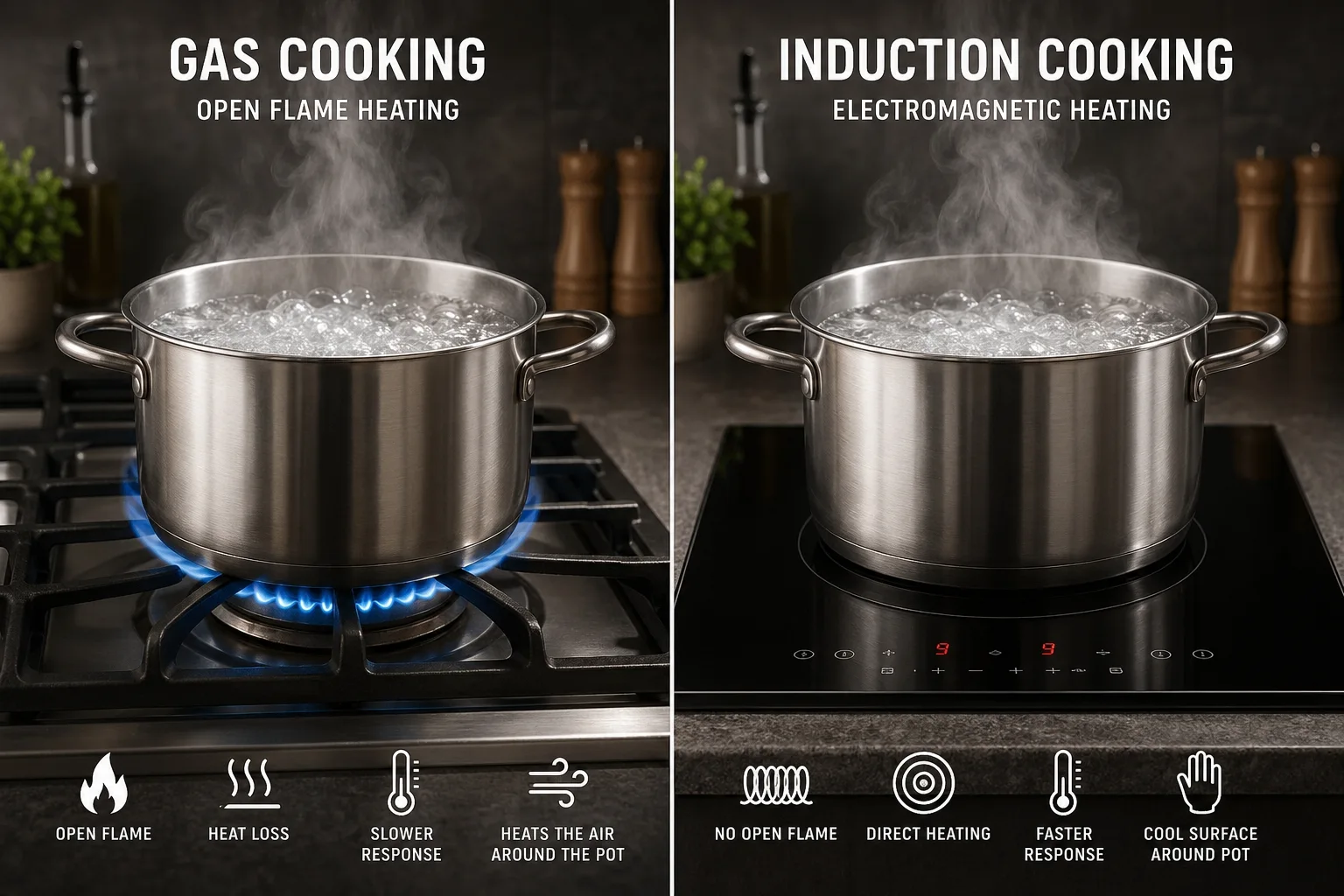
For most home cooks, an induction cooktop is the better stove because it cooks faster, wastes less heat, is easier to clean, and removes the risk of an open flame. However, a gas cooktop still makes more sense for cooks who strongly prefer visible flame control, frequent wok cooking, or universal cookware compatibility. For a complete overview, see induction cooktop comparisons.
That core decision becomes clearer when you compare the two cooktop types by the criteria that matter most in real kitchens: heating speed, temperature control, safety, cleaning, and energy efficiency. In particular, induction tends to win on speed and efficiency, while gas holds onto advantages in open-flame techniques such as charring and some wok-based cooking styles.
The next layer of the choice is practical, not theoretical. Home cooks also need to compare total cost, including purchase price, installation, cookware compatibility, ventilation, and long-term operating expenses. In other words, the “better stove” is not always the one with the best raw performance; it is the one that fits your kitchen, budget, and cooking habits with the fewest compromises.
To understand the choice fully, this guide moves from the basics of how each cooktop works to the real-life trade-offs that matter for everyday cooking at home. After that, it closes with the setup details and edge cases you should know before switching between induction and gas.
What Is the Difference Between Induction and Gas Cooktops?
Induction and gas cooktops are two cooking systems with different heat sources: induction uses electromagnetism to heat compatible cookware directly, while gas uses an open flame to heat the pan from below.
To understand that difference more clearly, it helps to think about where the heat is created. On an induction cooktop, electricity passes through a coil beneath the glass surface and creates a magnetic field. When a compatible pan sits on the zone, the pan itself becomes the heat source. On a gas cooktop, fuel burns into a visible flame, and that flame transfers heat into the cookware and the surrounding air at the same time. That is why induction usually feels more contained and efficient, while gas feels more traditional and tactile.
Is an Induction Cooktop an Electric Stove?
Yes, an induction cooktop is an electric stove, but it does not heat like a conventional electric smoothtop. It uses magnetic energy, heats faster, and transfers more of its energy into the cookware itself.
Because this question often creates confusion, the key distinction is not “electric versus non-electric,” but how electricity becomes heat. A standard radiant electric cooktop first heats the cooking element, then the element heats the pan. Induction skips that intermediate step by generating heat inside compatible cookware. That is why induction often behaves more like gas in responsiveness, even though it belongs to the electric category.
Induction vs electric cooktops
How to switch from gas to induction cooktop
Does a Gas Cooktop Heat the Pan More Directly Than Induction?
No, a gas cooktop does not heat the pan more directly than induction. Gas heats with a direct flame, but induction heats the cookware itself more directly because the pan becomes the heating element.
That distinction matters because many home cooks equate “visible flame” with “direct heat.” In practice, a gas flame sends significant heat into the air around the pan, while induction focuses more of its energy where cooking actually happens. This is one reason induction usually produces faster boil times and a cooler kitchen environment.
Why switch to induction — energy and eco benefits
Which Cooktop Heats Faster and Gives Better Temperature Control?
Induction wins on heating speed, gas is strong for visual flame response, and both can feel precise in different ways. For most home cooks, induction offers the best mix of fast boiling, fast adjustment, and repeatable control.
To build from that answer, you need to separate two related but different questions: how quickly a cooktop reaches high heat and how accurately it holds lower heat. Induction is usually faster at tasks like boiling water because it transfers heat into the pan with less waste. Gas, in contrast, gives immediate visual feedback through flame size and still feels intuitive for cooks who are used to managing heat by sight and hand movement.
Does Induction Boil Water Faster Than Gas?
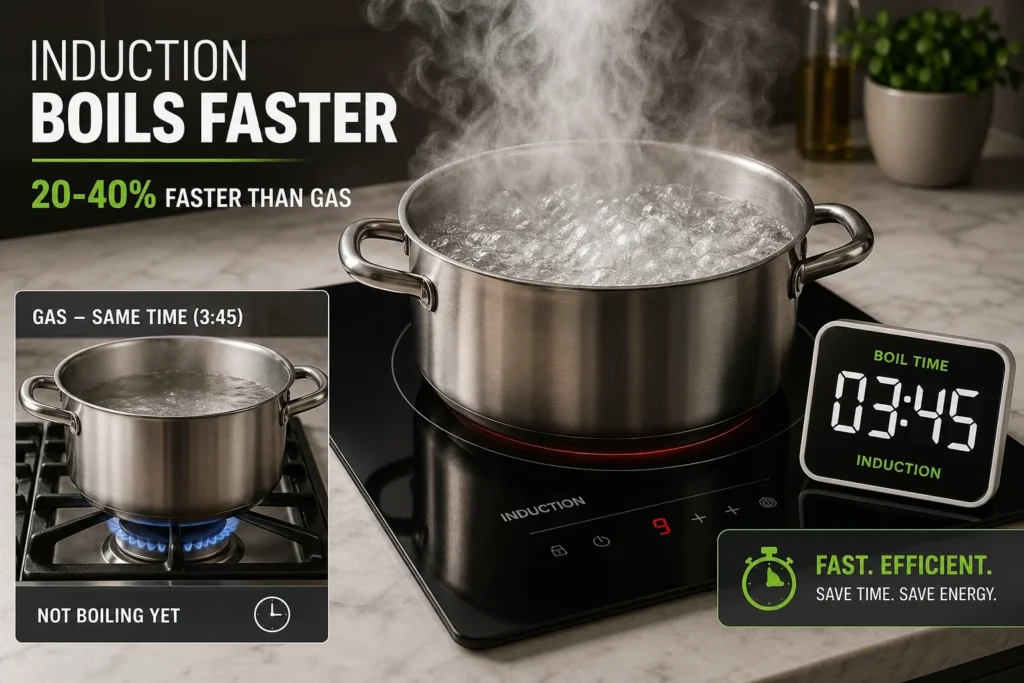
Yes, induction boils water faster than gas because it transfers heat more efficiently, reduces waste, and reacts faster when power increases. Those three advantages make induction the speed leader in most home kitchens.
Because boiling speed is one of the easiest performance tests to visualize, it is also one of the clearest. Breville notes that induction cooktops can bring water to a boil 20% to 40% faster than gas. CNET’s own test found that an induction cooktop boiled 60 ounces of water in just over five minutes, compared with just over eight minutes on gas. CHOICE also reported that induction transferred energy at roughly 85% efficiency, versus 32% for gas-powered heating elements, and that one top induction model boiled one liter of water in 2 minutes 19 seconds, while a gas cooktop took four minutes or longer.
Is Gas Better for Searing, Charring, and Wok Cooking?
Yes, gas is usually better for searing, charring, and wok cooking because it provides open-flame contact, sidewall heat, and broader cookware flexibility. Those three traits suit traditional high-heat techniques especially well.
That does not mean induction is weak at high heat; it means gas supports certain flame-dependent techniques more naturally. If you regularly char peppers over a burner, flambé, or use a round-bottom wok, gas still offers a cooking experience induction cannot fully replicate. JennAir specifically notes that gas excels at searing, charring, and wok-style cooking, while KitchenAid highlights gas for techniques such as charring, flambéing, and cast-iron grilling. For a home cook who values those methods every week, gas may still feel like the more satisfying tool.

Which Cooktop Is Safer, Cleaner, and More Energy-Efficient?
Induction is safer, cleaner, and more energy-efficient, while gas remains workable but demands more ventilation, more cleanup, and more caution around flame and heat loss.
To connect this back to daily use, the best stove is not just the one that cooks fastest. It is also the one that creates fewer problems before, during, and after the meal. In practical terms, that means looking at three things together: how hot the surrounding surface gets, how much mess the cooktop traps, and how much energy escapes into the room instead of the pan. On those three fronts, induction usually has the edge.
Is Induction Safer for Families With Children and Everyday Home Use?
Yes, induction is safer for families and everyday home use because it has no open flame, the surrounding surface stays cooler, and heating stops when compatible cookware is removed.
That safety advantage matters most in normal domestic routines, not just in emergencies. A parent moving quickly between dinner prep and cleanup has less exposure to flare-ups, loose sleeves near flame, or curious children reaching toward a burner. Consumer Reports explains that if you turn on an induction element without a pot on it, it does not get hot in the same way a traditional burner does, and the surface never reaches the same level of residual heat as a standard electric element. JennAir also emphasizes that induction minimizes the risk of burns or grease fires because there is no open flame.
Does Gas Need More Ventilation and Affect Indoor Air Quality More Than Induction?
Yes, gas usually needs more ventilation and affects indoor air quality more than induction because combustion releases pollutants, creates more ambient heat, and requires stronger airflow management.
The practical takeaway is not that every gas cooktop is unsafe by default, but that ventilation becomes a much bigger part of the ownership equation. CNET cites expert commentary on nitrogen dioxide, carbon monoxide, methane, and benzene concerns tied to gas use and emphasizes the value of using an exhaust fan or opening windows. CHOICE also notes health concerns around gas cooking, especially for people with asthma, while Rewiring America argues that induction removes indoor combustion pollution from the cooking process altogether. If your household includes children, older adults, or people with respiratory sensitivities, this criterion deserves more weight than many buyers initially give it.

Which Cooktop Is Easier to Clean After Daily Cooking?
Induction is easier to clean after daily cooking because it has a flat glass surface, fewer crevices, and less baked-on residue around burners and grates.
That difference becomes obvious the moment sauce boils over. On an induction cooktop, most spills stay on the smooth surface and are easier to wipe away because the area around the cookware does not get as hot as a gas grate or traditional radiant element. By contrast, gas cooktops usually require cleanup around burner caps, grates, and gaps where grease collects. CHOICE explicitly notes that induction surfaces are generally much easier to clean, while KitchenAid lists the quick-cooling, sleek surface as one of induction’s main practical benefits.

What Costs Should Home Cooks Compare Before Choosing a Stove?
Home cooks should compare four cost areas before choosing a stove: purchase price, installation cost, cookware cost, and long-term operating cost. Gas often starts cheaper; induction can deliver long-term efficiency benefits.
To make this easier to evaluate, the table below summarizes the main cost categories home cooks should review before deciding between induction and gas cooktops.
| Cost category | Induction cooktop | Gas cooktop |
|---|---|---|
| Upfront purchase price | Often higher | Often lower to mid-range |
| Installation | May require electrical upgrades | May require gas line or gas hookup |
| Cookware | May need magnetic-compatible cookware | Works with nearly all cookware |
| Running cost | Efficient, but depends on electricity price | Can be cheaper to run in some markets, but less efficient |
| Hidden home cost | Possible electrical panel/circuit work | Ventilation considerations, gas supply charges |
That table shows why a “better stove” cannot be chosen on sticker price alone. A lower purchase price can be offset by higher heat waste, extra ventilation needs, or supply charges. Conversely, an efficient induction model may cost more at checkout but save time, reduce kitchen heat, and fit a cleaner all-electric home plan over time.
Is a Gas Cooktop Cheaper to Buy Up Front?
Yes, a gas cooktop is often cheaper to buy up front because induction models usually carry a higher initial price, fewer low-end options, and more premium positioning.
This is one reason gas remains attractive to budget-conscious buyers. CNET’s comparison of several brands found that induction ranges were usually the most expensive category in their sample, often with the widest price spread. Breville also notes that induction has historically come with a higher upfront cost, even though prices have become more competitive as the technology has spread. If your decision horizon is short and you want the lowest cost at the time of purchase, gas often looks easier to justify.
Does an Induction Cooktop Cost More to Install or Save More Over Time?
Yes, an induction cooktop can cost more to install, and yes, it can save more over time in the right home setup. The answer depends on your electrical capacity, local utility rates, and cooking frequency.
Because this issue is highly situation-dependent, home cooks should think in two timelines. In the short term, CHOICE warns that some induction installations may require a new dedicated circuit or even a switchboard upgrade, which can add meaningful cost. In the long term, the same source says households may save on running costs by switching from gas to induction, especially when moving toward a broader all-electric home. CNET adds useful nuance by noting that in a state like New York, estimated hourly operating costs can still favor gas because local electricity prices matter. So induction is not “automatically cheaper”; it is often more efficient, but the final operating-cost outcome depends on your utility market.
Do You Need New Cookware for Induction?
Yes, you may need new cookware for induction because induction requires magnetic-compatible pots and pans, while gas works with nearly all cookware types.
This requirement is simple in theory but important in budgeting. Cast iron and many stainless steel pans usually work on induction, but aluminum, glass, copper, and some specialty pans may not unless they include an induction-compatible base. Consumer Reports recommends using the magnet test on existing cookware, while Breville points out that irregular shapes such as some woks may not work well on induction surfaces. For many households, the real cost of switching is not just the appliance; it is the appliance plus the cookware ecosystem around it.
How to check if cookware is induction compatible

Which Cooktop Is Better for Different Types of Home Cooks?
Induction is better for fast, clean, safety-first cooking; gas is better for traditional flame-based cooking; and the best choice depends on the kind of home cook you are.
To move from comparison into decision-making, it helps to stop thinking about appliances in the abstract and start thinking about actual people. A busy parent, a health-conscious household, a hobbyist stir-fry enthusiast, and a design-focused homeowner may all reach different conclusions from the same feature list. Matching the stove to the cook matters more than winning every category on paper.
Is Induction Better for Fast, Clean, Everyday Cooking?
Yes, induction is better for fast, clean, everyday cooking because it boils faster, cleans up easier, and keeps the kitchen cooler during routine meal prep.
That combination is exactly what many weekday home cooks need. If your usual routine involves boiling pasta, simmering soup, reheating leftovers, or cooking dinner after work with limited time, induction removes friction at almost every step. It heats quickly, spills are easier to wipe, and less ambient heat leaks into the room. For households that value convenience over culinary theater, induction often feels like the more modern and less demanding choice.
Is Gas Better for Traditional Cooks Who Want Flame Control?
Yes, gas is better for traditional cooks who want flame control because it offers visible heat cues, instant manual adjustment, and compatibility with almost any cookware.
That answer especially fits cooks who learned to judge heat by watching the flame and listening to the pan. Gas also feels familiar in a way induction does not, and that familiarity reduces friction for people who do not want to relearn cookware behavior or touch-based controls. If your cooking identity is built around tactile control, searing, and flame-facing techniques, gas may still deliver the more intuitive experience even if it loses on efficiency.
Which Stove Is Better for Small Kitchens, Busy Families, and Health-Conscious Homes?
Induction is better for small kitchens, busy families, and health-conscious homes because it limits excess heat, simplifies cleaning, and avoids open-flame combustion in the kitchen.
These households usually care less about restaurant-style flame technique and more about safety, speed, and comfort. A small kitchen gets stuffy faster under gas. A busy family benefits from quick cleanup and reduced burn risk. A health-conscious buyer may value the fact that induction eliminates indoor combustion during cooking. In those everyday home contexts, induction is not just technically better in a few categories; it is often better aligned with how the space is actually used.
Should Home Cooks Choose Induction or Gas Cooktops?
Yes, most home cooks should choose induction over gas because induction is faster, safer, and easier to maintain. Gas remains the better fit only for specific flame-focused cooking preferences.
To conclude the main decision directly, the default recommendation for modern home cooking is induction. That recommendation does not mean gas is obsolete. It means the average home cook gains more practical value from induction’s strengths than from gas’s strengths. Faster boiling, easier cleaning, less waste heat, and safer day-to-day operation solve more common household problems than visible flame solves.
Should You Choose Induction If You Want Speed, Safety, and Easy Cleanup?
Yes, you should choose induction if you want speed, safety, and easy cleanup because it combines efficient heating, cooler surfaces, and a wipe-clean design.
This is the clearest “yes” in the entire comparison. If your cooking life is defined by weeknight meals, family routines, small-space comfort, or energy-conscious thinking, induction directly answers those needs. It is the stove that reduces hassle while improving day-to-day performance, and that is why it is the more future-facing choice for most households.
Should You Choose Gas If You Value Flame Cooking and Maximum Cookware Flexibility?
Yes, you should choose gas if you value flame cooking and maximum cookware flexibility because gas supports open-flame techniques, works with almost any pan, and feels more natural for some experienced cooks.
This is the exception that proves the rule. Gas remains compelling when your cooking style truly depends on what only gas does well: charring over flame, accommodating specialty cookware without question, and delivering a classic tactile relationship between knob, flame, and pan. If those benefits are central to how you cook, gas may still be the right answer for you even when induction wins the overall comparison.
What Else Should You Know Before Switching Between Induction and Gas Cooktops?
Before switching between induction and gas cooktops, you should check your kitchen’s power setup, cookware edge cases, noise expectations, and backup cooking needs during outages.
After the main choice is made, these practical details become the contextual border between a good decision on paper and a smooth ownership experience in real life. This final section covers the issues that do not usually decide the comparison alone, but can absolutely affect satisfaction after installation.
Can Your Kitchen Electrical System Support an Induction Cooktop?
Yes, your kitchen can support an induction cooktop only if the electrical system has the required circuit capacity, wiring, and connection standard for the model you choose.
This is the first thing to verify before replacing gas with induction. CHOICE explains that some induction cooktops may require a 20A, 32A, or even 42A connection, and some homes may need a new circuit or switchboard work. That does not mean every installation becomes expensive, but it does mean buyers should ask an electrician early rather than assume a simple swap. If your kitchen is already configured for electric cooking, the transition may be easier; if not, infrastructure can become the biggest hidden cost in the project.
Why Do Some Induction Cooktops Make a Buzzing or Humming Noise?
Some induction cooktops make a buzzing or humming noise because electromagnetic vibration, pan construction, and cooling fans can create sound during operation.
This detail surprises first-time induction users because the technology otherwise feels so sleek and quiet. Consumer Reports notes that a buzz or hum is common and may be louder at higher settings, while Breville mentions that some people hear slight buzzing or fan sounds. In most cases, this is normal rather than a defect. Heavier, flat-bottom cookware can sometimes reduce vibration, which is why pan quality affects not just cooking performance but also acoustic comfort.
Is a Gas Cooktop Better During a Power Outage?
Yes, a gas cooktop can be better during a power outage because gas cooking is less dependent on household electricity than induction, and some users value that resilience.
That said, buyers should treat this as a situational advantage, not a universal deciding factor. If outages are rare in your area, day-to-day efficiency and convenience may matter more than backup cooking ability. But if you live somewhere with weather-related interruptions or strongly value off-grid-like resilience, gas gains a meaningful practical point that does not always appear in standard comparison charts.
Can You Use a Wok, Cast Iron, or Specialty Cookware on Both Cooktops?
Yes, you can use some shared cookware on both cooktops, but gas is more flexible overall while induction is more selective. Cast iron often works on both; specialty shapes can be more complicated on induction.
This is where edge cases matter. Cast iron, many stainless-steel pans, and enameled cast iron usually work well on induction if they are magnetic. Gas, however, does not care whether the cookware is magnetic, flat-bottomed, or specialized in the same way. That is why gas remains more forgiving for clay pots, copper pans, and some woks, especially round-bottomed versions. If your cookware collection is eclectic or built over years, gas lets you keep more of that flexibility without redesigning the system around compatibility rules.
In summary, home cooks choosing between induction and gas should start with the main question and end with the real-life setup details. If you want the best overall stove for modern home cooking, choose induction. If you want visible flame, technique freedom, and broader cookware compatibility, choose gas. The right answer depends on how you cook, but for most households, induction now offers the stronger everyday case.