
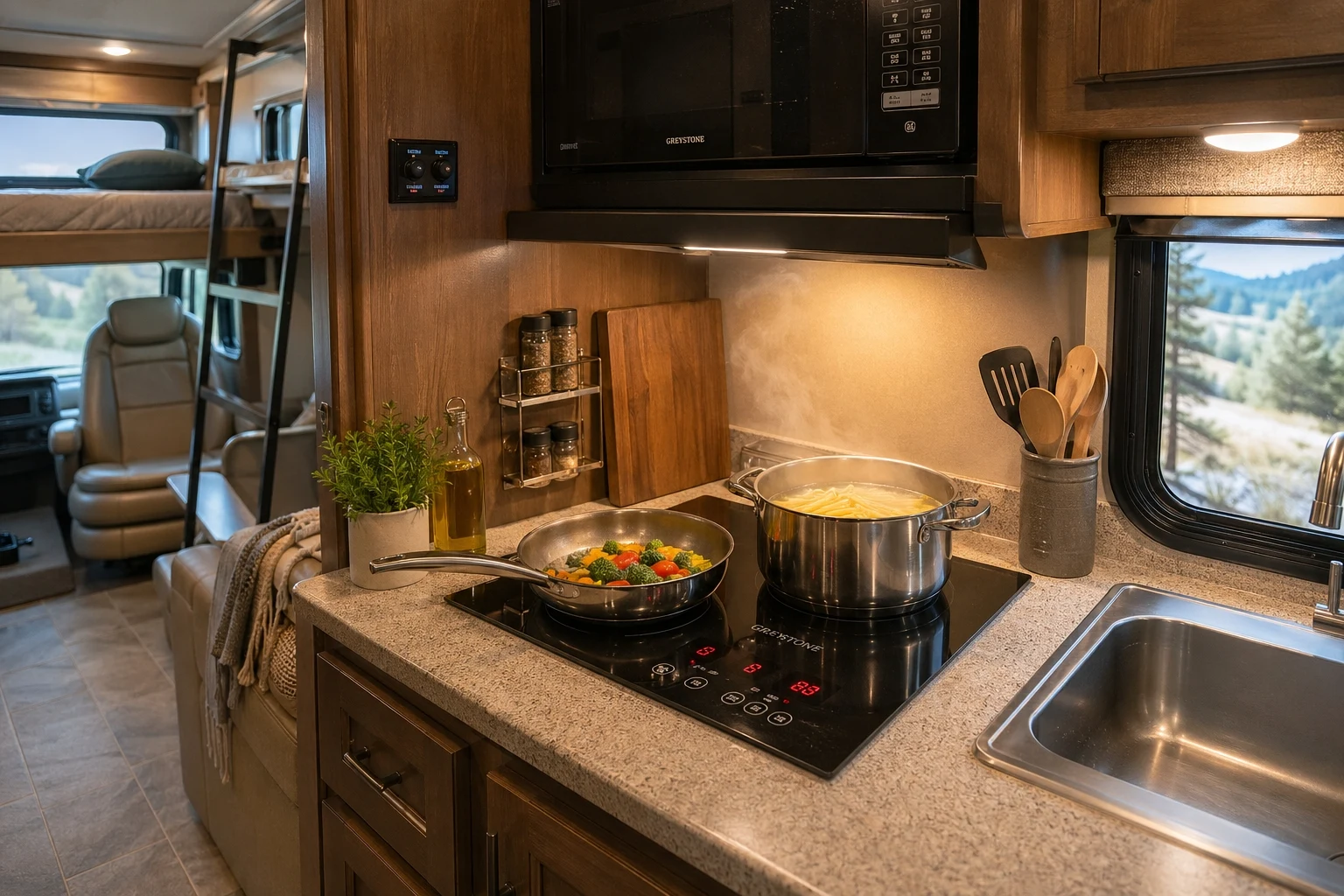
The best RV induction cooktops available today include the CAMPLUX Dual-Burner 1800W, NuWave Diamond, Duxtop 9600LS, Suburban 3308A, True Induction TI-2B, ISILER 1800W, Cuisinart ICT-60, Hamilton Beach 34104, Dometic CI-21, and Cusimax CMHP-C180. These portable electric stoves stand out for their compact footprints, safe flameless operation, and compatibility with standard 120V RV circuits. More importantly, they represent a genuine upgrade over traditional propane burners for RV owners who prioritize safety, precision, and ease of cleaning on the road. For a complete overview, see best induction cooktops.
Choosing the right unit requires understanding your RV’s electrical system. Most full-hookup campsites supply 30-amp or 50-amp shore power, which comfortably handles a 1800W induction cooktop — but the voltage type (120V AC or 12V DC), the number of burners, and whether you want a countertop or built-in installation all matter enormously for day-to-day cooking comfort.
Beyond the specs, safety and space efficiency are the two reasons RV travelers are switching to induction in record numbers. Unlike propane, induction generates no combustion byproducts, no CO risk, and no open flame inside a confined living space. The cooking surface itself stays cool to the touch, which is a meaningful advantage in a 200-square-foot home on wheels.
For travelers weighing induction against propane — especially full-timers and boondockers — the comparison goes deeper than just wattage vs. BTUs. Below, this guide walks through everything you need to make a confident, well-informed decision: from how induction works inside an RV, to which specific models earn a recommendation, to whether the technology makes sense when you’re camping off the grid.
Best camping induction cooktopsWhat Is an RV Induction Cooktop and How Does It Work?
An RV induction cooktop is a portable or built-in electric cooking appliance that uses electromagnetic fields — rather than open flame or a radiant heating element — to heat ferromagnetic cookware directly, making it one of the safest and most energy-efficient cooking methods available for life on the road.
To understand why this matters specifically for RV use, it helps to compare how induction differs from the alternatives most RVers are already familiar with.
A conventional propane burner combusts gas to produce heat, which then transfers to the pan. A standard electric coil or glass-ceramic radiant cooktop heats the surface first, then transfers that heat to the cookware. Induction skips both intermediate steps: the electromagnetic coil beneath the glass surface generates an alternating magnetic field that induces electrical current directly in the base of the pan. That current heats the pan itself — not the air around it, not the cooktop surface, not the counter below.
The practical result inside an RV is significant. The kitchen stays cooler, reducing the load on your air conditioning system. The glass surface only becomes warm from contact with the hot cookware, not from the cooking process itself. Spills don’t burn onto a scorching hot surface, which means cleaning takes seconds rather than scrubbing. And because there is no combustion, there is no carbon monoxide, no nitrogen dioxide, and no need for ventilation beyond what a standard enclosed kitchen would require.
Is an induction cooktop safe to use inside an RV?
Yes, an induction cooktop is safe to use inside an RV, for at least three key reasons: it produces no open flame, generates no combustion gases, and includes multiple automatic safety shutoffs that are standard across every reputable model.
The safety case for induction in an RV is, if anything, stronger than it is for a residential kitchen. RV propane systems carry real risks — gas leaks in a sealed space, detector failures, regulator malfunctions — that induction simply eliminates by design. There is no gas line involved, no pilot light, and no risk of an undetected leak accumulating in your living area overnight.
Specifically, the safety features built into quality RV induction cooktops include:
- Automatic pan detection: The cooktop only activates when it senses a compatible ferromagnetic pan on the surface. Remove the pan and the heating stops within seconds.
- Auto shut-off timers: Most models offer 1- to 3-hour programmable timers. Forget a burner on? The cooktop turns itself off.
- Overheat protection: Internal sensors monitor the unit’s temperature continuously. If the cooktop overheats — common in poor ventilation — it cuts power automatically.
- Child lock / safety lock: A button sequence disables all controls, preventing accidental activation in a moving vehicle.
- Cool-touch surface: The glass-ceramic top does not heat from the electromagnetic process itself. Only the area directly beneath a hot pan will warm from residual conduction — and that heat dissipates quickly once the pan is removed.
According to the National Fire Protection Association (NFPA), cooking equipment is the leading cause of home fires in the United States, with open-flame and radiant-element cooktops responsible for the vast majority of incidents. Induction’s flameless operation fundamentally removes the ignition source from the equation.
Can a standard 120V RV outlet power an induction cooktop?
Yes, a standard 120V RV outlet can power a single induction cooktop rated at 1800W or below, provided your shore power or generator supplies at least a 15-amp circuit — and ideally a 20-amp dedicated circuit for consistent performance.
This is one of the most practical questions RV owners have before purchasing, and the math is straightforward. A 1800W cooktop at 120V draws 15 amps (Power ÷ Voltage = Current: 1800W ÷ 120V = 15A). Most RV outlets are rated for 15 or 20 amps. Running a 1800W induction burner on a shared 15-amp circuit alongside a refrigerator, lighting, or other appliances can trip the breaker — so dedicated circuit use, or choosing a lower-wattage unit (900W–1300W), is advisable in older or smaller rigs.
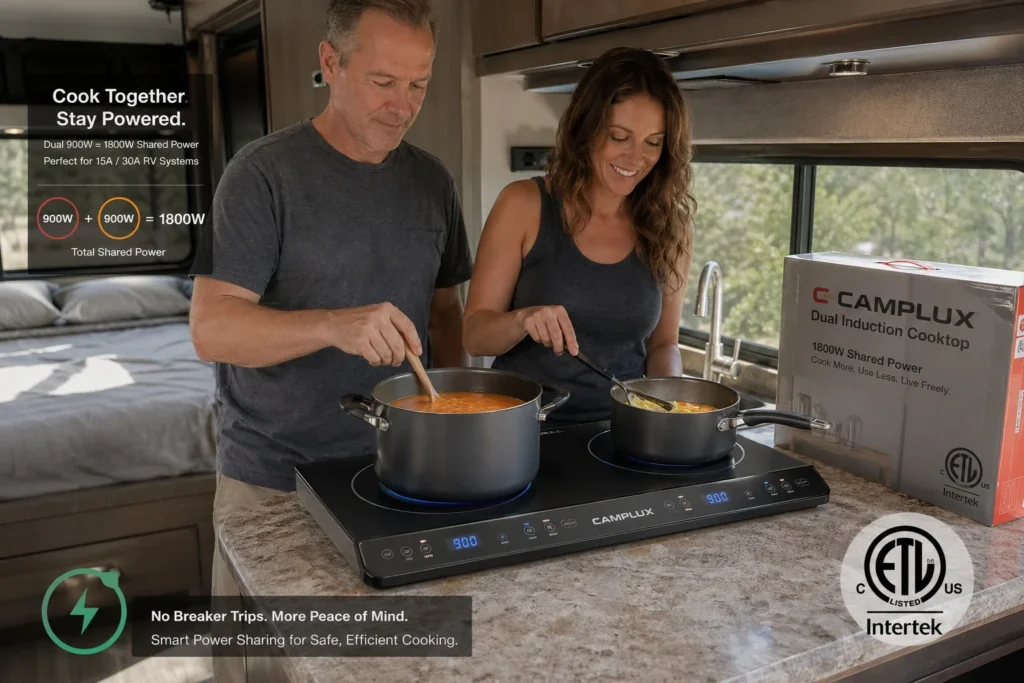
For dual-burner models, the picture shifts. The CAMPLUX and similar dual-burner units use shared power technology, meaning both burners together draw a maximum of 1800W, not 3600W. Power is distributed between the two zones intelligently — if one burner runs at full 1200W, the other is capped at 600W. This design exists specifically to protect RV circuits from overload.
The 12V DC option — relevant primarily for boondockers using solar and lithium battery systems — is addressed in the Supplementary Content section below, as it involves a different use case with distinct tradeoffs.
What Are the Best RV Induction Cooktops Available Today?
The best RV induction cooktops, ranked by versatility, safety certification, and RV-specific design, are the CAMPLUX Dual 1800W, NuWave Diamond, Duxtop 9600LS, Suburban 3308A, True Induction TI-2B, ISILER 1800W, Cuisinart ICT-60, Hamilton Beach 34104, Dometic CI-21, and Cusimax CMHP-C180.
Below is a structured breakdown of each model across the three primary categories RV buyers care about most: single-burner portables, dual-burner portables, and built-in countertop units.
Best portable induction cooktopWhat are the best single-burner induction cooktops for RVs?
Single-burner induction cooktops are the most flexible option for RV use — lightweight, easy to store, and low enough in wattage to run safely on almost any campsite circuit.
1. NuWave Diamond Induction Cooktop
The NuWave Diamond is the precision benchmark among single-burner RV units. It offers 91 pre-programmed temperatures from 50°F to 500°F in 5°F increments, plus a built-in digital probe for monitoring internal food temperature without lifting the lid. For RV cooks who want restaurant-level control in a 10-inch footprint, nothing in this price range competes.
- Power: 1300W (three selectable wattages: 600W / 900W / 1300W)
- Weight: 6.6 lbs — light enough for one-hand carry
- Certifications: ETL listed
- Best for: Full-timers who cook daily and value precision over raw power
2. Duxtop 9600LS Portable Induction Cooktop
The Duxtop 9600LS offers 20 power levels and 20 temperature settings (140°F–460°F), a digital timer up to 170 minutes, and a low-wattage starting point of 200W — useful for keeping food warm without overcooking. Its compact 11 x 11-inch body and 7.2-lb weight make it one of the most popular single-burner picks among van-lifers and motorhome owners alike.
- Power: 1800W (scalable from 200W to 1800W)
- Certifications: ETL listed
- Best for: Weekend campers and full-timers who want maximum adjustability
3. ISILER 1800W Sensor Touch Induction Cooktop
The ISILER holds the Amazon Choice designation for RV induction cooktops in its price tier and earns it with a combination of 10 power levels, a child lock, auto-shutoff, and a 5-foot power cord. The cooking zone accommodates pans from 3.9 to 8.6 inches, which is slightly smaller than competitors but suitable for most camp cooking scenarios.
- Power: 100W–1800W (scalable)
- Price tier: Budget-friendly (under $40)
- Best for: Occasional campers, first-time induction users
4. Hamilton Beach 34104 Single-Burner Induction Cooktop
The Hamilton Beach 34104 is a simple, reliable workhorse with six temperature settings (low, 2, 3, 4, 5, high), a keep-warm function, and a 1800W max rating. Its plug-in convenience — standard 120V, no setup — and intuitive rotary dial (rather than touch controls) make it particularly popular among older RV travelers who prefer straightforward operation.
- Power: 1800W
- Best for: Travelers who prefer physical controls over touch panels
What are the best dual-burner induction cooktops for RV kitchens?
Dual-burner induction cooktops allow simultaneous cooking — simmer a sauce while boiling pasta — without requiring a second outlet or exceeding your RV’s circuit capacity, thanks to shared power distribution.
5. CAMPLUX RV Induction Cooktop 2 Burners 1800W
The CAMPLUX is purpose-built for RV use and makes that clear from its first design decision: shared power technology. Both burners together draw a maximum of 1800W, configurable as 1200W + 600W, 900W + 900W, or similar combinations, always staying within a single 15-amp circuit. It carries ETL certification, includes a safety lock, hot-surface indicator, overheat protection, and auto-shutoff — and installs as either a countertop or built-in unit.
- Power: 1800W shared between 2 burners
- Installation: Countertop or built-in (cutout dimensions provided)
- Certifications: ETL certified
- Cookware zone: 4.7–9.4 inches per burner
- Best for: Couples and families in Class A, Class C, or fifth-wheel RVs with full hookups
6. True Induction TI-2B Counter Inset Dual-Burner Cooktop
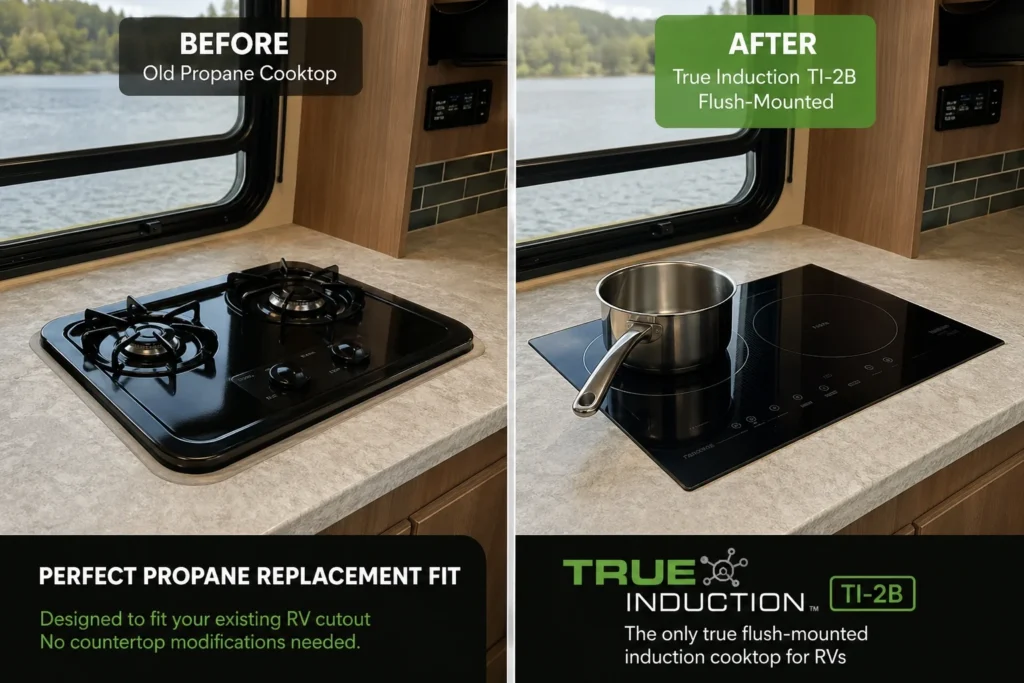
The True Induction TI-2B is designed specifically to drop into a counter cutout, maximizing usable counter space by sitting flush with the surrounding surface. Each burner operates independently with 10 heat levels (1–10) and an exact temperature range of 150°F–450°F. At 23 x 13 inches, it fits neatly into a standard two-burner propane drop-in cutout — making it an ideal replacement for travelers upgrading from gas.
- Power: 1800W total (two independent zones)
- Installation: Built-in counter inset (primary design)
- Best for: RV owners replacing an existing two-burner propane drop-in cooktop
7. Cusimax CMHP-C180 Double Induction Cooktop
The Cusimax CMHP-C180 offers 18 power levels per burner, independent zone control, a child lock, and a 3-hour timer — at a price point roughly 30% lower than comparable dual-burner units. It is not RV-specific in its marketing, but its 1800W shared power cap and 120V plug-in design make it functionally compatible with most RV setups.
- Power: 1800W (shared)
- Best for: Budget-conscious travelers who need two burners
Which RV induction cooktops work best as built-in countertop units?
Built-in RV induction cooktops are permanently mounted into a countertop cutout, providing a flush, integrated look that mirrors a residential kitchen while maximizing the small counter space available in most RV galleys.
8. Suburban 3308A RV Single Element Induction Cooktop
The Suburban 3308A is the most purpose-engineered built-in option on this list. It measures 23.6 x 15.3 inches with a required cutout of 22.8 x 14.6 inches, includes a 4-digit LED display, soft-touch controls, a 1-to-240-minute cooking timer, 10 heating levels, child lock, and auto safety shut-off. It operates on 120V/60Hz and carries a 2-year manufacturer warranty — the longest warranty in this roundup.
- Power: 1800W
- Installation: Built-in (requires cutout)
- Warranty: 2 years
- Best for: RV owners doing a planned galley renovation or replacement build
9. Dometic CI-21 Double Element Induction Cooktop
The Dometic CI-21 is Dometic’s entry into the built-in RV induction space, designed with the same dimensional standards as their propane cooktops to simplify replacement. It provides two independent induction zones, digital controls, and Dometic’s brand reputation for marine and RV-grade durability.
- Installation: Built-in
- Best for: Dometic-brand RV owners seeking a direct OEM-style replacement
10. Furrion 2-Burner Built-In Induction Cooktop
Furrion’s built-in induction cooktop rounds out the list with advanced safety features — auto shut-off, cool-touch surface throughout, and digital controls — packaged in a design that integrates cleanly with Furrion’s broader RV kitchen appliance ecosystem. It is an especially logical choice for RV owners whose rig already uses Furrion appliances.
- Best for: Furrion ecosystem users; new RV builds
The table below summarizes key specifications across all ten models for direct comparison:
| Model | Burners | Max Power | Installation | Certification | Best Use Case |
|---|---|---|---|---|---|
| NuWave Diamond | 1 | 1300W | Countertop | ETL | Daily precision cooking |
| Duxtop 9600LS | 1 | 1800W | Countertop | ETL | Adjustable everyday use |
| ISILER 1800W | 1 | 1800W | Countertop | — | Budget / occasional use |
| Hamilton Beach 34104 | 1 | 1800W | Countertop | — | Simple dial-controlled cooking |
| CAMPLUX Dual 1800W | 2 | 1800W shared | Countertop / Built-in | ETL | Families, full hookup |
| True Induction TI-2B | 2 | 1800W total | Built-in (counter inset) | — | Propane replacement |
| Cusimax CMHP-C180 | 2 | 1800W shared | Countertop | — | Budget dual-burner |
| Suburban 3308A | 1 | 1800W | Built-in | — | Galley renovation |
| Dometic CI-21 | 2 | — | Built-in | — | OEM replacement |
| Furrion Built-In | 2 | — | Built-in | — | Furrion ecosystem |
What Should You Look for When Choosing an Induction Cooktop for Your RV?
Choosing an RV induction cooktop comes down to five core criteria: wattage relative to your RV’s circuit capacity, number of burners, installation type (portable vs. built-in), safety certifications, and cookware compatibility.
Each of these criteria interacts with your specific RV setup and cooking habits. A weekend camper in a Class B van has different requirements than a full-time family in a 40-foot fifth wheel. The buying guide below addresses both.
What wattage is ideal for an RV induction cooktop?
For most RV setups, 1800W is the practical maximum for a single induction zone, and it should be run on a dedicated 15-amp or 20-amp circuit to avoid breaker trips.
Here is a quick wattage-to-use-case framework:
- 600W–900W: Suitable for keeping food warm, light simmering, or very small single-burner use in a 30-amp RV with multiple simultaneous appliances. Also the relevant range for 12V DC induction units.
- 1300W: The NuWave Diamond’s maximum output represents the best balance of cooking power and circuit safety. It draws roughly 10.8 amps at 120V, leaving comfortable headroom on a 15-amp circuit.
- 1800W: The most common RV induction cooktop wattage. At full power it draws 15 amps — exactly the rating of a standard outlet. Use a dedicated circuit, or run at the 60%–80% power level (1080W–1440W) as standard practice. This preserves headroom and extends the cooktop’s lifespan.
- 1800W shared (dual-burner): The safest choice for two-zone cooking in an RV. Shared power distribution ensures total draw never exceeds 1800W regardless of how many burners are active.
The one scenario where wattage choices become more complex is boondocking. Off-grid cooking on battery power is covered in the Supplementary Content section.
Does an RV induction cooktop require special magnetic cookware?
Yes, an RV induction cooktop requires cookware with a ferromagnetic base — meaning the bottom of the pan must be attracted to a magnet — and standard aluminum, copper, or glass cookware will not work without an induction interface disc.
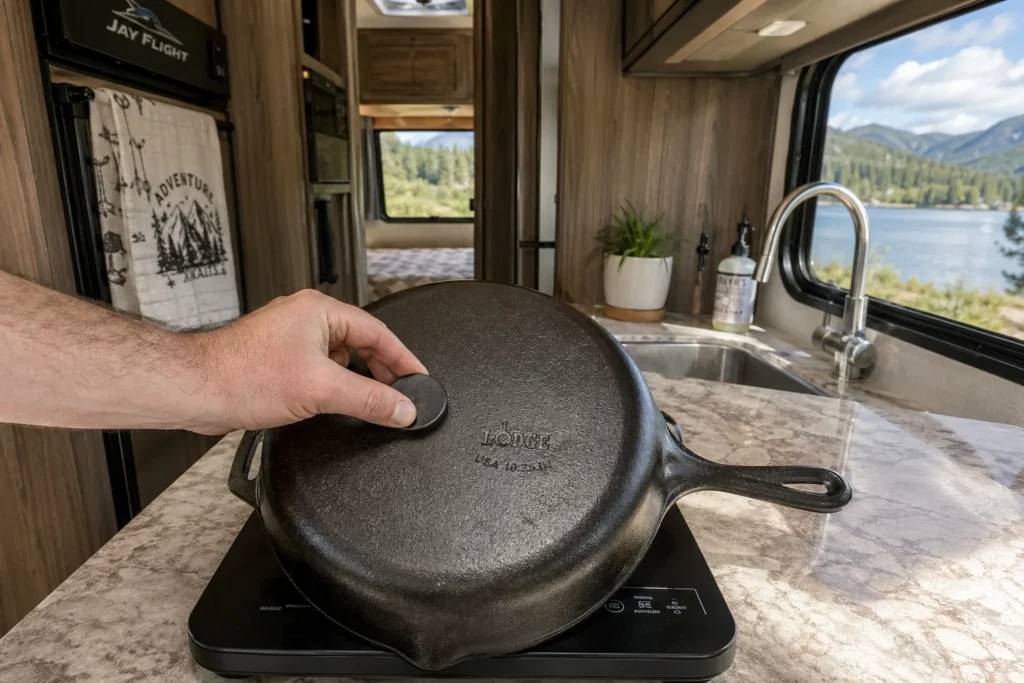
The practical test is simple: hold a refrigerator magnet to the bottom of your existing pots and pans. If it sticks firmly, the cookware is induction-compatible. If it slides off or barely clings, you will need new cookware or an induction disc adapter.
Compatible cookware materials include:
- Cast iron (all cast iron is compatible — seasoned cast iron, enameled cast iron)
- Stainless steel (most stainless steel is compatible; check for “18/0” grade rather than “18/10” for guaranteed compatibility)
- Carbon steel
- Magnetic hard-anodized aluminum (some modern cookware lines specifically add a magnetic base layer for induction use)
Not compatible without an adapter:
- Pure aluminum
- Copper
- Glass or ceramic
- Non-magnetic stainless steel (18/10 grade)
For RV travelers who already own a full set of non-compatible cookware, an induction interface disc (an $15–$30 flat magnetic plate) allows any cookware to work on an induction surface — though it slightly reduces efficiency by adding an intermediate heat-transfer step.
How to check if cookware is induction compatibleHow Do Portable and Built-In RV Induction Cooktops Compare?
Portable induction cooktops win on flexibility and upfront cost; built-in units win on integration, aesthetics, and maximizing permanent counter space — and the right choice depends almost entirely on whether you plan to stay in your current RV long-term or move between rigs.
This is fundamentally a tradeoff between versatility and permanence, and both categories have well-defined advantages.
What is the difference between a countertop and a built-in RV induction cooktop?
A countertop RV induction cooktop sits on top of any flat surface, plugs into a standard 120V outlet, and can be stored or repositioned as needed. A built-in unit drops into a pre-cut hole in the countertop, connects to hardwired or direct-plug electrical, and becomes a permanent fixture of the galley kitchen.
The practical differences between the two installation types break down as follows:
Countertop / Portable:
- No installation required — plug in and cook
- Fully portable between vehicles, campsites, and indoor/outdoor use
- Can be stored flat when not in use, freeing up counter space
- Less expensive ($30–$150 for most models)
- Slightly elevated above counter surface (typically 2–3 inches), which can feel unstable during travel if not properly secured
- Cord length (typically 4–5 feet) can limit placement flexibility near the outlet
Built-In:
- Flush with the counter surface for a clean, integrated look
- Does not shift or need to be secured during travel
- Maximizes perceived counter space — the cooktop surface is part of the counter
- Requires a cutout, which is permanent (though reverting to propane is possible with the right replacement unit)
- Higher cost ($200–$600+ for quality built-in units)
- Wiring must be properly sized and may require an RV technician for installation
For full-time RVers who have settled into a rig they plan to keep for years, the built-in route — particularly the Suburban 3308A or True Induction TI-2B — offers a more livable, residential feel. For part-timers, van-lifers, or travelers who upgrade rigs frequently, a portable unit like the Duxtop 9600LS or NuWave Diamond provides all the cooking capability with none of the commitment.
According to a 2023 survey by RV Industry Association (RVIA), more than 61% of full-time RV households reported replacing at least one original appliance within the first two years of full-timing — with cooking appliances cited as the most common upgrade category.
Is an Induction Cooktop or a Propane Stove Better for RV Cooking?
Induction wins on safety, cleanliness, and precision; propane wins on off-grid energy independence and compatibility with existing cookware — making induction the superior choice for RVers with reliable shore power or solar systems, while propane remains more practical for regular boondockers without significant battery capacity.
This comparison sits at the heart of the decision many RV travelers face when upgrading their galley kitchen, and it deserves a thorough answer across the dimensions that actually matter on the road.
How does energy efficiency compare between induction and propane RV stoves?
Induction is significantly more energy-efficient than propane in terms of heat transferred to the food: induction delivers approximately 84–90% of its electrical energy directly to the cookware, compared to 40–55% efficiency for propane burners, which lose substantial heat to the surrounding air.
In practical terms, this means an induction cooktop boils a quart of water in roughly half the time a propane burner of equivalent power output requires. The tradeoff is energy source: induction requires electricity, while propane requires — well, propane, which is energy-dense, widely available, and free of the circuit constraints that govern induction use.
The cost-per-meal comparison favors induction at campgrounds with electric hookups included in the site fee (common at KOA, state park, and private campgrounds). At $0.10–$0.14 per kWh (typical campground rate), boiling water for pasta costs roughly $0.02–$0.03 via induction. The equivalent propane consumption costs approximately $0.05–$0.08 per comparable cooking task at current propane prices.
Can you use an RV induction cooktop when boondocking off-grid?
Yes, you can use an induction cooktop while boondocking, but only if your battery bank and solar charging system can sustain the power draw — which typically requires a lithium battery system of 200+ amp-hours and a solar array of 400W or more for meaningful daily cooking use.
This is where the induction vs. propane debate becomes most nuanced. A standard 1800W induction cooktop running at full power draws 15 amps at 120V. To power that from a 12V battery bank through a pure-sine inverter, the actual DC draw is approximately 150+ amps from your 12V batteries (accounting for inverter losses). Running at full power for 30 minutes of cooking draws roughly 75 amp-hours — a significant fraction of even a 200Ah lithium battery’s usable capacity.
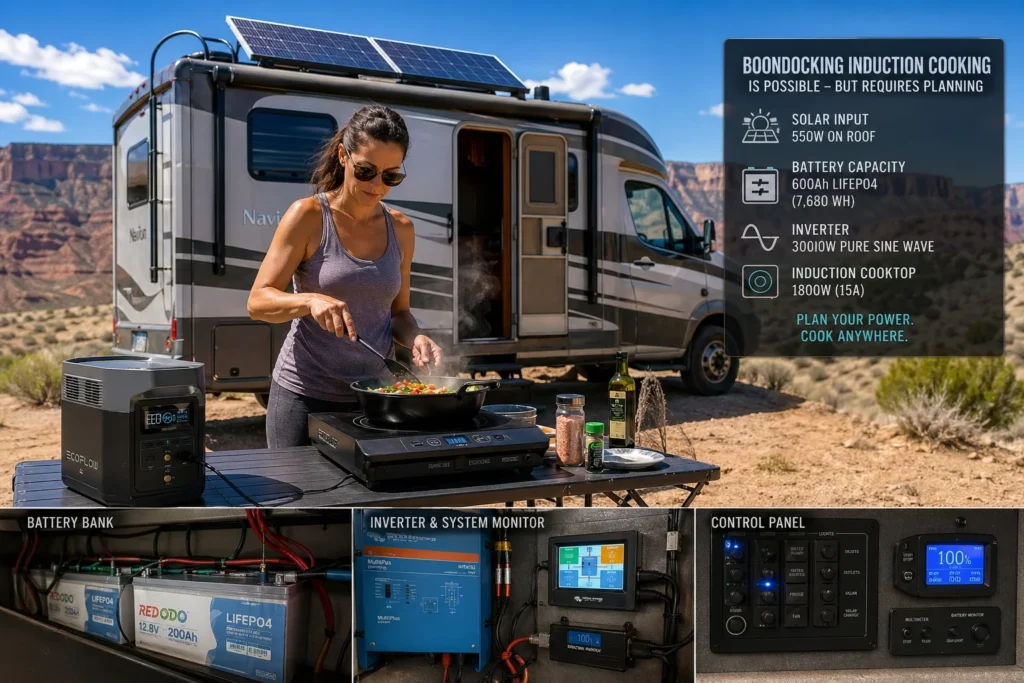
Strategies for boondocking induction users:
- Cook at reduced power settings (50%–60% of max wattage). Boiling still happens; it just takes 2–3 minutes longer. Battery draw drops proportionally.
- Cook during peak solar hours (10 AM–2 PM) so solar production offsets a portion of the cooktop’s draw in real time.
- Use a 12V DC induction cooktop (rare but available) — these eliminate the inverter conversion loss entirely, though they are typically limited to 600W–800W.
- Hybrid approach: Use propane for high-energy tasks (boiling large pots) and induction for precision tasks (simmering, melting, keeping warm).
Which is safer in a moving RV: induction or propane cooking?
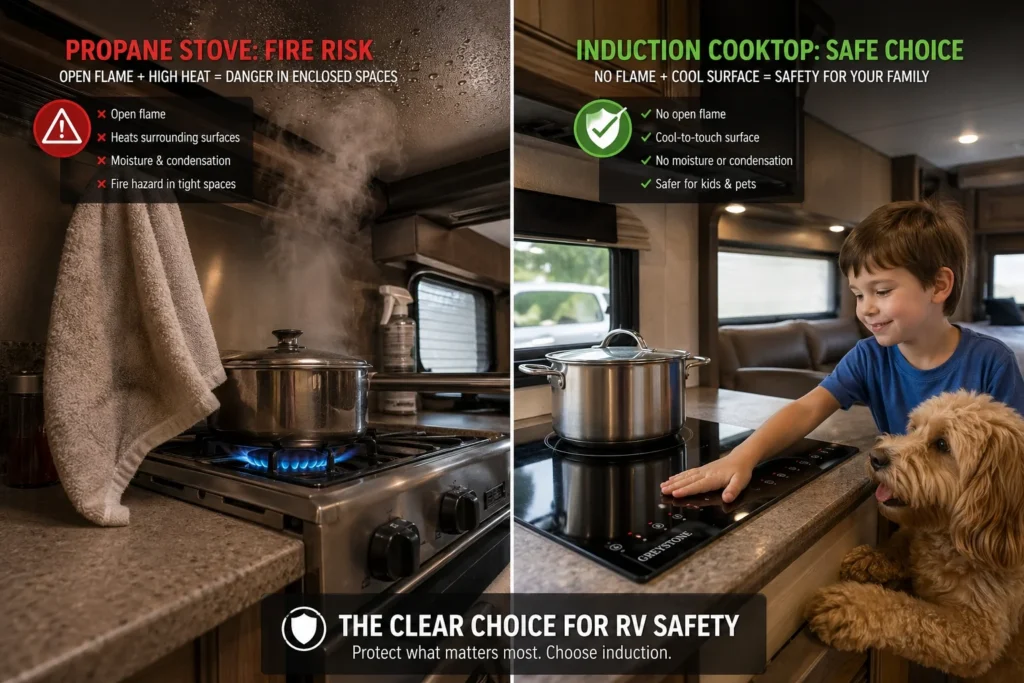
Induction is substantially safer than propane for cooking in a moving or recently parked RV, for three reasons: no combustion, no gas leak risk, and automatic shut-off when cookware is removed.
In a moving vehicle, propane presents the additional hazard of a pilot light going out under road vibration, potentially releasing unburned gas into the cabin before the occupants notice. Most RV propane systems include automatic shut-off valves, but the underlying risk — flammable gas accumulation in a confined space — is inherent to the technology.
Induction eliminates this risk category entirely. There is nothing to ignite, no gas to accumulate, and no pilot to maintain. The biggest “hazard” of an induction cooktop accidentally activated in transit is that it won’t turn on without a compatible pan firmly seated — the pan-detection mechanism prevents activation on empty surfaces.
For RV owners with children or pets, the cool-touch surface of induction cooktops provides an additional meaningful safety benefit. A child who touches a propane stove grate immediately after cooking will sustain a burn; a child who touches the glass surface of an induction cooktop 60 seconds after the pan is removed will feel warm glass, not a burning surface.
What types of RV travelers benefit most from switching to induction?
Full-time RVers at hookup sites, weekend campers at developed campgrounds, and RV owners doing a galley renovation benefit most from switching to induction — while regular boondockers and dry campers with limited solar capacity benefit least.
Specifically, induction is an excellent fit for:
- Full-hookup campers (50-amp service): Full electrical availability means no power constraints. Induction performs identically to a residential kitchen cooktop in this environment.
- RV park regulars: Most commercial RV parks include electrical hookups in the site rate, meaning induction cooking adds no incremental energy cost.
- Travelers with gas anxiety: Those who have experienced propane leaks, CO detector alarms, or regulator failures often report significantly reduced stress after switching to induction.
- Cooks who prioritize precision: Recipe-following, baking accompaniments, and temperature-sensitive cooking (candy making, tempering chocolate, precise sauce reduction) are dramatically easier with 91-step temperature control versus a propane burner’s broad flame range.
- Van-lifers and Class B owners with solar: A 400W+ solar array with a 200Ah lithium bank makes moderate induction cooking viable even off-grid, particularly with the reduced-power cooking strategies outlined above.
Induction is a harder sell for:
- Full-time boondockers with under 200Ah of battery capacity and a small solar array — propane remains more practical.
- Remote off-road overlanders in areas where electrical hookups are unavailable for weeks at a time and battery conservation is critical.
Tóm lại, the decision to switch from propane to induction in an RV is less a question of “which is better” in the abstract and more a question of how you camp. For the majority of RV travelers who spend most nights at campgrounds with electrical hookups, induction is unambiguously the superior cooking technology: safer, cleaner, faster, and more precise. For the minority who regularly camp without shore power and have not yet invested in a substantial solar and lithium battery system, propane remains the practical backbone — though a hybrid approach, keeping a single-burner propane unit for boondocking and using induction at hookup sites, offers the best of both worlds.