
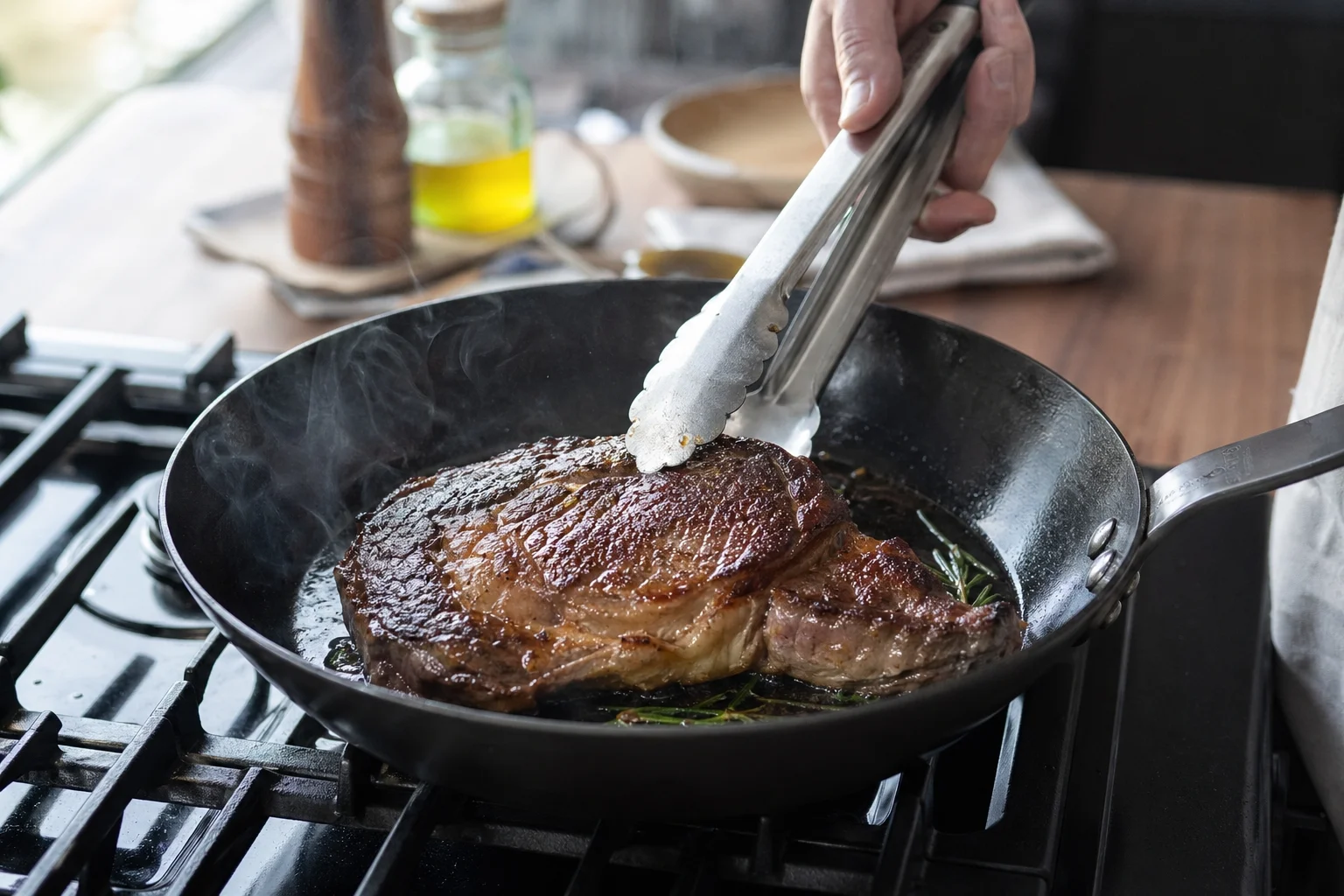
When it comes to finding the best carbon steel cookware, the top-tested options include the De Buyer Mineral B, Mauviel M’steel, Matfer Bourgeat, Lodge Carbon Steel Skillet, OXO Obsidian Carbon Steel Pan, Smithey Carbon Steel Skillet, Smithey Carbon Steel Wok, Northwest Skillet Company Fry Pan, Strata Carbon Clad Pan, and Misen Carbon Steel Wok — all rigorously tested for searing, sautéing, baking, and frying performance. These carbon steel skillets and pans consistently outperform both cast iron and non-stick alternatives across key metrics including heat responsiveness, natural non-stick patina development, weight, and long-term durability. In short, carbon steel cookware is no longer just a professional kitchen secret — it has become the gold standard for serious home cooks worldwide. For a complete overview, see induction cookware complete guide.
Beyond the product rankings, understanding what carbon steel cookware actually is and why professional chefs prefer it is essential before making any purchase decision. Carbon steel combines the heat conductivity of stainless steel, the durability of cast iron, and the smooth release surface of non-stick — yet it outperforms each of those individually over time. Furthermore, its safety profile is impeccable: free from PFOA, PTFE, and any synthetic coating that could degrade under high heat.
Choosing the right carbon steel pan, however, requires more than just picking the most popular brand. The comparison between carbon steel, cast iron, and non-stick reveals critical differences in weight, heat-up speed, surface behavior, and longevity that directly affect your cooking results. Understanding these distinctions empowers you to make a purchase decision grounded in real performance data rather than marketing claims.
Finally, no carbon steel pan performs at its best without proper seasoning and maintenance. Building a natural non-stick patina takes time, but the process is straightforward — and once established, your pan only improves with every use. Below, this guide walks you through every dimension of carbon steel cookware, from what it is and which products lead the market, to how it stacks up against the competition and how to care for it long-term.
What Is Carbon Steel Cookware and Why Do Professional Chefs Prefer It?
Carbon steel cookware is a type of high-performance cooking vessel made from an alloy of approximately 99% iron and 1% carbon — thinner, lighter, and more thermally responsive than cast iron, yet tougher and longer-lasting than any non-stick pan on the market. This precise alloy composition gives carbon steel its unique combination of rapid heat response, exceptional durability, and the ability to develop a natural non-stick surface through repeated seasoning. Specifically, its widespread adoption in professional restaurant kitchens — from Parisian bistros to Michelin-starred establishments — reflects a consensus among chefs that no other material delivers the same balance of performance and versatility.
To understand why professional chefs consistently choose carbon steel over other cookware materials, it helps to look at the key forms it takes. Carbon steel cookware includes several distinct hyponyms: skillets (the most common format), fry pans (with slightly flared sides), woks (ideal for high-heat stir-frying), sauté pans (with straight sides for braising and reducing), and roasters (for oven-based cooking). Each of these shares the same core material benefits while serving different cooking functions.
How to check if cookware is induction compatibleIs Carbon Steel Cookware Safe for Everyday Cooking?
Yes, carbon steel cookware is completely safe for everyday cooking — it contains no synthetic coatings, no PFOA, and no PTFE, making it one of the most health-conscious cookware choices available. Unlike traditional non-stick pans coated with Teflon or ceramic compounds, carbon steel’s cooking surface is composed entirely of iron and carbon, both of which are non-toxic and food-safe at any cooking temperature.
The only safety consideration worth noting is carbon steel’s mild reactivity with highly acidic foods such as tomatoes, citrus-based sauces, or wine reductions. Prolonged cooking of acidic ingredients in an unseasoned or lightly seasoned carbon steel pan can strip the patina and impart a slight metallic taste. However, once a carbon steel pan has developed a well-established seasoning layer after regular use, this reactivity is significantly reduced. For the vast majority of everyday cooking — searing proteins, sautéing vegetables, frying eggs, baking — carbon steel is not only safe but arguably superior to coated alternatives.
According to data compiled by America’s Test Kitchen in their 2025 carbon steel skillet review, every top-rated carbon steel model they tested passed food-safety standards and showed no toxic off-gassing even when heated to temperatures exceeding 500°F — a threshold at which many non-stick coatings begin to degrade.
What Are the Key Properties That Make Carbon Steel Cookware Stand Out?
Carbon steel stands out due to four defining properties: exceptional heat conductivity, lighter weight than cast iron, lifetime durability, and a self-improving natural non-stick surface. These four attributes together create a cookware experience that no single competing material can fully replicate.
Specifically, here is how each property performs in practice:
- Heat conductivity: Carbon steel heats up significantly faster than cast iron and distributes heat more evenly than stainless steel. This makes it ideal for high-heat techniques such as searing steaks, achieving the Maillard reaction on proteins, and flash-frying vegetables.
- Weight advantage: A standard 12-inch cast iron skillet weighs approximately 8 lbs, while a comparable carbon steel fry pan — such as the Matfer Bourgeat 11⅞-inch — weighs just over 5.5 lbs. That 30–40% weight reduction makes a meaningful difference when maneuvering a hot pan from stovetop to oven.
- Durability: Carbon steel is made from 99% iron and 1% carbon — a highly durable and malleable composite that can withstand drops, extreme heat, and heavy daily use without cracking or warping. Unlike non-stick pans, which typically require replacement every 3–5 years, a well-maintained carbon steel pan can last decades or even a lifetime.
- Natural non-stick patina: Each time you cook with oil in a carbon steel pan, a layer of polymerized fat bonds to the surface, gradually building a slick, naturally non-stick coating called a patina. Unlike synthetic non-stick coatings that degrade over time, this patina only gets better with use.
What Are the Best Carbon Steel Cookware Options Tested in 2025–2026?
The best carbon steel cookware tested in 2025–2026 spans three clear categories: best overall, best budget, and best wok — with top performers including De Buyer Mineral B, Mauviel M’steel, Matfer Bourgeat, Lodge Carbon Steel Skillet, OXO Obsidian, and Smithey Carbon Steel Wok, evaluated across real cooking tasks including searing, baking, deep frying, and sautéing over multiple weeks of testing.
The evaluation criteria used across major testing publications — including America’s Test Kitchen, CNN Underscored, and Food Network — consistently focused on the same core metrics: heat distribution quality, weight and handle ergonomics, ease of first seasoning, non-stick performance after break-in, induction compatibility, and price-to-performance ratio. Below are the results broken down by category.
Best woks for induction cooktopsWhich Carbon Steel Skillets Perform Best for Searing and High-Heat Cooking?
For searing and high-heat cooking, the De Buyer Mineral B, Mauviel M’steel, and Matfer Bourgeat are the three top-performing carbon steel skillets — each excelling in heat retention, Maillard reaction efficiency, and oven compatibility, with full induction support across all models.
Here is how the top three premium skillets compare in the context of searing performance:
| Pan | Weight (12″) | Handle Type | Induction | Best For |
|---|---|---|---|---|
| De Buyer Mineral B | ~5.5 lbs | Riveted steel | ✅ Yes | All-around high-heat cooking, stovetop to oven |
| Mauviel M’steel | ~4.8 lbs | Riveted steel | ✅ Yes | Lightweight precision searing, restaurant-style |
| Matfer Bourgeat | ~5.8 lbs | Arc-welded | ✅ Yes | Heavy-duty restaurant abuse, deep frying |
The table above compares the three leading premium carbon steel skillets across the most critical purchasing criteria: weight, handle construction, induction compatibility, and ideal use case.
The De Buyer Mineral B ships from the factory coated in beeswax — a protective layer that must be melted off in the oven before first use and seasoning. Its deep, wide profile makes it genuinely versatile for frying, braising, and oven finishing. The Mauviel M’steel is the lightest of the three and was rated best overall by multiple reviewers for its ease of use and natural non-stick development. The Matfer Bourgeat, while heavier and less refined in appearance due to its arc-welded handle, is built to absorb punishment in professional kitchen environments and comes in at a meaningfully lower price point than the De Buyer or Mauviel.
According to CNN Underscored’s 8-week testing report published in January 2026, the De Buyer Mineral B was named their top pick based on heavy construction, a second handle for stovetop-to-oven transport, and a depth wide enough to handle deep frying — tasks where most other carbon steel pans fell short.
Best stainless steel cookware for inductionWhat Is the Best Budget Carbon Steel Pan for Home Cooks?
For home cooks seeking the best budget carbon steel pan, the Lodge Carbon Steel Skillet and the OXO Obsidian Carbon Steel Pan are the two strongest value picks — both delivering reliable performance and excellent non-stick development at price points well below $60.
The Lodge 12-inch Carbon Steel Skillet comes pre-seasoned from the factory with a natural vegetable oil coating, making it immediately ready to use without the initial seasoning process that many carbon steel pans require. It is made in the USA, compatible with all cooktop types including induction, and priced under $50 — making it the most accessible entry point into carbon steel cooking. The tradeoff is that Lodge’s pre-seasoning is lighter than a fully built patina, so performance improves noticeably after the first several uses.
The OXO Obsidian was highlighted by multiple 2026 review sources as the most affordable carbon steel pan with genuinely impressive non-stick results out of the box. Its textured surface aids in oil adhesion during initial seasoning sessions, and its ergonomic handle design received high marks for comfort during prolonged cooking sessions.
Both pans are particularly well-suited for cooks transitioning away from Teflon non-stick pans who want the performance benefits of carbon steel without the investment required for a De Buyer or Mauviel.
Which Carbon Steel Woks Are Worth Buying for Stir-Frying?
For stir-frying, the Smithey Carbon Steel Wok and the De Buyer Carbon Steel Wok are the two top-rated options — both built to withstand the extreme high-heat demands of authentic stir-fry technique, where achieving the Maillard reaction at wok temperature (often exceeding 500°F) is essential to flavor development.
Carbon steel is, in fact, the traditional material for wok construction throughout Chinese and East Asian culinary history — and for good reason. Its rapid heat response allows the cook to control temperature precisely, while its lightweight build (significantly lighter than cast iron woks) makes the chef’s toss technique feasible without fatigue.

When selecting a carbon steel wok, two design choices matter significantly:
- Flat-bottom woks are compatible with Western stovetops including induction and glass-ceramic surfaces. They sacrifice a small amount of the traditional round-bottom heat concentration but are far more practical for most home kitchens.
- Round-bottom woks deliver the most authentic stir-fry performance by concentrating maximum heat at the center of the cooking surface, but require a wok ring or a gas burner for stable use.
The Smithey Carbon Steel Wok stands out for its hand-forged construction and refined surface finish, while the de Buyer wok is the go-to professional choice for durability and long-term seasoning stability.
How Does Carbon Steel Compare to Cast Iron and Non-Stick Cookware?
Carbon steel wins on weight and heat responsiveness, cast iron excels in heat retention and slow cooking, and non-stick leads in immediate food release convenience — but loses decisively on longevity, safety at high heat, and long-term value. Understanding these distinctions helps every cook make the right choice for their specific kitchen habits.
The comparison between these three cookware categories is not simply a matter of preference — it reflects fundamental differences in material science, cooking application, and lifecycle cost. The following breakdown addresses each key criterion directly.
Using cast iron on induction cooktops
Is Carbon Steel Better Than Cast Iron for Everyday Use?
Yes, carbon steel is better than cast iron for most everyday cooking tasks — specifically because it is 30–40% lighter, heats up faster, and responds more precisely to temperature changes, making it far more practical for the wide range of techniques used in daily home cooking.
That said, cast iron retains a meaningful edge in specific contexts:
| Criteria | Carbon Steel | Cast Iron |
|---|---|---|
| Weight (12″ pan) | ~5.5 lbs | ~8 lbs |
| Heat-up speed | Fast (2–3 min) | Slow (4–6 min) |
| Heat retention | Good | Excellent |
| Temperature precision | High | Low |
| Ideal cooking method | Searing, sautéing, frying | Slow cooking, braising, baking |
| Seasoning requirement | Yes | Yes |
| Lifetime durability | Excellent | Excellent |
This table compares carbon steel and cast iron across seven practical criteria to help you decide which material fits your cooking style.
Cast iron’s superior heat retention makes it the better choice for low-and-slow braising, Dutch oven-style cooking, and cornbread baking where even, sustained heat is more important than responsiveness. However, for the vast majority of everyday cooking — morning eggs, seared chicken thighs, sautéed vegetables, pan sauces — carbon steel’s lighter weight and more dynamic heat control make it the objectively more versatile daily driver.
Specifically, the 2.5-lb weight difference becomes critically important when the pan is hot and full of food. Maneuvering a heavy cast iron skillet with one hand while plating or tossing ingredients is a real ergonomic challenge — one that carbon steel eliminates entirely.
Does Carbon Steel Outperform Non-Stick Pans in the Long Run?
Yes, carbon steel decisively outperforms non-stick pans in the long run — because while non-stick coatings degrade within 3–5 years, carbon steel’s cooking surface actively improves with every use, ultimately delivering better food release performance than any synthetic coating ever could.
The comparison between carbon steel and non-stick is one of the most consequential decisions a home cook can make when building their cookware collection:
| Criteria | Carbon Steel | Traditional Non-Stick (Teflon) |
|---|---|---|
| Surface type | Natural polymerized oil patina | Synthetic PTFE/PFOA coating |
| Lifespan | Lifetime (decades) | 3–5 years |
| High-heat safety | Safe up to 600°F+ | Degrades above 500°F |
| Non-stick quality | Improves over time | Decreases over time |
| Dishwasher safe | No | Sometimes (but reduces lifespan) |
| Environmental impact | Recyclable, no synthetic chemicals | PFAS concerns with disposal |
| Price over 10 years | Low (one purchase) | High (multiple replacements) |
The table above contrasts carbon steel and traditional non-stick across seven long-term ownership criteria, highlighting why carbon steel becomes the more economical and safer choice over time.
The most important point in this comparison is the inverse performance trajectory: non-stick pans begin losing their release properties from the moment of first use, while carbon steel pans begin gaining them. By the time a Teflon pan needs replacing, a well-seasoned carbon steel pan is just hitting its stride. Furthermore, the health concerns surrounding PTFE off-gassing at temperatures above 500°F — a threshold easily reached during searing — make carbon steel the safer choice for high-heat applications.
According to a widely cited study published by the Environmental Working Group, overheated Teflon cookware can release multiple toxic gases and particulates within minutes of reaching extreme temperatures — a risk that is entirely absent with carbon steel, cast iron, or stainless steel.
How Do You Season and Maintain Carbon Steel Cookware Properly?
Seasoning carbon steel cookware involves applying a thin layer of high-smoke-point oil to the pan’s surface and heating it until the oil polymerizes — a process that takes 20–30 minutes and can be completed on the stovetop or in the oven, with the goal of building a durable, naturally non-stick patina layer by layer. Proper maintenance after each use then protects and strengthens that patina over time.
Many first-time carbon steel owners approach seasoning with unnecessary anxiety — but the process is genuinely straightforward. What matters most is using the right oil, applying it in a thin (not thick) layer, and reaching the oil’s smoke point consistently. Here is the complete process from start to finish.
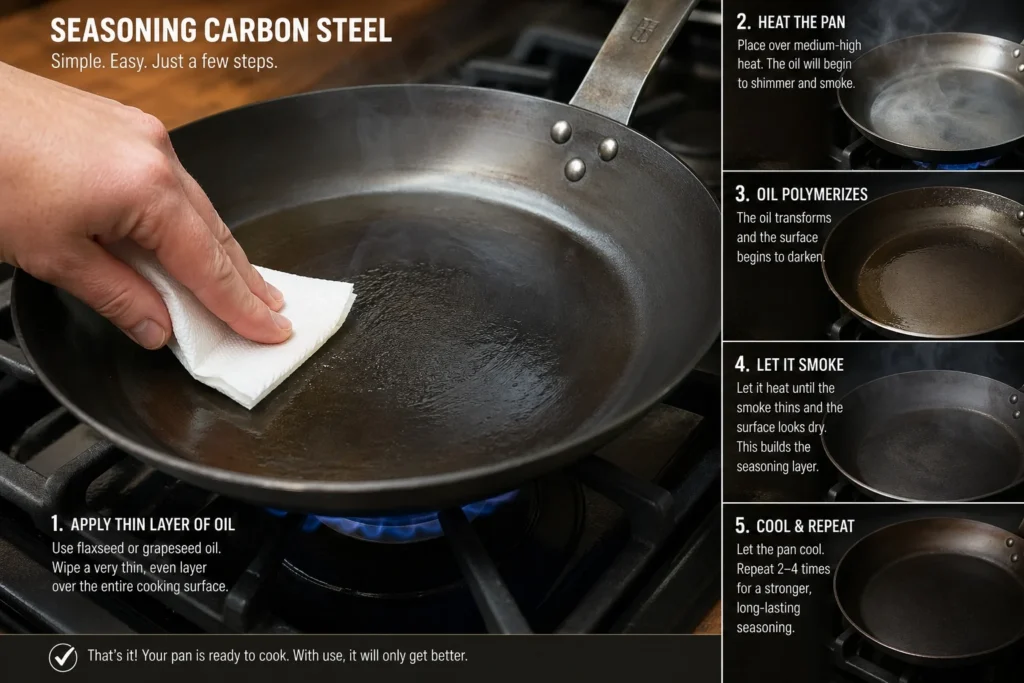
First-time seasoning (stovetop method):
- If the pan arrives with a factory coating (beeswax on De Buyer, anti-rust oil on others), remove it by scrubbing with hot water and a small amount of dish soap — this is the only time soap is appropriate.
- Dry the pan completely over medium heat on the stovetop for 2–3 minutes.
- Apply a very thin, even layer of high-smoke-point oil (flaxseed oil, grapeseed oil, or refined coconut oil) using a paper towel.
- Heat the pan over medium-high heat until the oil begins to smoke and the surface darkens visibly. This is polymerization occurring.
- Remove from heat, allow to cool, and repeat the process 2–3 times for the initial seasoning session.
Ongoing maintenance after each use:
- While the pan is still warm (not hot), wipe out any excess food with a paper towel.
- Rinse with hot water and scrub lightly with a brush or steel wool if needed — no soap.
- Dry immediately and completely over low heat for 1–2 minutes.
- Apply a final light coat of oil with a paper towel before storing.
Is Soap Safe to Use When Cleaning Carbon Steel Pans?
No — soap should not be used on carbon steel pans after the initial factory coating removal, because dish detergent strips the polymerized oil patina that forms the pan’s natural non-stick surface. However, this rule comes with important nuance.
Specifically, modern dish soaps are significantly milder than older formulations that contained lye-based saponifiers. A very brief rinse with a mild dish soap after a particularly greasy cooking session will not immediately destroy a well-established patina. The risk is cumulative: repeated soap use over time gradually degrades the seasoning, leading to sticky surfaces, uneven food release, and eventual rust vulnerability.
The correct approach to cleaning a carbon steel pan is:
- Step 1: While pan is still warm, wipe out excess food and oil with a paper towel.
- Step 2: Rinse under hot running water while scrubbing with a non-soaped steel wool ball or stiff brush.
- Step 3: Return the pan to the stovetop over low heat for 60–90 seconds to evaporate all moisture completely.
- Step 4: Apply a single thin wipe of oil using a paper towel before storing.
As confirmed by America’s Test Kitchen’s 2025 maintenance guide for carbon steel: “Hot water and a good ball of steel wool are more than enough to clean any stuck-on food — and the entire process takes about 30 seconds once you’re used to it.”
How Long Does It Take to Build a Non-Stick Patina on Carbon Steel?
A functional, food-release-quality non-stick patina typically develops after 3–10 cooking sessions with fatty foods — with a fully mature, dark black patina requiring several weeks of regular use. The speed of patina development depends directly on the types of food cooked, the oils used, and the heat levels applied.
The chemistry behind patina formation is a process called polymerization: when oil is heated to or beyond its smoke point in contact with iron, the fatty acid molecules break down and bond covalently to the metal surface, forming a hard, slick polymer layer. Each cooking session adds a new molecular layer to this structure.

The best oils for building patina quickly and durably, ranked by polymerization efficiency:
- Flaxseed oil — highest in omega-3 fatty acids, polymerizes fastest and forms the hardest initial layer; preferred for initial seasoning sessions
- Grapeseed oil — high smoke point (420°F), light texture, excellent for ongoing maintenance seasoning
- Refined coconut oil — solid at room temperature, applies evenly; good all-purpose option
- Vegetable shortening (Crisco) — traditional professional kitchen choice; builds patina steadily over time
- Avoid: Olive oil and butter — both have too low a smoke point and can produce a sticky, gummy coating rather than a true polymerized patina
The fastest way to build patina is to cook fatty, high-heat foods in the early sessions: bacon, sautéed sausage, pan-fried potatoes, or thick cuts of protein seared in avocado oil. Avoid acidic foods and eggs during the first 5–8 uses, as acidic foods strip nascent seasoning and eggs require a more mature patina to release cleanly.
What Makes Certain Carbon Steel Cookware Worth the Premium Price?
Premium carbon steel cookware — typically priced between $120 and $350 for a single pan — justifies its cost through three distinct factors: specialized manufacturing methods (hand-forging, bluing, multi-clad construction), material purity and provenance (French-milled steel, 99% iron alloys), and professional-grade construction details (flat interior rivets, ergonomic handle geometry, oven-safe ratings to 600°F+). For serious home cooks and professional chefs who cook daily, the investment pays for itself in performance and longevity within the first year of use.
The difference between a $45 Lodge carbon steel skillet and a $180 De Buyer Mineral B PRO is not merely brand prestige — it reflects tangible differences in steel thickness, surface finish quality, handle attachment method, and the precision of the pan’s geometry. The following sections examine three specific premium attributes that define the top tier of carbon steel cookware.
What Is Blued Carbon Steel and Does It Perform Differently?
Blued carbon steel is a specialized variant of standard carbon steel cookware that has been subjected to a controlled heat treatment process — called bluing — which oxidizes the iron surface to create a thin layer of magnetite (Fe₃O₄), giving the pan a distinctive blue-grey color and providing enhanced rust resistance from day one.
Standard (raw) carbon steel arrives from the factory in a state that is highly susceptible to surface oxidation — hence why manufacturers like De Buyer coat their pans in beeswax for shipping and why immediate seasoning after purchase is critical. Blued carbon steel, by contrast, already has a protective oxide layer bonded to the surface before it reaches the customer.
In practical performance terms, blued carbon steel:
- Resists rust more effectively during the initial seasoning period before patina is established
- Accepts seasoning more evenly because the oxidized surface provides a better bonding substrate for polymerized oils
- Transitions visually from its characteristic blue-grey color to a deep black as cooking sessions accumulate and the polymerized patina builds over the oxide layer
- Performs identically to standard carbon steel once a mature patina has developed — the bluing advantage is most significant in the first weeks of ownership
America’s Test Kitchen specifically noted in their 2025 review that pans with “blued” carbon steel offered a meaningful advantage for first-time carbon steel users, as the surface protection reduced the anxiety and learning curve associated with rust management during the break-in period.
Are Hand-Forged Carbon Steel Skillets Worth the Investment?
Yes — hand-forged carbon steel skillets are worth the investment for serious cooks who prioritize craftsmanship, heirloom-quality durability, and peak cooking performance, though they represent a micro-niche of the market that commands premium prices between $150 and $400 per pan.

The distinction between hand-forged, stamped, and spun carbon steel construction is fundamental to understanding what separates artisan cookware from mass production:
- Stamped carbon steel (most common): A flat sheet of carbon steel is pressed into shape using a die-stamp machine. This process is fast and economical but can result in uneven steel thickness across the cooking surface, leading to slight hot spots.
- Spun carbon steel: A disc of steel is rotated at high speed on a lathe while a tool presses it into shape. This creates very consistent wall thickness and is the method used by Northwest Skillet Company.
- Hand-forged carbon steel: A blacksmith manually hammers and shapes the steel, typically using traditional techniques. This process creates unique surface texture, exceptional structural integrity, and pans that are genuinely one-of-a-kind.
The Northwest Skillet Company 12-Inch Carbon Steel Fry Pan — produced by a single craftsman at Homestead Springs Farm & Forge in Northeast Oregon — was designated America’s Test Kitchen’s upgrade pick in their 2025 review, described as “beautiful and performing beautifully.” At approximately $200–$250 per pan, it represents the ceiling of the hand-forged carbon steel category and is explicitly positioned as an heirloom piece intended to be passed down across generations.
Can Carbon Steel Cookware Be Used in Professional Restaurant Kitchens?
Yes — carbon steel cookware is not only suitable for professional restaurant kitchens, it is the dominant cookware material in professional kitchen environments worldwide, particularly in French, Japanese, and Chinese culinary traditions where high-heat technique and pan longevity are non-negotiable requirements.
The characteristics that make carbon steel the professional standard are precisely the ones that make it challenging for beginners: it requires seasoning, reacts poorly to acidic foods when unseasoned, and must be dried and oiled after every wash. In a professional kitchen where pans are used daily for multiple services, these requirements are simply built into the workflow — and the rewards (unmatched searing performance, zero coating degradation, decades of useful life) far outweigh the maintenance commitment.
Specific professional-grade carbon steel cookware designed for restaurant abuse includes:
- De Buyer Mineral B PRO: Features a stainless steel handle rated to 600°F oven use — ideal for dishes that begin on the stovetop and finish in the oven during service
- Matfer Bourgeat Black Steel Pan: The material of choice in many French restaurant kitchens; designed to withstand repeated thermal shock and heavy-handed daily use
- Carbon steel woks over commercial gas burners: The BTU output of commercial gas burners (ranging from 15,000 to 150,000 BTU) is perfectly matched to carbon steel’s rapid heat response — achieving the “wok hei” (breath of the wok) flavor that is impossible to replicate with cast iron or stainless steel
Beyond stovetop cooking, carbon steel is compatible with campfire cooking, pizza ovens (temperatures exceeding 700°F), broilers, and any induction, gas, electric, or glass-ceramic cooktop — making it the single most versatile cookware material available for both professional and advanced home cooking contexts.
What Is Carbon Steel Clad Cookware and How Is It Different?
Carbon steel clad cookware is a multi-layer construction that bonds a carbon steel cooking surface to an aluminum or stainless steel core — combining the natural non-stick patina benefits of carbon steel with the superior even-heat distribution properties of aluminum, resulting in a pan that heats more uniformly and responds faster than solid carbon steel alone.
The leading example of this category is the Strata Carbon Clad Pan, which the manufacturer describes as featuring a top carbon steel cooking surface bonded to a light-responsive aluminum core — a construction approach borrowed from premium stainless steel clad cookware (such as All-Clad) and applied to carbon steel for the first time.
The key advantages of carbon steel clad construction over traditional single-layer carbon steel:
| Feature | Traditional Carbon Steel | Carbon Steel Clad |
|---|---|---|
| Heat distribution | Good but can develop hot spots | Excellent, highly uniform |
| Weight | Medium (lighter than cast iron) | Lighter (aluminum core reduces mass) |
| Heat-up speed | Fast | Very fast |
| Non-stick development | Full patina builds naturally | Full patina builds naturally |
| Price | $40–$250 | $100–$300+ |
| Ideal for | All-around high-heat cooking | Cooks who want precision heat + patina benefits |
This table compares traditional single-layer carbon steel against the newer carbon steel clad construction across six criteria, clarifying which technology suits which cooking style.
Carbon steel clad cookware is particularly well-suited for home cooks who want the long-term non-stick patina benefits of carbon steel combined with the forgiving, even-heat behavior they may be accustomed to from stainless clad or hard-anodized aluminum cookware. It eliminates the one legitimate criticism of traditional thin carbon steel pans — the potential for hot spots on low-BTU electric or induction cooktops — while preserving everything that makes carbon steel special.